
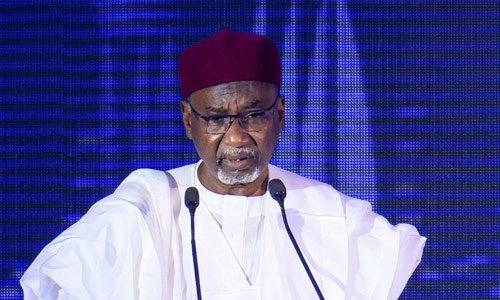
A former Director-General of the National Intelligence Agency (NIA), Ambassador Ahmed Rufai, has revealed how a rescued Chibok schoolgirl expressed a desire to return to her husband within the Boko Haram terrorist group despite being reunited with her parents after years in captivity.
Rufai disclosed that the woman, who was among the schoolgirls abducted by Boko Haram insurgents in April 2014, had been married to three members of the terrorist organisation during her captivity, with her first two husbands killed in combat.
The former intelligence chief made the disclosure while speaking at an international security forum in Qatar, where he examined the challenges associated with terrorist abductions, hostage negotiations and the rehabilitation and reintegration of victims rescued from extremist groups.
According to him, the experience demonstrated the complicated circumstances confronting security agencies when victims who have spent years in captivity develop emotional and social attachments within the environments in which they were held.
Recounting the incident, Rufai explained that the rescued woman had developed a relationship with a Boko Haram zonal commander who assumed the role of a father figure during her captivity.
He said the commander had taken responsibility for her welfare and arranged subsequent marriages for her whenever she lost a husband in combat.
“She had a godfather who was a zonal commander of the terrorist group, who adopted her as a daughter. Each time she lost her husband in the fight, he would be the one to get her a new husband,” Rufai said.
The former NIA Director-General explained that the woman was eventually rescued by security operatives and taken to Abuja, where she underwent medical examinations and intelligence debriefing.
However, he said her reaction after being reunited with her family surprised those involved in her rescue and rehabilitation.
According to Rufai, although she expressed affection for her parents and wanted to see them, she did not wish to remain with them and instead wanted to return to the environment where she had been held.
“She loved them. She wanted to see them, and so on. And then the third interesting thing is that we subjected her to medical checks and found her to be very healthy. But the interesting thing is that she wanted to go back,” he stated.
Rufai explained that the experience illustrated the difficulties involved in reintegrating individuals who had spent prolonged periods in terrorist captivity, particularly where their personal relationships and daily lives had become intertwined with those of their abductors.
The disclosure comes more than 12 years after Boko Haram insurgents abducted 276 schoolgirls from Government Girls Secondary School, Chibok, Borno State, on April 14, 2014.
The mass abduction attracted widespread national and international condemnation and triggered the global #BringBackOurGirls campaign, which demanded the rescue and safe return of the schoolgirls.
Although some of the victims escaped and others were subsequently released or rescued through security operations and negotiations, many spent years in captivity.
Accounts from survivors and human rights organisations documented how some abducted girls were subjected to forced marriages, sexual violence, coercion and other forms of abuse while being held by the insurgents.
Some also gave birth to children during captivity, creating additional challenges for their rehabilitation and eventual reintegration into their families and communities.
Rufai’s account highlights how prolonged captivity can complicate the process of returning victims to normal life, particularly where they have been subjected to coercive relationships and long-term separation from their families.
However, the circumstances described by the former intelligence chief do not establish that the woman’s marriages were voluntary or that her expressed desire to return represented an informed choice free from the effects of captivity.
The former NIA chief also used the forum to explain the different motivations behind terrorist abductions and the implications for intelligence gathering, hostage negotiations and security operations.
He maintained that not every kidnapping was carried out primarily for financial gain, explaining that some terrorist organisations abducted victims to advance political or ideological objectives.
“In most cases, it was political, to make their case known,” Rufai said.
According to him, politically or ideologically motivated abductions often require security agencies to examine the wider objectives of the perpetrators before determining how to respond.
He distinguished such incidents from kidnappings carried out principally to obtain ransom, where financial demands may form the basis of negotiations.
Rufai explained that when abductors were motivated by money, they generally communicated their demands, making it necessary in some circumstances to explore discreet negotiations through trusted intermediaries.
“In a situation where they really needed money, they would let it be known, and there, in that kind of situation, you have to use what we discussed yesterday: hostage diplomacy, and it has to be through back channels,” he stated.
The former intelligence chief said such negotiations required careful handling and discretion, particularly where the safety of hostages depended on communication between security agencies and individuals who had established relationships with the abductors.
He explained that trusted intermediaries could play an important role in facilitating discussions, while unnecessary publicity surrounding sensitive negotiations could undermine efforts to secure the release of victims.
Rufai also drew a distinction between ideologically motivated terrorist groups and criminal networks involved in kidnapping for ransom.
According to him, some criminal gangs were primarily interested in financial rewards and material benefits rather than the religious or political objectives associated with extremist organisations.
“They are not ideologically driven. They have no ideology. They want to enjoy life. They are not looking forward to dying and going to paradise. Their paradise is here,” he said.
He described kidnapping for ransom as a major security challenge confronting Nigeria, noting that criminal networks involved in abductions often participated in other unlawful activities.
The former NIA Director-General identified arms trafficking, vehicle theft and attacks on security personnel among the criminal activities associated with some of the networks.
He added that the Nigerian government was making efforts to address the security challenge.
His disclosure concerning the rescued Chibok schoolgirl brings renewed attention to the difficulties involved in rehabilitating survivors of prolonged terrorist captivity.
Beyond securing the physical release of abducted persons, the account underscores the need to address the psychological, social and family-related consequences of years spent under the control of armed groups.
The experience also highlights the importance of treating survivors as victims whose rehabilitation may require sustained professional support, rather than assuming that physical rescue automatically resolves the effects of captivity.
Rufai maintained that understanding the motivations of abductors and the circumstances experienced by victims was essential to developing effective security responses and reintegration strategies.
Post Title: “She Wanted To Go Back” — Ex-NIA DG Reveals How Rescued Chibok Girl Sought Return To Boko Haram Husband Despite Family Reunion By Naijaonpoint.