
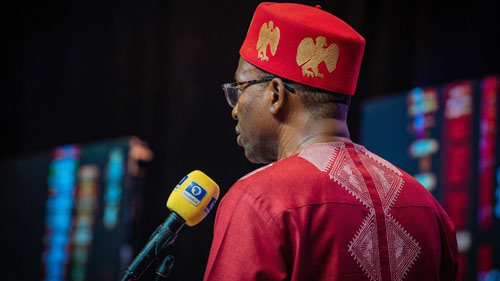
The decision by Anambra State Governor, Professor Chukwuma Soludo, and his Osun State counterpart, Ademola Adeleke, to coordinate President Bola Tinubu’s 2027 re-election campaigns in their respective states has generated concerns among National Assembly and State House of Assembly candidates, with some fearing that the political arrangement could undermine their electoral chances.
The development has particularly unsettled candidates of the All Progressives Grand Alliance (APGA) in Anambra State, where some aspirants fear that voters opposed to Soludo’s alliance with the ruling All Progressives Congress (APC) could cast protest votes for candidates of the Nigeria Democratic Congress (NDC).
In Osun State, some APC legislative candidates have also expressed dissatisfaction with the appointment of Adeleke, a member of the Accord Party, as Tinubu’s campaign coordinator, arguing that the arrangement could strengthen Accord candidates at their expense.
Meanwhile, some Accord candidates are concerned that voters who support Tinubu in the presidential election may mistakenly vote for APC candidates in the National Assembly elections instead of distinguishing between the parties on the ballot papers.
The concerns followed the October 14 inauguration of Adeleke and Soludo as state coordinators of the APC Presidential Campaign Council, despite their continued membership of Accord and APGA, respectively.
According to the timetable released by the Independent National Electoral Commission (INEC), the presidential and National Assembly elections are scheduled for January 16, 2027.
Voters will receive separate ballot papers for the presidential, senatorial and House of Representatives elections, a development that has heightened concerns among candidates whose parties are supporting a presidential candidate from another political platform.
In Anambra State, some APGA candidates who spoke on condition of anonymity expressed fears that Soludo’s involvement in Tinubu’s campaign could weaken their electoral prospects.
A female House of Representatives candidate in Awka said the governor’s decision had created uncertainty within the party, leaving some candidates unsure how to explain the political arrangement to their supporters.
She disclosed that campaign activities had slowed considerably because party members were confused about the implications of supporting an APC presidential candidate while seeking legislative victories for APGA.
According to her, Soludo had convened a joint stakeholders’ meeting involving APGA and APC members to discuss strategies for the forthcoming elections, but the development had failed to resolve the concerns of affected candidates.
She accused the governor of failing to adequately consult party candidates before accepting the campaign appointment.
The candidate warned that growing dissatisfaction among APGA supporters could translate into protest votes for the NDC, particularly among voters who support former Anambra State Governor Peter Obi.
She said some party members believed that Soludo’s political alignment with Tinubu could create an advantage for NDC candidates contesting legislative seats.
According to her, even candidates who had no direct disagreement with Obi could suffer electoral setbacks because of voters’ opposition to the governor’s decision.
Another APGA candidate contesting a seat in the Anambra State House of Assembly expressed similar concerns, alleging that the appointment had deepened disagreements within the party.
The candidate maintained that some APGA stakeholders considered the arrangement a threat to the party’s political identity and electoral independence.
He questioned how the party could successfully persuade voters, particularly traders and residents of rural communities, to support Tinubu on the APC platform while simultaneously voting for APGA candidates in legislative elections.
The candidate argued that the arrangement could encourage voters opposed to Soludo’s position to transfer their support to the NDC.
He further alleged that some APGA leaders and supporters had privately protested the governor’s involvement in the APC presidential campaign but were reluctant to challenge the decision publicly.
However, the Anambra State Publicity Secretary of APGA, Ejimofor Opara, dismissed suggestions that the arrangement would undermine the party’s legislative ambitions.
Opara maintained that APGA’s support for Tinubu did not amount to abandoning its candidates for the Senate, House of Representatives or State House of Assembly.
He explained that party officials, candidates and supporters had been informed of the arrangement and that APGA remained committed to winning legislative seats in the state.
The party’s position indicates that its leadership intends to maintain support for Tinubu at the presidential level while retaining its independent political identity in other electoral contests.
A similar disagreement has emerged in Osun State, where some APC candidates have criticised the decision to appoint Governor Adeleke as Tinubu’s campaign coordinator.
One APC House of Representatives candidate, who spoke anonymously, described the arrangement as politically disadvantageous to members of the ruling party contesting legislative elections.
He argued that handing responsibility for Tinubu’s campaign to an Accord governor could strengthen the opposition party’s candidates and weaken the position of APC contestants.
According to him, Adeleke’s appointment had boosted the confidence of Accord candidates while leaving some APC candidates uncertain about the political and financial support they would receive.
He also expressed concern about the relationship between Adeleke and prominent APC figures, including the party’s National Secretary, Ajibola Basiru, and his predecessor, Iyiola Omisore.
The candidate questioned whether APC legislative contestants would receive sufficient attention and support while the governor continued campaigning for Accord candidates in the state.
Another APC House of Representatives candidate described the arrangement as abnormal and discouraging.
He argued that Adeleke could support Tinubu’s re-election without necessarily assuming responsibility for coordinating the APC presidential campaign in Osun.
The candidate maintained that the appointment had failed to adequately consider the interests of APC members contesting legislative seats.
However, the Chairman of the House of Representatives Committee on Foreign Affairs, Wole Oke, dismissed fears that Adeleke’s appointment would automatically benefit Accord candidates.
Oke defended the arrangement, explaining that it was a decision taken by the APC leadership and should be respected by party members.
He expressed confidence in the ability of APC candidates to win legislative elections despite the unusual political alliance.
Drawing from his electoral experience, Oke said he had contested six elections, winning four as an opposition candidate and one as a candidate of a ruling party, while losing one election as an opposition candidate.
He maintained that contesting elections against candidates backed by a sitting governor was not unfamiliar territory and expressed confidence in his political prospects.
Similarly, the APC candidate for Ede-North/Ede-South/Egbedore/Ejigbo Federal Constituency, Ayodele Asalu, said he believed the arrangement would eventually favour APC candidates.
Asalu rejected suggestions that the party had been weakened by Adeleke’s appointment and expressed optimism about his chances in the forthcoming election.
On the Accord side, the Chairman of the party’s National and State Assembly candidates in Osun State, Adewale Egbedun, who is also the Speaker of the Osun State House of Assembly, insisted that the arrangement would not undermine the party’s electoral ambitions.
Egbedun said Accord was targeting victory in all 38 National Assembly and State House of Assembly seats in Osun.
He explained that the party hoped to secure the state’s three senatorial seats, nine House of Representatives seats and 26 House of Assembly seats.
According to him, Accord candidates would support Adeleke in mobilising votes for Tinubu while independently campaigning for victory in their respective constituencies.
The Speaker maintained that supporting the President’s re-election did not diminish Accord’s determination to win legislative elections.
He acknowledged that convincing some voters to support different political parties in separate elections could present challenges but argued that such concerns could be addressed through sustained engagement and voter education.
However, an Accord House of Representatives candidate in Osun West Senatorial District expressed fears that the arrangement could confuse some voters, particularly elderly persons and those with limited literacy.
The candidate explained that while some voters might support Adeleke and Accord, they could mistakenly vote for APC candidates in all three elections after being encouraged to support Tinubu in the presidential contest.
He noted that ballot papers would contain political party names and symbols rather than the names of presidential candidates alone, making it important for voters to distinguish between the separate contests.
Another Accord candidate acknowledged similar concerns, stressing that the alliance would require careful explanation to ensure that supporters understood the difference between voting for Tinubu and supporting Accord candidates in the legislative elections.
The competing positions highlight the challenges arising from cross-party political alliances ahead of the 2027 general elections, particularly where governors belonging to different political parties are coordinating the presidential campaign of the ruling APC.
While the governors’ appointments are intended to strengthen Tinubu’s campaign structures in Anambra and Osun, some candidates fear that the arrangements could affect party loyalty, voter behaviour and the electoral prospects of contestants seeking legislative offices.
For APGA candidates in Anambra, the immediate concern is the possibility of protest votes benefiting the NDC, while some APC candidates in Osun fear that Adeleke’s leadership of Tinubu’s campaign could strengthen Accord’s political influence.
Accord candidates, on the other hand, are concerned about possible confusion among voters who may support Tinubu at the presidential level but prefer Accord representatives in the National Assembly.
Despite these concerns, party leaders and other candidates have maintained that the alliances can be managed without sacrificing their parties’ electoral ambitions.
With the presidential and National Assembly elections scheduled for January 16, 2027, the controversy has brought renewed attention to how political parties intend to educate voters and reconcile cross-party presidential endorsements with their separate legislative campaigns.
Post Title: “We Are Crying Seriously” — APGA Candidates Fear Electoral Defeat Over Soludo-Tinubu Pact As NDC Gains Attention In Anambra By Naijaonpoint.