
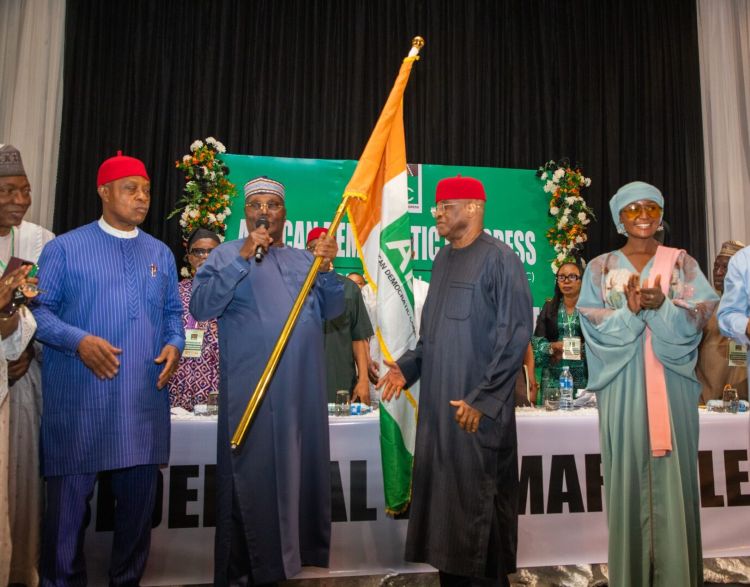
The African Democratic Congress (ADC) has criticised the Federal Government’s planned N50,000 monthly cash transfers to vulnerable Nigerians, describing the initiative as an election gimmick ahead of the 2027 general elections.
In a statement issued on Saturday, the party’s National Publicity Secretary, Bolaji Abdullahi, accused the government of attempting to hoodwink Nigerians with what he described as poorly timed interventions.
The criticism followed Friday’s announcement by the Minister of Humanitarian Affairs and Poverty Reduction, Bernard Doro, that the Federal Government would begin monthly payments of N50,000 to selected vulnerable households under the National Emergency Relief and Stabilisation Intervention (NERSI).
Doro had explained that the programme was designed to cushion the effects of rising living costs on low-income Nigerians.
However, Abdullahi questioned the timing of the announcement, arguing that the latest intervention, alongside other recently announced government measures, indicated that President Bola Tinubu was in “full panic mode” ahead of the 2027 elections.
“Since the ADC and our Presidential Candidate, Atiku Abubakar, have made affordability and reducing the cost of living the cardinal focus of our campaign, the government has been announcing one desperate intervention or another,” he said.
The ADC spokesperson recalled previous government announcements, including a proposed $1 billion Renewed Hope Social Intervention Fund, a 30-day fuel discount and cheaper transportation services scheduled to commence on October 1, which he claimed had failed to produce the promised results.
“In August, they announced a $1 billion so-called ‘Renewed Hope Social Intervention Fund’. But it was only an announcement, nothing more.
“Then, they announced a 30-day fuel discount, which made no sense. Then they announced the so-called cheaper transportation by October 1 across the states. Again, nothing happened.
“They have also announced a N70,000 transportation allowance to workers. Now, it is N50,000 for everyone. They are just thrashing around, hoping that something would stick.”
Abdullahi also questioned the purchasing power of the proposed N50,000 payment, arguing that the amount would do little to ease the financial difficulties confronting average Nigerian households.
“How much food can a family purchase with that amount?” he queried.
“How much transport can it cover? And for how long? Petrol prices have risen roughly sevenfold. Food and transportation costs have followed, not to talk about the cost of basic drugs.
“It is just a desperate and cynical attempt to buy back the goodwill of the people. But it is too little, too late.”
He further questioned why the government had not incorporated the financial assistance into its economic reform plans from the beginning if it had the resources to provide such support.
“If they could give N50,000 to vulnerable Nigerians, why didn’t they factor it into reform plans from day one rather than make it an election-season handout?” he asked.
The opposition party also raised concerns over the management of previous cash transfer programmes, citing a recent Auditor-General’s report which reportedly found insufficient evidence that N33.75 billion allocated to support 3.29 million vulnerable households in 2023 reached genuine beneficiaries.
Abdullahi questioned why the government was introducing another cash transfer initiative without first establishing accountability for the previous programme.
He warned that the latest intervention could create another opportunity for the alleged diversion of public funds for partisan purposes.
“At best, this is an election gimmick designed to deceive Nigerians into believing that a government which has neglected them for more than three years suddenly cares about their welfare,” he said.
“At worst, it could become another scheme to siphon public funds under the convenient cover of poverty alleviation.”
The ADC spokesperson maintained that addressing Nigeria’s cost-of-living crisis required sustainable measures to restore citizens’ purchasing power and reduce the prices of essential commodities, particularly food, energy and transportation.