
NaijaonpointOnline | Investigative Report
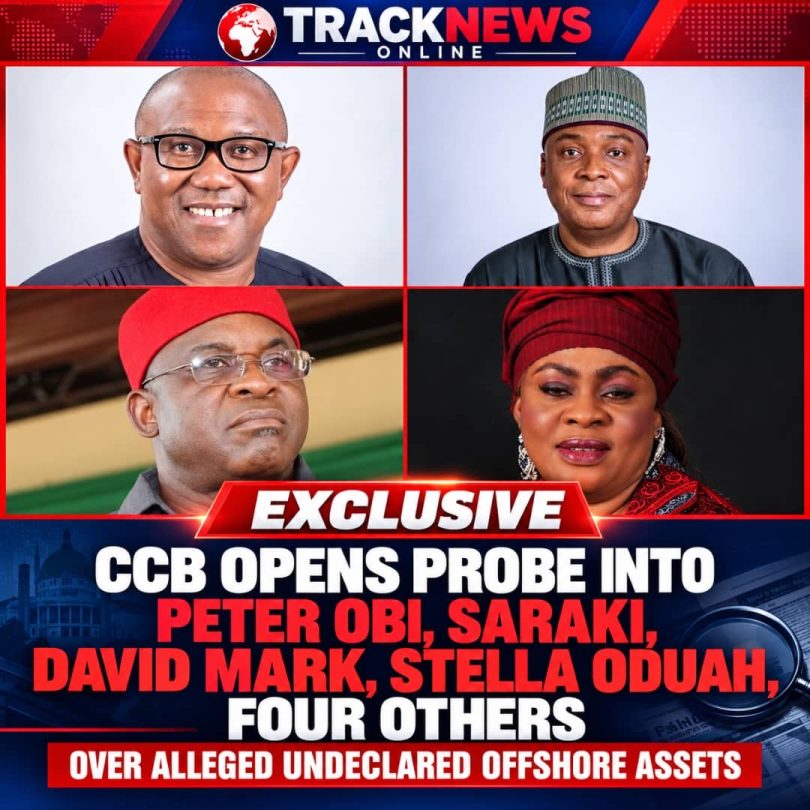
The Code of Conduct Bureau (CCB) has commenced investigations into seven prominent Nigerians named in the Panama Papers and Pandora Papers over allegations involving undeclared offshore assets, foreign business interests and potential breaches of Nigeria’s code of conduct for public officers.
Those reportedly under investigation include former Anambra State Governor and Nigeria Democratic Congress (NDC) presidential candidate Peter Obi; former Senate Presidents Bukola Saraki and David Mark; and former Minister of Aviation Stella Oduah.
Others are the late former Bayelsa State Governor Diepreye Alamieyeseigha, former Delta State Governor James Ibori, and retired President of the Delta State Customary Court of Appeal, Stella Ogene.
Sources within the bureau confirmed the development to Premium Times, which participated in the International Consortium of Investigative Journalists’ global investigations that exposed offshore financial arrangements involving politicians, businesspeople and public officials across several countries.
According to one CCB source, investigators have been assigned to the seven cases, while other Nigerians named in the leaked documents may also face scrutiny.
The source reportedly said all Nigerian officials identified in the Panama and Pandora Papers would be investigated, adding that seven cases had already been assigned to designated officers who had commenced work.
An aide to the bureau’s chairman also confirmed that investigations were ongoing.
The development marks a renewed phase in efforts to establish whether public officials named in the international investigations complied with Nigeria’s asset declaration and other public service requirements.
However, being named in the leaked documents or investigated by the CCB does not, by itself, establish that any individual committed an offence.
CCB REVISITS THE PANDORA PAPERS
The bureau’s engagement with Premium Times over the allegations dates back to October 2021, shortly after the Pandora Papers investigation was published.
At the time, the CCB wrote to the newspaper, describing the international investigation as an exercise that had generated significant reactions worldwide and requesting cooperation in investigating and potentially prosecuting individuals implicated in the revelations.
The newspaper’s Editor-in-Chief, Musikilu Mojeed, responded on October 18, 2021, expressing the publication’s willingness to assist.
Mojeed explained that the newspaper’s objective was to provide citizens with information needed to make informed decisions while giving law enforcement agencies relevant leads for further action.
Years later, questions remained about the progress of the investigations.
On July 29, 2026, Premium Times again wrote to the bureau, requesting an update on its inquiries into public officials named in the Pandora Papers.
The newspaper expressed concern that several years had passed without sufficient public information about whether investigations had been initiated or concluded in a number of cases.
In September 2026, the CCB reportedly responded that it was reviewing the materials in line with its statutory mandate.
The bureau also indicated that it might invite a representative of the newspaper to provide clarification but declined to disclose further details, citing concerns about prejudicing the investigative process.
PETER OBI AND THE OFFSHORE COMPANY ALLEGATION
The Pandora Papers investigation raised questions about Peter Obi’s connection to NEXT International (UK) Limited, a British company in which he reportedly remained a director for 14 months after becoming governor of Anambra State.
The report alleged that the arrangement raised concerns under Section 6 of the Code of Conduct Bureau and Tribunal Act.
It also questioned whether certain offshore holdings and a foreign bank account had been properly declared while Obi was in public office.
Obi reportedly said he was unaware that jointly owned assets were required to be declared in the circumstances described. He has also maintained that he did not divert public funds.
Importantly, the Pandora Papers allegations concerning his corporate interests and asset declarations did not themselves establish that he diverted public money.
The CCB’s reported investigation is expected to examine the relevant records and determine whether any applicable legal requirements were breached.
Any conclusions about liability would depend on the evidence and the outcome of the appropriate legal process.
STELLA ODUAH AND £6.7 MILLION IN LONDON PROPERTIES
Former Aviation Minister Stella Oduah was also linked to offshore arrangements examined in the Pandora Papers.
The investigation reported that four London properties valued at approximately £6.7 million were acquired between October 2012 and August 2013 through International Trading and Logistics Company Limited, a company registered in Seychelles in which Oduah was identified as the ultimate beneficial owner.
The properties were reportedly purchased without mortgages.
The investigation also linked Oduah to three additional London properties.
A leaked suspicious activity report from Deutsche Bank reportedly showed that a Nigerian company linked to her transferred $71,973 to a London property agency approximately one month before one of the purchases.
Oduah served as Minister of Aviation from 2011 to 2014 before representing Anambra North Senatorial District in the Senate.
The central question for investigators is whether the relevant interests and assets were properly declared in accordance with the requirements applicable to her during her time in public office.
The existence of offshore companies or overseas property does not automatically establish wrongdoing.
RETIRED JUDGE’S OFFSHORE COMPANY
The Pandora Papers also identified offshore corporate interests linked to Stella Ogene, a retired President of the Delta State Customary Court of Appeal.
According to the investigation, Ogene established Assete Media Limited in Seychelles in 2009 to acquire a London property.
The documents also reportedly showed that she remained listed as a director of a Nigerian private company for approximately 10 years while serving as head of the Customary Court of Appeal.
The reported corporate arrangements raise questions about whether her business interests were compatible with the rules governing public officers and whether any applicable declaration requirements were satisfied.
Those questions would need to be assessed against the specific legal provisions governing her office and the documentary evidence available to investigators.
NICHOLAS MUTU ALSO LINKED TO A SEYCHELLES COMPANY
The Pandora Papers investigation further linked Nicholas Mutu, a member of the House of Representatives, to Forest Group of Company, a Seychelles-registered entity.
The company reportedly acquired a property in north London for £620,000 in 2012 and sold it for £730,000 in 2014.
Mutu denied being a director of the company, stating that it belonged to his wife.
However, the investigation reported that UK Land Registry records and leaked corporate documents identified him as a director, shareholder and beneficial owner.
The reported discrepancy between Mutu’s response and the documents cited by the investigation is another matter that could warrant documentary scrutiny.
The available report does not establish whether the CCB has formally assigned his case to an investigating officer as part of the seven cases already being examined.
SARAKI AND THE PANAMA PAPERS
Former Senate President Bukola Saraki was among the prominent Nigerians linked to offshore entities in the Panama Papers, published in 2016 following a leak of documents from Panamanian law firm Mossack Fonseca.
The investigation examined offshore structures associated with individuals and companies across several countries, including Nigeria.
According to Premium Times, documents indicated that the Saraki family held interests in at least four assets through offshore arrangements that were allegedly not declared to the CCB.
One of the entities identified was Sandon Development Limited, a Seychelles-registered company linked to Saraki’s wife, Toyin.
The company was reportedly used to acquire a property in Belgravia, London, in 2012.
The documents also reportedly showed that Saraki subsequently took control of Landfield International Developments Limited, a British Virgin Islands company, through a Jersey-registered entity.
A board meeting in January 2015 allegedly approved the sale of the company to him for more than £3 million.
The CCB’s reported investigation could examine the ownership structures, transaction records and relevant asset declarations to determine whether any breaches occurred.
DAVID MARK’S BRITISH VIRGIN ISLANDS CONNECTIONS
Former Senate President David Mark was also named in the Panama Papers investigation.
The leaked documents reportedly linked him to at least eight British Virgin Islands companies during his time in public office.
According to the investigation, Mossack Fonseca repeatedly flagged Mark as a politically exposed person, a designation financial institutions use to identify individuals whose public positions may expose them to heightened corruption risks.
The report stated that the nature of the businesses conducted through the companies could not be established.
Being classified as a politically exposed person is not evidence of criminal wrongdoing. Similarly, ownership or association with offshore companies is not automatically unlawful.
The questions for investigators concern the nature of the interests, the applicable public service rules and whether the relevant assets and interests were properly declared.
ALAMIEYESEIGHA’S OFFSHORE CORPORATE NETWORK
The Panama Papers also revealed offshore corporate connections involving the late Diepreye Alamieyeseigha, who governed Bayelsa State from 1999 until his impeachment in 2005.
According to the investigation, Alamieyeseigha became the first director and secretary of Solomon & Peters Limited, a British Virgin Islands company incorporated months after he assumed office.
The company was reportedly linked to property acquisitions and financial transactions in several jurisdictions, including the United Kingdom, the United States and South Africa.
British authorities returned more than £5 million in recovered assets to the Bayelsa State Government in 2012.
The investigation also reported that Alamieyeseigha’s asset declarations for 1999 and 2003 did not reflect the scale of the overseas assets subsequently uncovered.
The reported CCB inquiry raises questions about the scope of the bureau’s review of historical declarations and offshore interests linked to former public officials.
Because Alamieyeseigha is deceased, any legal or administrative action involving his affairs would necessarily depend on the applicable law and the circumstances of the case.
WHAT NIGERIAN LAW SAYS ABOUT ASSET DECLARATION
Nigeria’s constitutional and statutory framework imposes asset declaration obligations on public officers and establishes restrictions on certain private business activities and foreign bank accounts.
The Code of Conduct provisions require public officers to declare their assets and liabilities, including relevant interests involving their spouses and unmarried children under 18, in accordance with the applicable rules.
The framework also restricts the operation of foreign bank accounts by public officers and limits their involvement in private business activities, subject to specified exceptions.
However, the legality of a particular offshore arrangement depends on its circumstances, the individual’s official position, the timing of the transaction and the specific provisions applicable.
Offshore companies are not inherently illegal. They may be established for legitimate commercial, investment or estate-planning purposes.
The legal issue arises where evidence establishes that an arrangement breached applicable disclosure requirements, restrictions on business activities or other laws.
Where investigations establish sufficient evidence of a violation, a case may be referred for proceedings before the Code of Conduct Tribunal, subject to the applicable legal process.
OTHER PROMINENT NIGERIANS NAMED IN THE LEAKS
The Panama Papers investigation also identified other Nigerian businesspeople and public figures in connection with offshore entities.
Those named in the broader reporting included billionaire industrialist Aliko Dangote and his brother, Sayyu Dantata; Oando chief executive Wale Tinubu; the late televangelist T.B. Joshua; former Defence Minister Theophilus Danjuma; Globacom chairman Mike Adenuga; and the late Ooni of Ife, Okunade Sijuwade.
Their appearance in the broader investigation does not establish that all were subjects of the seven cases reportedly assigned to CCB investigators.
The bureau’s reported position is that other Nigerian officials identified in the Panama and Pandora Papers may also be examined.
ACCOUNTABILITY QUESTIONS RETURN TO THE FORE
The reported commencement of investigations comes years after the Panama and Pandora Papers brought offshore corporate arrangements involving politicians, public officials and wealthy individuals into international focus.
For the CCB, the challenge will be to establish whether the documentary evidence supports allegations of non-disclosure or other violations, while distinguishing lawful offshore ownership from conduct prohibited by Nigerian law.
The investigations will also test whether the bureau can provide credible updates on cases that have remained in the public domain for years without clear information about their progress.
For Nigerians, the central issue is whether the investigations will produce verifiable findings and, where the evidence warrants it, appropriate legal action.
NaijaonpointOnline will continue to follow developments in the CCB investigations and report any verified updates on the cases, the bureau’s findings and subsequent legal proceedings.
TRACKNEWS ONLINE — INVESTIGATIVE DESK