
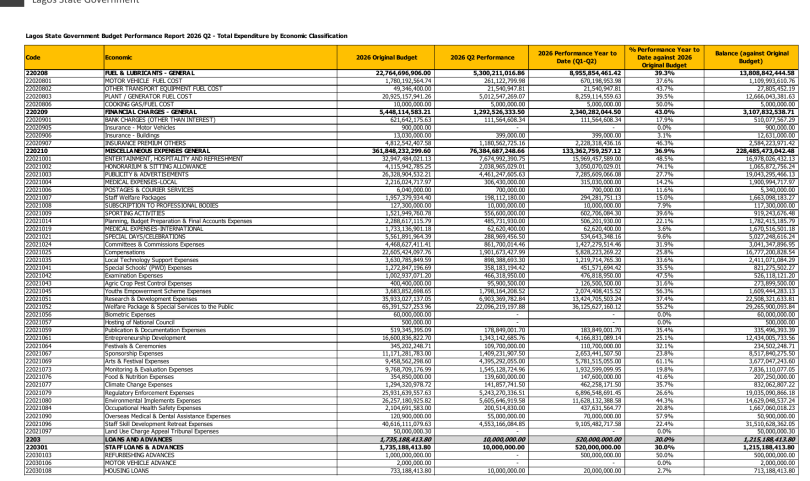
The Lagos State government under Governor Babajide Sanwo-Olu spent about ₦19.02 billion on refreshments, entertainment, hospitality, honoraria, and sitting allowances between January and June 2026, while spending only ₦7.3 billion on primary healthcare, SaharaReporters can report.
This is amid industrial actions by healthcare workers, complaints over poor remuneration and welfare, and persistent shortages of medical personnel in public hospitals in the state.
The spending figures, contained in the Lagos State Government’s 2026 Second Quarter (Q2) Budget Implementation Report, raise questions about the state’s spending priorities at a time when patients struggle with overcrowded hospitals, long waiting hours, disruptions to essential medical services, residents are facing growing difficulties accessing healthcare, and medical professionals are repeatedly embarking on strikes over their welfare and working conditions.
SaharaReporters’ analysis of the report showed that the state spent ₦15,969,457,589 on refreshments, entertainment, and hospitality against an annual budget of ₦32.95 billion.
This represents approximately 48.5 per cent of the amount budgeted for the entire year, with six months still remaining in the 2026 financial year.
The government also spent ₦3,050,070,029 on honoraria and sitting allowances out of an annual allocation of ₦4.115 billion, representing approximately 74.1 per cent of the yearly budget within the first half of the year.
By comparison, the state government’s spending on primary healthcare during the same period stood at ₦7,328,006,100.44, representing approximately 38.1 per cent of its annual budget of ₦19.23 billion.
The figures come against the backdrop of a worsening healthcare access crisis in Lagos, where patients struggle with overcrowded public hospitals, prolonged waiting periods, rising medical expenses and disruptions caused by industrial actions by healthcare workers.
The pressure on Lagos State public hospitals was particularly visible during the prolonged industrial action by members of the Joint Health Sector Unions (JOHESU), which began in December 2025 and continued into January 2026.
By January, the strike had disrupted services across several public hospitals in the state, forcing patients to seek medical services outside government facilities and exposing families to additional financial burdens.
At the Lagos State University Teaching Hospital (LASUTH), patients and relatives reportedly encountered overcrowded emergency units and reduced manpower.
One particularly distressing account involved the parents of a teenage girl who had reportedly been referred from Ifako-Ijaiye General Hospital for a blood transfusion but could not secure a bed at LASUTH.
The family reportedly faced the prospect of seeking treatment at another hospital, despite the financial implications.
At the Alimosho General Hospital in Igando, patients were reportedly directed to obtain medicines outside the facility because the hospital pharmacy was affected by the strike.
One patient, identified as Chioma, said she had been buying medicines outside the hospital, while another elderly patient complained that private pharmacies charged more than the government hospital’s pharmacy.
At the General Hospital, Ifako-Ijaiye, the strike also affected access to patient records, with some patients reportedly instructed to use exercise books to record their medical information.
The JOHESU Lagos State Council Secretary, Adegboyega Kabiawu, told journalists that the union’s grievances included unresolved salary and professional recognition issues, unequal implementation of retention allowances, errors in call-duty and shift-duty allowances, and inadequate transportation for health workers.
Kabiawu said the union had previously had about 10 staff buses serving the health sector across the three tiers of healthcare in Lagos, but only one remained functional.
JOHESU also complained about the state government’s failure to address longstanding issues affecting pharmacists, medical laboratory scientists and other health professionals.
The union said its members constituted about 85 per cent of the health workforce, underscoring the impact of their withdrawal of services on public hospitals.
The crisis has not been limited to non-medical health workers.
In June 2026, resident doctors at LASUTH embarked on a three-day warning strike over unresolved welfare concerns, including delayed implementation of revised professional allowances, non-payment of specialist allowances to eligible senior registrars, outstanding salary shortfalls and promotion arrears.
The Nigerian Medical Association (NMA), Lagos State branch, warned at the time that the dispute could trigger wider disruptions across the state’s healthcare system if the grievances were not addressed.
The doctors also demanded the completion of the Resident Doctors’ Quarters and the release of the 2026 Medical Residency Training Fund, among other outstanding entitlements.
In September 2026, the Nigerian Association of Resident Doctors (NARD) backed another industrial dispute involving LASUTH resident doctors, citing unresolved specialist allowances, salary shortfalls and advancement arrears.
The association said some affected doctors were still owed 25 months of arrears arising from delayed implementation of the revised Professional Allowance Table.
The doctors also complained that assurances previously given by government officials had not translated into full payment of their entitlements.
The welfare disputes have raised concerns about the state’s ability to retain medical professionals at a time when Nigeria’s health sector is already battling the migration of doctors and other skilled workers.
The pressure on the healthcare system was further highlighted in September as media reports documented long queues and doctor shortages at several Lagos public hospitals.
There were reports that patients were spending hours waiting to obtain hospital cards, make payments, see doctors and collect prescribed medicines.
At Gbagada General Hospital, patients were reportedly seen waiting for extended periods, while some people at Mushin General Hospital spent more than two hours waiting to see doctors.
At Ikorodu General Hospital, a patient reportedly said the crowd could be so overwhelming that visitors might spend an entire day waiting and still leave without receiving the required care.
At Mushin General Hospital, the challenge was attributed to staffing shortages due to inadequate remuneration, with claims that doctors sometimes worked shifts extending to 70 continuous hours.
The President of the Association of Resident Doctors, LASUTH chapter, Dr Alaba Akerele, reportedly confirmed that doctors were resigning and that the departures were increasing the workload of those who remained.
The Immediate Past Chairman of the Nigerian Medical Association in Lagos, Dr Babajide Saheed, also attributed doctors’ departures to poor remuneration, unfavourable conditions of service, heavy workloads, inadequate equipment, and difficult working environments.
Saheed also cited the high cost of transportation and accommodation in Lagos as additional pressures on medical professionals.
In August 2026, Governor Babajide Sanwo-Olu acknowledged the scale of the staffing challenge, saying Lagos needed about 40,000 doctors and 40,000 nurses to adequately serve its population.
The governor said that the state has approximately 7,000 doctors and that the available doctors were effectively doing the work of many more.
The Lagos State Commissioner for Health, Prof. Akin Abayomi, also acknowledged in September 2026 that outpatient attendance at public hospitals had doubled within six months.
Abayomi attributed the increase partly to the rising cost of private healthcare, which was pushing more residents towards government hospitals.
The commissioner said the influx of patients, combined with the migration of healthcare professionals, had placed enormous pressure on doctors and other health workers.