
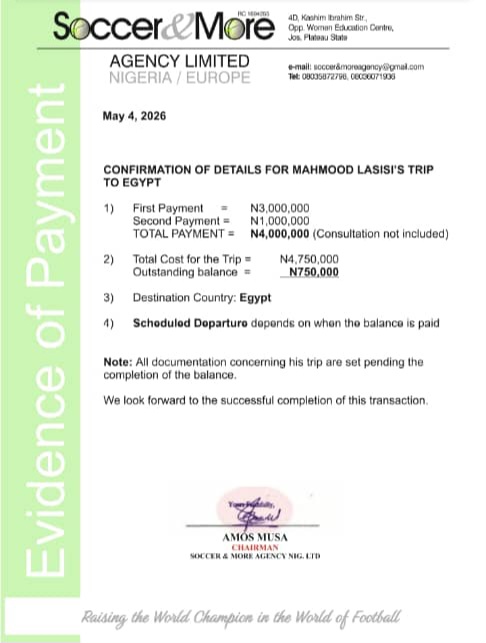
An investigation by SaharaReporters has uncovered how a Nigerian family paid ₦4.7 million under a ₦4.75 million football-placement arrangement that promised their son training in Egypt, a professional club contract and a pathway to European football, only for the player to return to Nigeria about a month after his arrival without the promised trial.
The arrangement involved Amos Musa, popularly known as Coach Pojo, who presented himself to the family as a licensed FIFA agent with 35 years of experience, according to the family’s account and documents reviewed by SaharaReporters.
The deal also involved Dr. Ejembi Emmanuel, who introduced Musa to the family and was subsequently named as a guarantor in an undertaking signed by the player’s parents.
Documents obtained by SaharaReporters, together with accounts from the family and information from other sources, show a series of changes to the original arrangement before and after Mahmood Lasisi travelled to Egypt on July 13, 2026.
The proposed three-month visa and football training programme eventually became a one-month visa on arrival. The player was subsequently taken to accommodation where other Nigerian footballers were staying, while the promised professional trial did not materialise.
Mahmood returned to Nigeria on August 13, 2026, after his Egyptian visa expired, according to his mother, Lasisi Risikat Abidemi, a Deputy Commander of the National Drug Law Enforcement Agency (NDLEA).
The evidence reviewed by SaharaReporters raises questions about the money paid by the family, the services that were actually delivered, the arrangements made for Mahmood in Egypt and the roles played by Musa, Ejembi and another man identified as Abass Elhag.
The ₦4.75m Football Package
The transaction began after Abidemi sought help finding a way for her son to continue his education while pursuing a professional football career.
Abidemi met Ejembi in November 2024 at Maduka University, Enugu State, while processing admission for her daughter. She subsequently told him about Mahmood, who had returned from Turkey during his second year at university because of foreign exchange difficulties.
On February 14, 2025, she discussed Mahmood’s desire to combine his education with football with Ejembi.
Ejembi subsequently introduced the family to Musa.
During a conference call involving Abidemi, her husband, Ejembi and Musa, the proposed football package was presented to the family.
The package was priced at ₦4.75 million and was supposed to take Mahmood to Egypt on a three-month visa for training and acclimatisation.
The proposed arrangement went beyond training.
The family was told that Mahmood would subsequently be signed by a Division 2 or Division 3 football club, receive allowances, gain university admission and eventually have a pathway into professional football in Europe.
Mahmood’s passport data page, O’Level result and football videos were subsequently provided as part of the process.
Ejembi also endorsed the arrangement and, according to Abidemi, offered to help the family financially by borrowing them ₦700,000 when his pension benefits were paid.
The payment trail reviewed by SaharaReporters shows that Abidemi ultimately paid ₦4.7 million for Mahmood’s football programme in Egypt.
She initially paid ₦200,000 as a commitment fee, after which agreement forms were sent to her and her husband for signing.
Following the payment of her pension benefits in August 2025, she made a further ₦2.8 million payment. She subsequently paid another ₦1 million and a final ₦700,000, bringing her total payment to ₦4.7 million.
An undertaking dated August 30, 2025, and obtained by SaharaReporters, records the payment arrangement. The document states that the family had paid ₦2.8 million, with the remaining ₦1.9 million to be paid in four instalments once Mahmood was signed by a football club.
The undertaking also identifies Dr. Ejembi Emmanuel as the guarantor of the family’s commitment under the arrangement.
The payment records therefore show that the family eventually fulfilled ₦4.7 million financial commitment out of ₦4.75 million, while the subsequent events in Egypt form the basis of the family’s complaint over whether the services promised under the agreement were delivered.
The First Warning Signs
The original arrangement envisaged Mahmood travelling in November or December 2025.
But the proposed departure did not happen.
The family was subsequently told that the November travel window was too short and that Mahmood should instead travel in May 2026, three months before the purported trial, to give him time to acclimatise and train.
When May arrived, however, the plan changed again.
The explanation given to the family was that the World Cup was ongoing and there would not be sufficient time for training.
The repeated changes increased the family’s concerns, particularly as questions arose about the travel arrangements and the documentation required for the trip.
The family was also told at one point that Mahmood needed to travel with $1,000.
According to Abidemi, Ejembi conveyed the request to her, explaining that the money was for Mahmood’s travelling allowance.
A flight ticket was later sent to the family through Ejembi, but the family noticed that its duration did not correspond with the three-month visa arrangement originally presented to them.
Questions Over The Paperwork
Three days before Mahmood’s eventual departure, Musa introduced another man to the family during a conference call, describing him as his legal officer.
The introduction came as the family began asking more questions about the arrangement.
Abidemi’s daughter, Nusrat, who participated in the call as the family’s legal representative, questioned Musa about his documents, the proposed destination in Egypt and the people involved.
She also questioned the address appearing on Musa’s letterhead and CAC documents and raised concerns about the person with whom Mahmood was expected to stay in Abuja.
Musa subsequently introduced Abass Elhag as his partner in Egypt.
That introduction was followed by a document that became central to the Egypt leg of the arrangement.
A letter obtained by SaharaReporters and purportedly issued by African Egyptian Sports identified Elhag as the person who would receive Mahmood at Cairo airport, assist him with his visa on arrival and take him to the organisation’s sporting facility.
Translated copy of احمد عباس ——_093023.pdf
The document further stated that the organisation would provide accommodation and other documentation for Mahmood during his purported trial.
Mahmood travelled to Egypt on July 13, 2026.
The Three-Month Visa Became One Month
What Mahmood encountered in Egypt differed significantly from the arrangement originally presented to his family.
Instead of the three-month visa discussed with the family, Mahmood obtained a one-month visa on arrival after paying $30, according to his mother’s account.
He also reportedly had to pay ₦25,000 for a yellow fever vaccination card before leaving Nigeria.
The visa discrepancy is significant because the original package had been built around a three-month stay for training and acclimatisation before the football trial.
The arrangement on the ground, however, soon generated further problems.
According to Abidemi, Elhag demanded money from Mahmood, complaining that Musa had not paid him.
She said Elhag eventually took the $93 Mahmood had remaining for his feeding expenses.
Abidemi subsequently contacted both Ejembi and Musa over the issue. She said Ejembi promised that the additional money Mahmood had spent would be refunded, but that the refund never came.
The Football Trial That Never Happened
The original package promised a professional football pathway.
But Mahmood was instead taken to a facility where several other young Nigerian footballers were staying while waiting for purported trials.
Abidemi described the facility as a “cage” and said the players were waiting for opportunities that did not materialise.
An older Nigerian footballer subsequently visited the group and told them that they had allegedly been scammed because there was no football trial waiting for them in Egypt.
The footballer reportedly advised the players to leave Egypt before their visas expired.
According to Abidemi, the player also warned that Nigerian youths were being taken to Egypt by criminal agents under the guise of securing professional football opportunities. That broader claim has not been independently established by SaharaReporters.
The episode became a direct confrontation over Musa’s responsibility.
During a conference call involving Mahmood, his parents, Ejembi and the Nigerian footballer, Musa reportedly declined to participate.
According to Abidemi, Musa said he was no longer responsible for Mahmood because his contract with the family had ended when he handed the player over to Elhag.
The family rejected that position, arguing that its agreement had been with Musa, not Elhag.
Abidemi also rejected a claim that Mahmood had refused to attend a trial, saying there was evidence to contradict that assertion.
Mahmood eventually returned to Nigeria on August 13, 2026, after his Egyptian visa expired.
Ejembi’s Role In The Deal
The documents and account reviewed by SaharaReporters place Ejembi at several stages of the arrangement.
He introduced Musa to the family and participated in the discussions that preceded the deal.
More significantly, an undertaking obtained by SaharaReporters identifies him as the guarantor for the family’s payment commitment.
His involvement also continued after the initial introduction, with Abidemi maintaining that he participated in discussions concerning payment, travel arrangements and the problems that emerged after Mahmood arrived in Egypt.
After Mahmood returned to Nigeria, the family sought to recover its money.
Abidemi said she demanded ₦3.5 million from the ₦4.7 million package after agreeing to forgo ₦1.2 million allegedly spent on the return ticket.
Instead, she said Ejembi asked whether the money could be converted into two years’ school fees for her daughter at his university.
She rejected the proposal, saying the money was intended to support Mahmood’s football career.
When she later asked Ejembi about efforts to recover the money, she said he told her to “calm down” and contact Musa.
She refused and told him she would expose both men.
According to Abidemi, Ejembi told her to go ahead.
“He said I should go ahead. Hence the reason why I am here,” she said.
The evidence obtained by SaharaReporters suggests that Mahmood’s case is not isolated as the newspaper established that there are other players who are victims of a similar arrangement by other agents.
A document obtained by SaharaReporters lists several young Nigerian footballers, namely Aminu, Freedom, Eze, Saif, Emmanuel, Ahmed and Lasisi, as stranded around Cairo’s El Maadi El Gadida area.
A separate source also told SaharaReporters that several other Nigerian footballers were stranded at different locations in Egypt.
The source claimed that one player was trying to raise ₦540,000 to return home by September 10, while his agent had allegedly charged approximately ₦1.15 million for his flight ticket.
Those claims require further investigation and independent corroboration.
Musa, Ejembi Yet To Respond
Musa, also known as Coach Pojo, is identified in the complaint as a pastor at the Ark of Covenant Resurrection Center in Dadin Kowa, Jos, Plateau State.
SaharaReporters contacted Musa and asked him to respond to the allegations that he presented himself as a licensed FIFA agent, collected money from the family and failed to deliver the promised football trial in Egypt.
He had not responded as of the time of filing this report.
SaharaReporters also contacted Dr Ejembi Emmanuel over allegations concerning his role in introducing Musa to the family, endorsing the arrangement, acting as guarantor and subsequently participating in discussions over the failed deal.
He had also not responded as of press time
Follow the Sahara Reporters channel on WhatsApp: https://whatsapp.com/channel/0029VaFClvtH5JM6SSsP7M2Y