
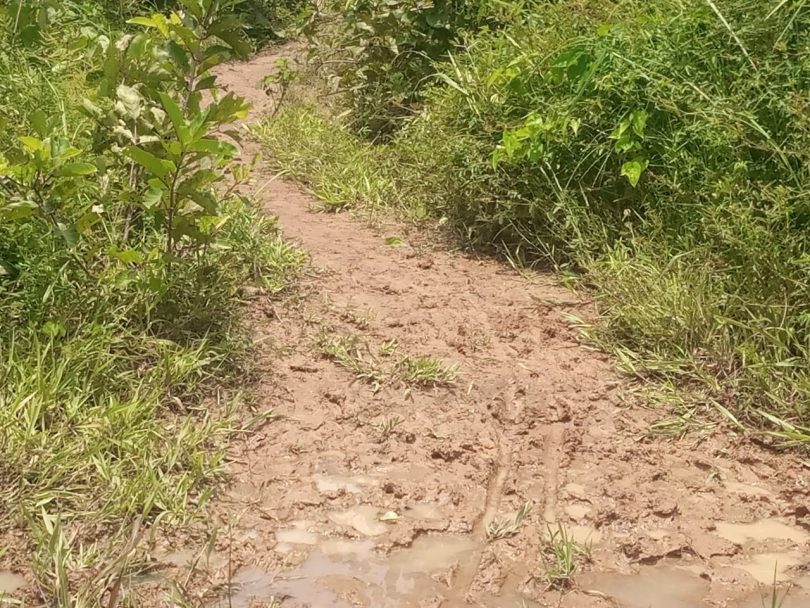
Along the newly laid 21-kilometre asphalt corridor constructed by Governor Peter Mbah’s administration to facilitate joint security patrols, silence reigns supreme.
What was intended as a lifeline for rural commerce and agricultural resurgence instead serves as a highway through ghost communities. Broken roofing sheets dangle from charred roof beams, wild thickets swallow residential quarters, while forgotten places of worship stand gutted and silent.
On August 19, an investigative team from SaharaReporters undertook a two-hour journey by commercial motorcycle deep into the agrarian heartland of Eha-Amufu in Isi-Uzo Local Government Area, Enugu State.
Traversing 10 once-flourishing agricultural settlements, including Orie Ogbete Mgbuji, Ukwuekwu-Mgbuji, Ekpufu-Mgbuji, Onungbede and Amuogbu Ebo, the team witnessed the lingering aftermath of violent attacks which, according to residents, displaced thousands.
Across the 21-kilometre stretch, human presence was reduced to mere shadows. Only four people were encountered around the village squares at Ukwuekwu-Mgbuji and Ekpufu-Mgbuji combined.
In Ogbete Mgbuji, the historic hub of regional trade where hundreds once gathered daily, the local market has been defunct for years. The abandoned Anglican Church Parish now serves as a fortified outpost for a joint security taskforce comprising soldiers, police officers, Nigerian Security and Civil Defence Corps (NSCDC) personnel, state Forest Guards and local vigilantes.
Yet, despite the security presence, safety remains a major concern for displaced villagers attempting to reclaim their ancestral lands.
Security operatives stationed at the Ogbete Mgbuji outpost told SaharaReporters that herders routinely move large herds into cultivated fields at night, destroying crops before disappearing.
A senior security agent, speaking on condition of anonymity, said, “One of the major incidents involved cows grazing on over five hectares of rice fields cultivated collectively by returning residents in the night. You know what five hectares of rice farms entail; the grueling physical labour, the massive financial investment, and the hopes of entire families. All of that was wiped out overnight. Yet, the devastated residents demanded nothing more than an assurance that the herders would be stopped from repeating such destruction.”
Rather than strict sanctions or restitution, community members said security responses often amount to temporary mediation, with local Fulani leaders contacted to move cattle elsewhere while farmers bear the losses.
‘No one has returned to Onungbede’
Mrs Nkechi Onunze, from Onungbede-Mgbuji village farm settlement, said her family was among those whose houses were burnt during the attacks.
She said she had returned not to rebuild her home but to harvest crops because her family was struggling to survive.
“I am from this Onungbede and my house is close to this road and among the houses burnt by the Fulani herdsmen and their accomplice,” she told SaharaReporters.
She added, “No government agency, either from the state or the Federal Government, brought any relief in any kind to us or to me and other affected residents to repair or reconstruct our houses.”
She said residents remained scattered across other communities.
“And no one has returned to this farm settlement. Why you see me here is because I came to harvest some crops so that hunger will not kill my children,” she said. “We are squatting with my father-in-law after our house was burned by the invaders.”
Onunze said residents were afraid to return because of the continued presence of armed herders.
“Fulani herdsmen are still very much around here in the settlement as you can also see their traces,” she said. “When they are around, they also come in the night. That is the time they destroy farm crops.”
“We are still pleading with the government and security agencies to rein in the herders and stop them, so that we can finally return to our homes,” she said. “We are suffering where we are squatting because we cannot find land to cultivate on.”
She said travelling to the abandoned settlement had also become a financial burden.
“From where we are staying to this place is N2,000 by tricycle. To and fro, we spend N3,000 or N4,000 depending on what you are carrying,” she said.
“Our greatest fear is the Fulani herdsmen and until they stop them from invading and grazing on our farms, we will not find it comfortable to return to live here again.”
Survivor recalls deadly attack
Sunday Ajah, a survivor of one of the attacks and a native of Ekpufu-Mgbuji, accompanied SaharaReporters during the tour and recounted his near-death experience.
“I survived the attack. It was the first attack in Ekpufu. I stumbled on them on the road because the attackers blocked the road and started killing people,” he said.
“They were killing people on the road and they snatched my motorcycle and burnt it. It was by God’s mercy that I escaped and survived the attack. When I was running in the bush, I wasn’t thinking that I would make it alive because they pursued me. They killed many people that day.”
Ajah said the attacks scattered families and forced residents into churches, schools and relatives’ homes.
“We are still picking up the pieces of what is left in our village,” he said.
He alleged that armed attackers included Fulani herders and people from neighbouring communities in Benue State.
Ajah said cattle continued to enter farmlands.
According to him, “Fulani herdsmen lead their cows to graze everywhere in Ekpufu. In short, there is a rice farm, which is over five hectares, that they grazed on overnight.
“If you see it, you will shed tears for what they did to their fellow humans. The damage was too much, yet no accountability,” he lamented.
“Our people are still calm, trying to cultivate cassava farms,” Ajah said.
He appealed to the government to provide an access road to Ekpufu-Mgbuji and increase security presence.
A Market That Died After Attacks
Ajah also took SaharaReporters to Ogbete, where he recalled how the attacks killed a once-thriving market.
“Ogbete, this is four years since the market stopped operating. People were trading in the market on January 7, 2022 when it was invaded,” he said. “People from Benue State in their numbers carrying guns attacked the people. They killed so many people, including women and children in this market. People ran helter-skelter.”
According to him, traders from Enugu and Benue states once patronised the market before violence forced it to close.
“Since the attack they closed the market and nobody was coming,” he said. “Our people are no longer living here but they come to pick some things. They pick nuts for their abandoned homes and go back to where they are squatting.”
Ajah said he wanted to return home but needed government intervention.
“I desire to return to my residence today and tomorrow if government will help us, especially grading our access roads and making it easily accessible,” he said.
‘Nobody Has Returned To Ebo Farm Settlements’
Ogbu Gabriel, from Amuogbu-Ebo, said the situation is worse in several Ebo farm settlements.
“Nobody has returned to their house in Ebo farm settlements where they were sacked by Fulani herdsmen and Benue people,” Gabriel said. “Even to cultivate their farms is difficult, because after cultivating it, the Fulani herdsmen will come in the night to graze on it.”
He listed Amuobelebe, Amuokpobe, Amuogbaga and Amuogbu among the settlements where he said residents had not returned.
“Some of the people living in those places have travelled to cities, some are at home squatting with their relations but doing nothing,” he said.
According to him, “Most of them survive by going for daily-paid jobs, farming for people, or going to construction sites to work as labourers. They do menial jobs just to survive till the next day.”
Gabriel challenged claims that residents had fully returned.
“Anybody who says that our people have returned to their homes are capital liars. The government should come and see things for themselves,” he said.
He said many houses, churches and schools destroyed during the attacks had not been rebuilt.
“I mean not a single building has been reconstructed or rebuilt,” Gabriel said.
Gabriel said some people who went to their farms never returned.
“Many people who went to only farm their land didn’t return back, most times we recovered their corpses and some are still missing till date,” he said.
“Because of that, people are afraid of going there. They don’t know what will happen to them.”
At Ukwuekwu-Mgbuji, Sunday Ogbuabor said a small number of residents had returned but lived in constant fear.
“Here is Ukwuekwu-Mgbuji farm settlement. We are living here in the settlement but the biggest problem we have is the Fulani herdsmen, to the extent that everything we farm, their cows graze on it,” Ogbuabor said.
He said cattle recently destroyed crops on nearby farms.
“You can see farm crops they grazed yesterday. What we cultivated they came, surrounded and destroyed almost everything,” he said. “The cows were more than 50 in number that invaded the farm.”
Ogbuabor said residents who had returned did not feel safe enough to sleep at night.
“Our minds are not at rest,” he said. “Even those of us who have returned here, we don’t sleep in the night because we are always afraid.”
He said even houses that were not burnt had deteriorated after years of abandonment.
“My own house, they (Fulani herdsmen) vandalised the roof, and so many other people. Many houses were burnt. I am living in another person’s house as we speak because I have no house again,” he said .
He said the government needs to do more than construct roads and deploy security personnel.
He also called for compensation for farmers whose crops had been destroyed.
“Government has not made Fulani herdsmen to pay compensation to the farmers whose farms were destroyed,” he said. “Should we resort to killing their cows again, that is when you will see government and security agencies showing muscles. But now they see them destroy our farm crops and they can only call the Arados (pastoralists or Fulani community leaders/heads ) and their owners to come and carry their cows. This is not accountability.”
Ogbuabor appealed for reconstruction and stronger surveillance.
“We also appeal to government to assist us in rebuilding our destroyed houses to enable those who have intentions to return to come back,” he said. “So many people desire to return to their homes but they don’t have houses anymore because their homes were destroyed during the attacks.”
“The government should deploy drone surveillance in the area to monitor and track the criminals in real time,” he said.
Security presence, but fragile peace
Despite residents’ concerns, the joint security team at Ogbete has brought some measure of reassurance.
Ogbuabor said security personnel recently responded when cattle entered cultivated farms.
“Three days ago, when the cows entered our farms, the leader of the joint taskforce called the owner and within 30 minutes, he came and took the cows out,” he said.
But he said cattle were often allowed to roam without shepherds, particularly at night.
As SaharaReporters left the settlements, the contrast was stark: a newly built road intended to reconnect communities to the outside world, security personnel occupying an abandoned church, and homes and public buildings disappearing beneath years of unchecked vegetation.
For residents like Onunze, Ajah, Gabriel and Ogbuabor, the settlements are not simply abandoned buildings. They are homes they want back, farms they want to cultivate and markets they want reopened.
They believe the communities can come alive again if the government guarantees security, rebuilds destroyed structures, restores access roads and addresses the recurring destruction of crops.
For now, residents continue to make cautious journeys into the settlements to harvest crops from lands they once lived on freely.
Four years after the attacks emptied the communities, the people have not forgotten their homes. They are waiting for the security and conditions that will make returning possible.