
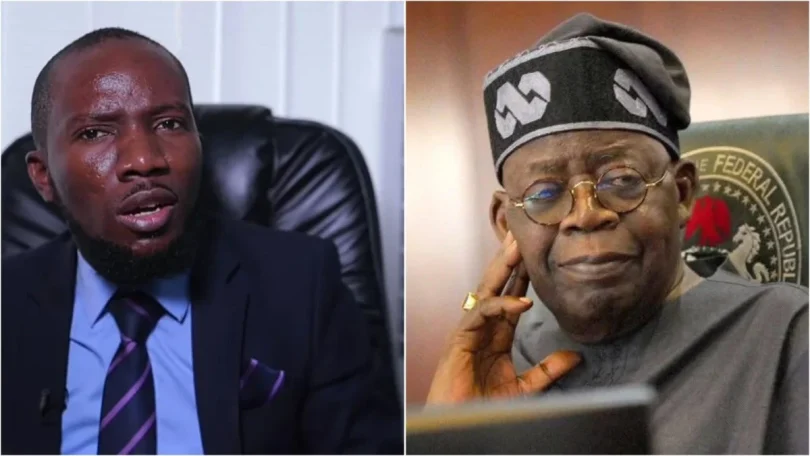
Human rights lawyer, Inibehe Effiong, has described as embarrassing the move by the United States Federal Bureau of Investigation, FBI, to block public release of some records linked to allegations involving President Bola Tinubu.
Effiong reacted in a post on X after reports emerged that the FBI had asked a United States court to allow it to file a confidential explanation for withholding parts of the documents sought in a Freedom of Information Act, FOIA, case.
“This is so embarrassing for our country,” Effiong wrote.
“Sadly, many see nothing wrong with this.”
The lawyer also criticised Nigerians who continue to defend political figures despite allegations surrounding their personal and public records.
“They keep talking about ‘my candidate’, the said candidate is a man whose age, educational qualifications, family history, career record and criminal background are a spectacle of shame,” he said.
Effiong’s comments followed an application filed by the FBI before the United States District Court for the District of Columbia.
The agency asked the court for permission to file what it described as an ex parte, in-camera declaration.
An ex parte, in-camera declaration is a confidential submission made directly to a judge and kept outside the public court record.
The FBI said it could not publicly explain all the reasons for withholding the records because doing so could disclose information the agency seeks to protect.
According to the agency, public disclosure could reveal law-enforcement techniques and procedures.
The FBI also argued that release of the records could reasonably be expected to endanger the life or physical safety of an individual.
The agency asked the court to review its detailed explanation privately rather than make the material available to the public.
The FBI asked the court to consider its detailed explanation privately rather than place it before the public.
Under the request, the FBI would submit the declaration under seal, allowing the judge to review the basis for the withheld information without making the explanation available to the public or Greenspan. The agency said this procedure was necessary to protect the information at issue.
The records were requested by Aaron Greenspan, an American businessman and founder of PlainSite, in a long-running FOIA case.
Greenspan had sought documents from the FBI and the Drug Enforcement Administration, DEA, connected to historical allegations involving Tinubu.
The case concerns records and documents connected to a 1992 and 1993 investigation in the United States.
In April 2025, a United States judge ordered the FBI and DEA to lift their earlier refusal to confirm or deny whether they held records connected to Tinubu.
The court held that the agencies had not sufficiently justified their use of what is known as a Glomar response.
A Glomar response allows an agency to neither confirm nor deny the existence of requested records where confirming or denying the records could reveal protected information.
The FBI’s latest application does not mean the court has approved the withholding of the documents.
It is a request for permission to explain, in private, why the agency believes some of the information should remain undisclosed.
The FBI relied on FOIA provisions that protect personal privacy, confidential sources, law-enforcement methods and information that could endanger an individual.
The agency said it would submit its confidential declaration by August 28 if the court grants the request.