
Doctors in China were left with a puzzling medical case after a man arrived at the hospital complaining of discomfort while urinating and blood in his urine.
Follow Our WhatsApp Channel here
Despite his symptoms, the man’s vital signs were stable, and he showed no other obvious signs of distress.
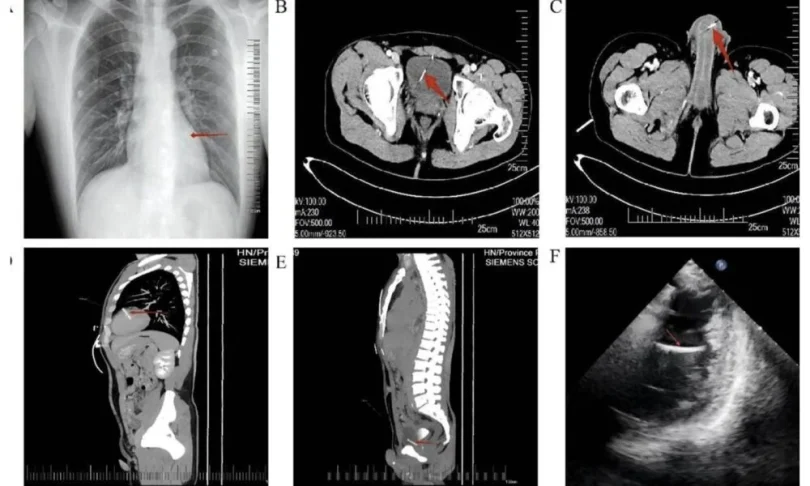
However, an imaging test revealed something unusual near his heart. Doctors subsequently ordered a contrast-enhanced CT scan to get a clearer view of the suspected object.
Follow Our Facebook Page here
The scan revealed multiple “needle-like metallic foreign bodies” lodged in different parts of his body.
One of the most concerning findings was a 1.4-inch metallic pin that had pierced the pericardium, the fluid-filled sac surrounding the heart.
Doctors were unable to determine how the objects had entered his body. The man, who had a history of intellectual disability dating back to childhood, could not provide an explanation, while his father, who serves as his legal caregiver, was also unaware of how the objects got there.
However, doctors discovered that the man had previously undergone treatment at another hospital two years earlier, where two foreign objects had been removed from his abdomen.
The history led doctors to suspect a condition known as self-embedding, a form of non-suicidal self-injury in which a person deliberately inserts foreign objects into the body.
The case presented a major challenge because removing the objects could potentially cause further damage, particularly those located close to vital organs.
Doctors therefore decided to first remove the object they considered the greatest immediate threat.
Surgeons successfully removed an intact black metallic sewing needle from the man’s pericardium. The needle was found to be corroded, suggesting that it had remained inside his body for an extended period.
Doctors did not find any obvious wound or scar on his chest that could explain how the needle had entered the area around his heart.
Following the operation, the man’s heart function temporarily deteriorated as a result of the existing injury and the strain of surgery.
He was discharged from the hospital nine days after the procedure.
At a nine-month follow-up appointment, the patient remained clinically stable, and his heart function had recovered.
Doctors decided not to immediately remove the other needles found throughout his body because doing so could create additional complications. Instead, they opted to monitor the remaining foreign objects closely.