
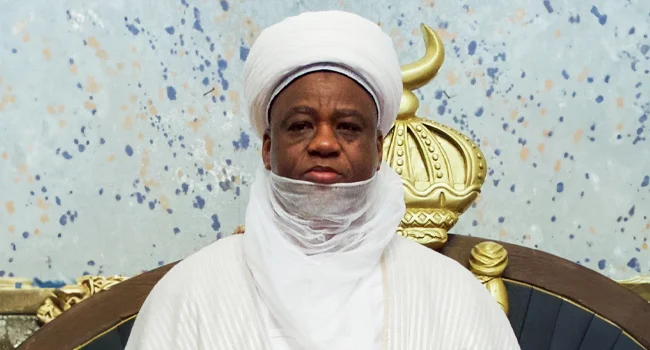
Sultan of Sokoto and Co-Chair, Nigeria Inter-Religious Council (NIREC) Muhammadu Sa’ad Abubakar has declared that bandits and terrorists must no longer be labelled as Muslims, warning that such misrepresentation fuels division and distorts the true teachings of Islam.
Speaking in Abuja on Wednesday at the first triannual meeting of NIREC, themed “Religious Literacy for National Cohesion,” the Sultan urged Nigerians to separate criminality from religion and support decisive action against perpetrators of violence.
He stressed that ignorance, illiteracy and poor religious understanding, especially among some clerics, remain major drivers of conflicts often wrongly framed along religious lines.
The Sultan also called on government to enforce the full weight of the law on bandits to restore peace, unity and development across affected communities.
“Let’s give bandits and terrorists their rightful names and treat them as such. We should stop calling them Islamic terrorists, even if they may be Muslims. In Islam, if you take one life, it is like taking the life of all humanity. The Holy Book refers to humanity not Muslims or Christians alone.
“You cannot go to the market strapped with explosives, kill yourself and others while shouting ‘Allahu Akbar,’ and expect heaven. Such a person’s place is hell, not paradise. Terrorists and bandits are criminals and we should treat them as such, not as Muslim criminals or Muslim bandits,” he said.
He further cautioned against equating fluency in Arabic with religious authority, noting that language does not confer Islamic scholarship.
“Arabic is a language, not a certificate of Islamic scholarship. Even Christians in Jordan and other Arab countries use Arabic in their religious practices because it is the language of the community,” he added.
The Sultan stressed that both Islam and Christianity share core values, urging clerics to speak responsibly and foster mutual trust, while dismissing fears of religious domination.
He also responded to criticism over perceived silence by Muslim leaders, insisting efforts are ongoing behind the scenes to address the crisis.
President of the Christian Association of Nigeria (CAN), Daniel Okoh, described Nigeria’s diversity as a potential strength if properly managed, warning that misunderstanding and manipulation could turn it into a source of division.
He said. “Religious literacy is not just academic knowledge of doctrines or rituals. It involves awareness, sensitivity and respect for others’ beliefs and practices. It equips individuals and communities to engage constructively across differences, challenge stereotypes and resist divisive narratives. It is a tool for building bridges of understanding, tolerance and peaceful coexistence.”
He noted that NIREC remains a critical platform for dialogue and conflict resolution, even as tensions are often wrongly framed as religious despite deeper social, economic and political roots.
Okoh called for the integration of religious literacy into education systems and public discourse, urging schools and places of worship to promote unity, respect and responsible citizenship.
Secretary to the Government of the Federation, SGF, George Akume said NIREC was established to strengthen dialogue, understanding and sustainable peace across the country.
He warned that rising insecurity, low trust and identity-based tensions are being worsened by stereotypes, poor communication and the weaponisation of religion and ethnicity.
“Dialogue remains a vital instrument for nation-building. National cohesion cannot be built on suspicion or exclusion, but on justice, dignity, mutual respect and the assurance that every citizen matters.”
Akume added that improving religious education quality, alongside stronger roles for traditional and religious leaders, is key to building a more tolerant and cohesive society, urging stakeholders across sectors to work together in shaping a generation grounded in mutual respect and shared national values.
Related