
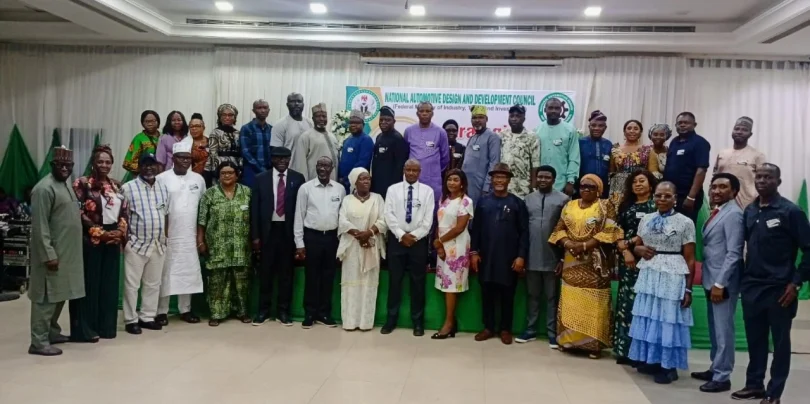
The National Automotive Design and Development Council (NADDC) has challenged its management and staff to move beyond routine administrative activities, meetings and reports and focus on delivering measurable results that directly advance Nigeria’s automotive industry.
The charge was made on Wednesday in Calabar, Cross River State, by the Director, Vehicle Electrification Department, Engr. Ayinde Abdullahi, who represented the Director-General of NADDC, Otunba Oluwemimo Joseph Osanipin, at the opening of the council’s 2026 Strategic Management Retreat.
The three-day retreat, holding at the Metropolitan Hotel, Calabar, from August 26 to 28, has the theme, “Driving Institutional Excellence: Aligning Capacity, Culture, and Compliance with the NADDC Corporate Mandate.”
Abdullahi said the retreat was convened to enable the council’s management and staff to step away from their normal office environment, critically examine their operations and develop strategies to improve institutional performance.
ALSO READ: Malami inaugurates 600-member ADC campaign council in Kebbi
According to him, NADDC must constantly ask whether its interventions are increasing local automotive production and local content, improving services to investors, creating jobs, building technical capacity and facilitating technology transfer.
“Every department should be able to answer three questions: What is our mandate? What outcomes are we responsible for? How will we measure our success?” he said.
Abdullahi identified capacity, culture and compliance as the three pillars on which institutional excellence must be built.
“Capacity gives us the ability to deliver; culture gives us the willingness to deliver; and compliance ensures we deliver responsibly,” he said.
He urged the council to build a workforce that is technically skilled, adaptable and capable of responding to emerging developments in the automotive industry, particularly electric mobility, alternative fuels, digitalisation and vehicle cybersecurity.
The director also called for a workplace culture anchored on integrity, accountability, professionalism, collaboration, innovation, service and results.
He said NADDC must replace “ownership in place of excuses, collaboration in place of competition, performance in place of routine, innovation in place of resistance, service in place of bureaucracy, and accountability in place of blame.”
Abdullahi further stressed the need to break down institutional silos, noting that major interventions such as electric mobility involve several areas, including policy, standards, infrastructure and skills development.
The NADDC director said management must lead the institutional transformation by example by rewarding performance, addressing underperformance, encouraging innovation, investing in staff, strengthening internal controls and clearly communicating the council’s objectives.
On the choice of Calabar as the venue, Abdullahi said the city provided an ideal environment for candid discussions, while its reputation for cleanliness, peace and hospitality made it suitable for the annual management gathering.
He also noted the presence of automotive-related projects in Cross River State, including an automobile assembly facility, saying the council’s investments across states were designed to promote even development and give different parts of the country a sense of belonging.
The retreat is coming at a time when NADDC is intensifying efforts to develop technical capacity for Nigeria’s evolving automotive industry. The council recently commenced a two-week specialised training programme for 300 technicians and youths across six states, including Cross River, focusing on vehicle mechatronics and CNG retrofitting.
Also speaking, the Special Adviser to the Cross River State Governor on Automobile Technicians Regulatory Department, Chief Ndem Effiong, commended NADDC for its interventions in the state.
Effiong said NADDC had established an Automotive Training Centre in Awi, Akamkpa Local Government Area, for the training of technicians and other operators in the automotive value chain.
He added that the council was also establishing a CNG and electric vehicle centre at the University of Calabar.
According to him, about 50 technicians, motor dealers and spare-parts dealers in Cross River are currently undergoing CNG-related training, including female automobile technicians and other operators across the value chain.
He said the state government had encouraged the council to hold the retreat in Cross River as part of efforts to strengthen collaboration and strategic engagement between the state and NADDC.
In a goodwill message, the Chairman of the House Committee on Industry, Hon. Dr Enitan Dolapo Badru, represented by Dr Usman Ibrahim, assured NADDC of the continued support of the National Assembly.
Badru said the automotive industry remained central to Nigeria’s industrialisation because of its potential to create jobs, promote technology transfer, save foreign exchange and build local technical capacity.
He said the National Automotive Industry Development Plan (NAIDP) could only succeed if NADDC itself remained strong, efficient and excellent.
The lawmaker urged participants to use the retreat to critically examine their internal processes and develop an action plan that was “realistic, measurable and time-bound.”
“Excellence is not an accident. It is built deliberately. It is built when leadership sets the tone, when staff take ownership, and when partners align,” he said.
On behalf of the participants, the Director of Press and Protocol, Mrs Susan Taiwo, described the retreat as a valuable refresher course, particularly for directors and heads of departments.
Taiwo said the exercise would help leaders improve their relationship with subordinates and colleagues, sharpen their leadership skills and better understand how their individual responsibilities contribute to the council’s overall mandate.