
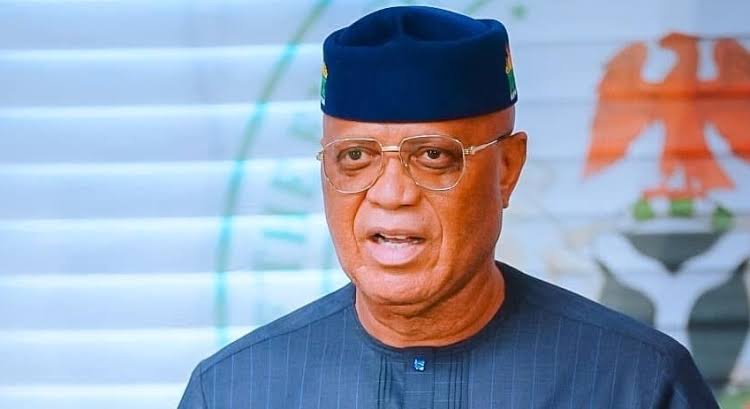
Fejiro Oliver
Twenty seven. That is the number of Akwa Ibom State parastatals, boards and companies that never submitted financial statements for audit in 2025, some with no audited account since they were created, and the list includes the state’s flagship airline, Ibom Air, which the Auditor-General records as having “no report from inception.”
The figure sits in item 72 of the 160-page Report of the Auditor-General on the Accounts of Akwa Ibom State for the year ended 31 December 2025, signed by Isaiah R. Ntekim. Alongside Ibom Air, the defaulters include Anchor Insurance Company, Dakkada Global Oil Palm, the Ibom Icon hotel, Tropicana Mall, Akwa Ibom Power Company, Akwa Ibom State University with accounts outstanding from 2022 to 2025, the state television and radio corporations with accounts outstanding from 2022 to 2025, and Greenwall Technologies. The 1999 Constitution, in section 125, makes the audit of public accounts a constitutional duty, and the state’s audit law requires parastatals to render their accounts yearly. Twenty seven entities ignored it, and the 2025 audit closed without their books.
The same report carries what the auditors did find when they looked. At the Ministry of Trade and Investment, the bank statement showed N5.525 million received from the World Bank NG-CARES Programme in 2025. The money was not recorded in the cash book. No payment vouchers and no supporting documents were produced for audit inspection. The report’s words are blunt: the amount “was transferred out to an individual account without evidence of authorization thus violating Financial Regulation Nos. 601 and 602.” Those regulations govern the custody and disbursement of public money, and moving programme funds into a private pocket breaks both.
The farm loans are worse. The Agricultural Loans Board disbursed N80.6 million in interest-free loans to 806 dry-season farmers. Only N2.45 million was ever recovered, leaving N78.48 million unrecovered, and the scheme’s account sat in Heritage Bank, a bank that no longer exists. Public money meant for farmers in 2025, and in the years before it, is sitting in a dead bank with no recovery plan on record.
The Ministry of Special Duties and Ibom Deep Seaport paid N8.4 million in cash to contractors in 2025 instead of by cheque or bank transfer, an irregularity the Financial Regulations expressly forbid because cash payments to contractors defeat the audit trail. The same ministry carried doubtful diesel supply payments of N4.62 million that audit could not verify. At the High Court of Justice, Abak, court deposits of N3.74 million collected for third-party beneficiaries in 2025 were not refunded to the beneficiaries but lodged in a savings account with Akwa Savings and Loans Limited. Court deposits are money held in trust, not government revenue, and diverting them into a savings account breaches the Financial Regulations on the handling of deposits. Another N4.33 million in High Court deposits in Uyo is stuck in the defunct Heritage Bank.
The payroll findings read like a register that nobody supervises. The Hospitals Management Board paid N9.93 million in salaries in 2025 to five staff on overseas studies who were never granted permission to study abroad but kept drawing pay. The Ministry of Health paid N3.39 million in salaries to retired staff still sitting on the payroll in 2025. At the College of Education, Afaha Nsit, auditors found unexplained other reserves of N20.2 million unchanged in the records for over six years, a loan liability of N82.17 million unattended for over six years, and a N30 million “unstructured convocation loan.”
Ibom Mortgage Bank, the state’s own mortgage institution, had not met the N5 billion minimum share capital requirement as of 2025, carried an unremitted NDIC premium of N55.1 million, unremitted VAT, PAYE and withholding tax of about N41.6 million, and a cash reserve ratio of 0.1 percent against the Central Bank of Nigeria’s 2.0 percent. Two Toyota Hilux pick-up vans at the Ministry of Lands and Town Planning could not be physically verified in 2025, which is to say government vehicles went missing.
Then there is the anomaly the statements confirm but cannot explain. The Ministry of Budget and Economic Planning recorded salaries of N35.48 billion in 2025 against N199 million in 2024, a figure confirmed in the SABER programme annexure, with no explanation anywhere in the accounts.
Perhaps the most damning passage of the 2025 report is the Auditor-General’s confession about his own office. He writes that the audit scope “was limited as a result of inadequate funding of audit activities” and that revenue and payroll audits “were not carried out during the year.” The state’s Financial Regulations, the rulebook meant to govern all of this, were last revised in 2003, twenty three years ago.
Governor Umo Eno’s Auditor-General still signed an unqualified opinion on the 2025 accounts, with the caveat that full IPSAS compliance cannot be claimed. The opinion says the statements show a true and fair view. The report beneath it says twenty seven parastatals filed nothing, World Bank money entered a private account, farmers’ loans died in a dead bank, and the auditor himself did not have the funding to finish the job.
Source: …Secretsreporters