
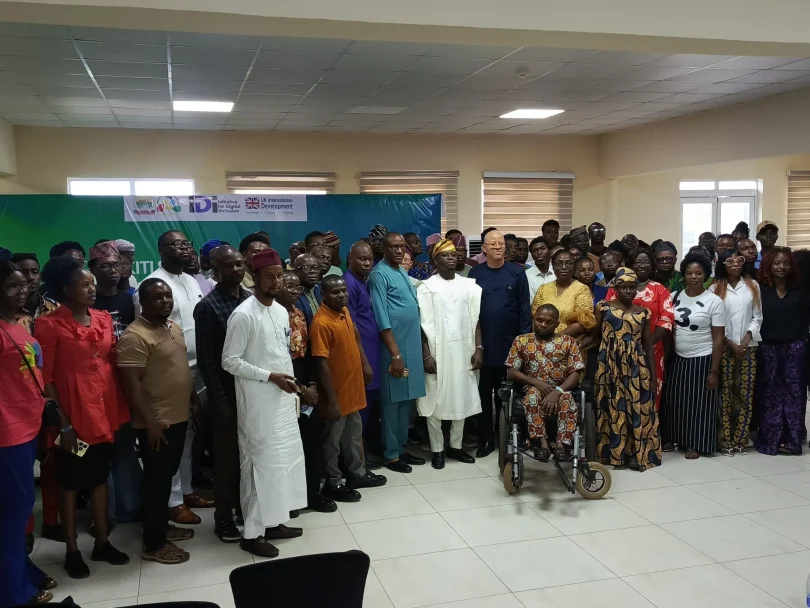
The United Kingdom Government has partnered with the Ekiti State Government to accelerate digital transformation in the state through policy, regulatory and institutional reforms aimed at strengthening the digital economy and expanding access to technology-driven opportunities.
Part of the partnership was unveiled at a stakeholders’ engagement forum held in Ado-Ekiti on the Digital Policy, Regulatory and Institutional Reforms Project. The forum was organised by the Ekiti State Ministry of Innovation, Science and Digital Economy in collaboration with the Initiative for Digital Inclusion (IDI), with support from the UK Foreign, Commonwealth and Development Office (FCDO).
The engagement brought together government officials, private sector operators, civil society organisations, development partners, academics and players in the technology ecosystem to deliberate on reforms required to build a more inclusive and digitally empowered Ekiti.
Speaking at the event, the Commissioner for Innovation, Science and Digital Economy, Seun Fakuade, said the partnership reflected the state government’s determination to translate Ekiti’s high educational attainment and intellectual capital into innovation, enterprise development, employment and wealth creation.
ALSO READ: Nigeria risks communal instability over insecurity, don warns
Fakuade said the administration of Governor Biodun Oyebanji had prioritised future-of-work skills, digital infrastructure and an enabling environment for young people and businesses to thrive in the state.
He said the state had established a public-sector-led Startup Garage equipped with digital innovation tools, robotics kits and 3D printers, while work was ongoing on a larger 1,200-seater facility expected to provide advanced infrastructure for young innovators, entrepreneurs and startups.
According to him, Ekiti is also home to a Digital Innovation City approved by the Federal Executive Council, with the broader vision of creating a pipeline through which young people can acquire digital skills from primary school to university and ultimately develop businesses.
The commissioner noted that the state had benefited significantly from its partnership with the UK Government, recalling the Young Innovators Programme through which six Ekiti youths received support, with some beneficiaries already pursuing advanced opportunities at home and abroad.
He said the state would continue to pursue partnerships capable of strengthening its innovation ecosystem, adding that the government was committed to ensuring that young people trained in Ekiti could compete favourably with their counterparts anywhere in the world without having to leave the state in search of opportunities.
Representing the UK FCDO and the UK Government’s Digital Access Programme, Osondu Nwokoro of the Initiative for Digital Inclusion (IDI) said the initiative marked an important milestone in efforts to accelerate digital transformation in Ekiti.
Nwokoro said the event was designed not merely as a consultation but as a co-creation process through which stakeholders would help shape practical reforms across six critical areas: digital infrastructure and access, digital economy strategy, civic technology, digital public infrastructure, connectivity reform, and digital literacy and skills development.
He said the project would produce a digital economy diagnostic, digital economy strategy and implementation framework, civic technology strategy, roadmap for digital public infrastructure, connectivity reform framework, and a digital literacy and skills development strategy.
He added that hundreds of public officials, educators and other stakeholders would also receive capacity-building support to strengthen the state’s ability to sustain the reforms beyond the lifespan of the project.
Nwokoro said the initiative was part of the UK’s broader digital partnership with Nigeria, aimed at expanding meaningful digital access, strengthening digital resilience and cybersecurity, supporting innovation and entrepreneurship, and creating trusted digital ecosystems that promote inclusive economic growth.
He commended the Ekiti Government, particularly the Ministry of Innovation, Science and Digital Economy, for demonstrating strong ownership of the reform agenda and creating an enabling environment for collaboration.
The stakeholders were urged to engage openly and critically during the discussions, with Fakuade stressing that their contributions would help identify gaps, priorities and interventions needed to build a stronger digital ecosystem in Ekiti.
The commissioner said the success of the initiative would ultimately depend on translating the recommendations into practical actions capable of improving public services, creating jobs, supporting businesses and ensuring that the benefits of digital transformation reach citizens across the state.