
*Says INEC Partners Microsoft, Google, IFES To Strengthen Tech Capacity
The Chairman of the Independent National Electoral Commission (INEC), Prof Joash Ojo Amupitan, SAN, has said the success of Artificial Intelligence (AI) in elections will depend more on strong institutions and effective governance than on the sophistication of the technology itself.
The INEC chairman stated this on Thursday, September 10, 2026, while delivering Nigeria’s presentation at the Global Conference on Responsible AI and Elections in Ottawa, Canada. He was accompanied by the Commission’s Director of Information and Communication Technology (ICT), Dr Lawrence Bayode.
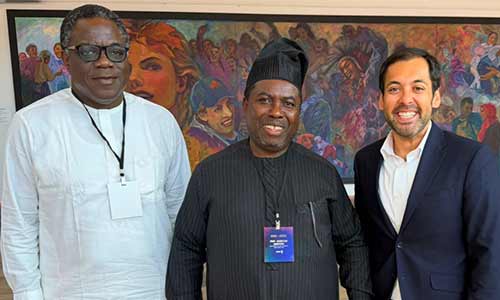
On the sidelines of the same three-day conference, which held from September 9 to 11, 2026, the chairman held a series of strategic engagements with Microsoft, Google and the International Foundation for Electoral Systems (IFES) as part of efforts to strengthen the Commission’s technological capacity ahead of the 2027 general elections.
Amupitan said the increasing use of algorithms and data in democratic processes had made responsible innovation a major consideration for election management bodies.
According to him, Nigeria has progressively deployed technology to improve the credibility, efficiency and transparency of its elections, citing the Bimodal Voter Accreditation System (BVAS), the INEC Result Viewing Portal (IReV) and the Automated Biometric Identification System (ABIS).
He said the technologies were introduced to reduce human error and limit manual interference in the electoral process.
The chairman noted that the sheer scale of elections in Nigeria made technology indispensable, disclosing that the country has more than 93 million registered voters, about 180,000 polling units and approximately 185,000 BVAS devices deployed across the 36 states and the Federal Capital Territory.
“AI must strengthen electoral integrity, improve public service, and always remain under human control,” he said.
He cautioned that the adoption of AI should not be driven by technology for its own sake, but by its ability to deliver measurable improvements in election administration, service delivery and public confidence.
Amupitan outlined the legal architecture within which technology is deployed in Nigeria’s elections, listing the 1999 Constitution, the Electoral Act 2026, INEC regulations, the Nigeria Data Protection Act 2023 and the Cybercrimes Act 2024.
He said the Electoral Act 2026 provides for the voters’ register, electronic voting devices, biometric accreditation, electronic transmission of results, as well as the use of accredited and transmitted data in the collation and declaration of results.
On the Commission’s state of preparation, the chairman said INEC had already commenced institutional measures, including the development of an AI Roadmap for phased adoption and an AI Governance Framework currently undergoing internal approval.
“Responsible AI begins with institutional readiness — not technology,” he said.
“Responsible AI begins with institutional readiness — not technology,” he said.
Amupitan listed five principles guiding the Commission’s AI initiatives as human oversight; transparency and accountability; data protection and privacy; cybersecurity and risk management; and operational value and public trust.
He stressed that AI would remain a support tool for election officials and would not replace human decision-making.
Giving a practical example of current deployment, the chairman said INEC had introduced an intelligent Results Management process through which polling unit result forms are digitised, data extracted from scanned Form EC8A, and the figures compared with BVAS entries.
According to him, discrepancies are automatically flagged for review by officials before publication.
“The system does not alter results. It assists officials by identifying issues that require human attention,” he explained.