
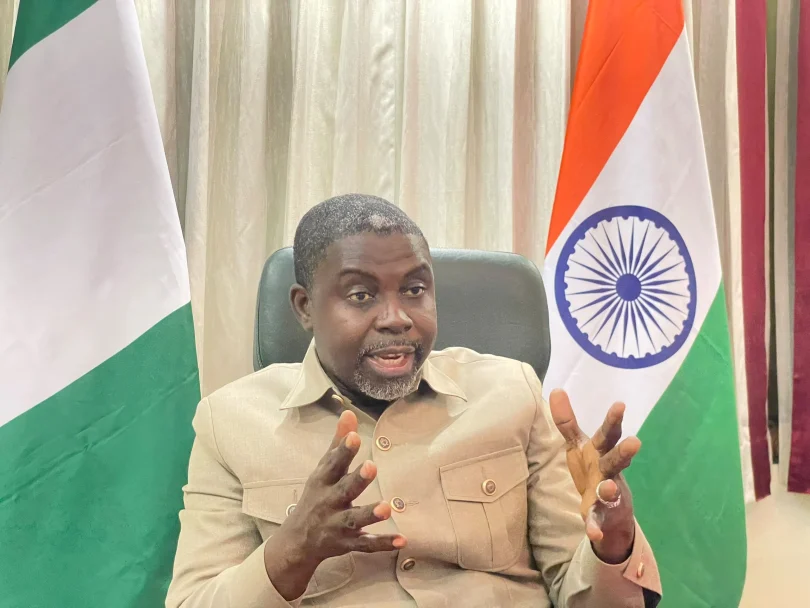
Nigeria is targeting a rebound in bilateral trade with India to about $27 billion by 2027, the High Commissioner to India, Ambassador Saidu Dahiru Muhammad, has said.
Muhammad disclosed this in New Delhi during an interactive session with diplomatic correspondents covering the 2026 BRICS Summit, saying the Nigerian mission was working to deepen economic relations with India and attract investments into key sectors of the Nigerian economy.
According to him, trade between Nigeria and India stood at about $27 billion in 2022-23 before declining to approximately $14.95 billion in 2024-25.
The envoy attributed the decline to several factors, including the absence of a substantive Nigerian head of mission in India for a period, global economic uncertainties and geopolitical tensions.
He, however, said commercial activities had started to recover, with current trade figures put at between $8.7 billion and $8.9 billion.
“Trade has started picking up again. We are seeing figures between $8.7 billion and $8.9 billion, and we are optimistic that we can return to previous levels by the end of 2027,” Muhammad said.
He said the mission was prioritising trade and investment promotion as part of efforts to strengthen Nigeria-India relations, urging Nigerian businesses to explore opportunities in India’s rapidly expanding technology ecosystem.
Muhammad identified agri-tech, health-tech, pharmaceutical technology and mining technology as areas with significant opportunities for Nigerian investors.
He also listed renewable energy, manufacturing, healthcare, pharmaceuticals, the circular economy and the creative industry as sectors with strong potential for expanded bilateral cooperation.
“There are enormous opportunities for Nigeria to leverage India’s technological expertise and manufacturing capacity for our economic development and industrial growth,” he said.
The High Commissioner specifically called for stronger partnerships between Nigerian and Indian healthcare institutions, urging Indian investors to establish medical facilities in Nigeria.
He said such investments would help reduce the pressure of medical tourism by providing Nigerians with access to quality healthcare services at home while also creating opportunities to serve patients from other African countries.
Muhammad said the Nigerian High Commission would work closely with the Nigerians in Diaspora Commission (NiDCOM), Economic and Financial Crimes Commission (EFCC), Nigerian Investment Promotion Commission (NIPC) and other government agencies to strengthen information sharing, diaspora engagement and service delivery.
“We intend to work closely with agencies such as NiDCOM, the EFCC, NIPC and other relevant institutions to improve information sharing and service delivery,” he said.
The envoy said the mission was also intensifying efforts to engage Nigerians living in India, particularly students, business people and those travelling for medical purposes.
He disclosed that the High Commission was upgrading its website and social media platforms, including LinkedIn, Instagram, Facebook and X, to provide Nigerians with timely information on travelling, studying and doing business in India.
According to him, the upgraded platforms would provide practical guidance on Indian laws, immigration requirements, cultural expectations and other issues relevant to Nigerians travelling to the country.
Muhammad further disclosed plans to engage universities across India to improve the monitoring and welfare of Nigerian students from matriculation to graduation.
“We want to engage with students from the point of matriculation to graduation, stressing the importance of complying with visa conditions and remaining focused on their studies,” he said.
He said the mission was compiling a database of universities attended by Nigerians and would provide prospective students with information on legitimate institutions.
The High Commissioner also urged Nigerians resident in India to comply with local laws and immigration regulations, warning that non-compliance could expose them to legal and security challenges.
“Every time they have access to us, we hammer on the need to abide by the rules. Compliance with the rules will help them avoid legal and security challenges,” he said.
He added that the mission was encouraging Nigerians who had experienced difficulties in India to share their experiences with prospective travellers and students to help others avoid similar challenges.
Muhammad said closer cooperation between the Nigerian and Indian diplomatic missions was also facilitating information exchange on Nigerians travelling to India for education, healthcare and business.
“We are using that synergy to let Nigerians know when they come. They think we don’t know, but we already know they are here,” he said.