
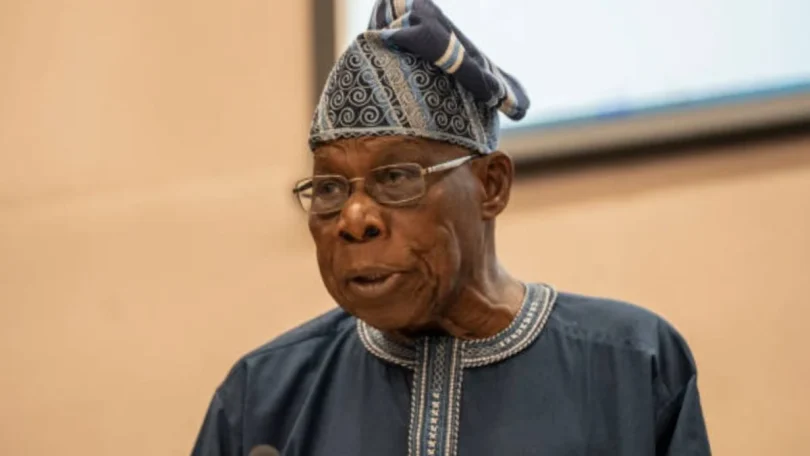
Former President Olusegun Obasanjo has said Nigeria has no reason to remain poor.
According to the former Nigerian leader, the country has enough natural and human resources to produce what its people need and build a prosperous economy.
Obasanjo blamed part of Nigeria’s economic difficulties on policies that encourage the importation of goods that could be produced locally, saying such practices discourage farmers and other domestic producers.
The former president spoke during an interview on C-Suite Cafe, hosted by Ikem Okuhu, where he questioned why a country blessed with vast land, water, rainfall and a large population should struggle with poverty.
“Give me one reason why Nigeria should be poor. Is it the land that we don’t have or the desert that we are in or the people that we don’t have or the water that we don’t have or the rain that we don’t have?” he asked.
Obasanjo said Nigeria’s agricultural potential should be treated as a major economic asset rather than allowing the country to depend heavily on foreign products.
He recalled his experience as chairman of the African Union when he travelled to Guinea-Bissau alongside John Kufuor, who was then chairman of the Economic Community of West African States.
According to Obasanjo, the two leaders observed that Guinea-Bissau had fertile land and agricultural resources but still depended on imported food. He said they saw bananas and other fruits growing naturally as they approached the country, only to find imported apples and grapes being served at their hotel.
“That’s part of the reason why we are poor,” Obasanjo said.
He used the experience to highlight what he described as a wider problem across African countries, where local resources are sometimes left underdeveloped while governments and consumers rely on imported products.
Obasanjo also recalled Nigeria’s rice policy in 1979, saying restrictions on rice imports were introduced to encourage local farmers and move the country towards self-sufficiency.
He said agricultural officials had inspected rice farms before the military government left office and reported that Nigeria was making progress towards producing enough rice for domestic consumption.
However, according to the former president, subsequent administrations reversed the policy and opened the country to increased rice imports.
“When our successors came, one of the first things they did was to lift importation of rice, not to encourage production of rice but to encourage importation of rice, and the farmers couldn’t sell their own rice,” he said.
In August, the African Democratic Congress (ADC) rejected suggestions that the 2027 presidential election would be determined by former President Obasanjo or any other individual, insisting that Nigerians themselves would decide the outcome.
The opposition party made the statement while responding to attacks on its presidential candidate, Atiku Abubakar, and comments attributed to Obasanjo concerning the former vice president.
The ADC, through its National Publicity Secretary, Bolaji Abdullahi, accused the All Progressives Congress (APC) of using criticism of Atiku to divert attention from the performance of President Bola Tinubu’s administration.
“The African Democratic Congress (ADC) has observed the All Progressives Congress (APC)’s increasingly desperate obsession with our presidential candidate, Alhaji Atiku Abubakar,” Abdullahi said.
The party argued that Nigerians were more concerned about the rising cost of living, insecurity, unemployment and poverty than the personal opinions of political figures.
The ADC said Obasanjo was entitled to his views about Atiku but maintained that political opinions could not erase what it described as the economic record of the period when Atiku served as vice president and chairman of the National Economic Council.
“Former President Olusegun Obasanjo is entitled to his personal opinion of Alhaji Atiku Abubakar. Every Nigerian, including former presidents, enjoys that democratic right. But opinions do not erase records,” the party said.
The opposition party also challenged the Federal Government and the APC to explain why food prices and other basic necessities remained high despite claims of economic growth.
It questioned why more Nigerians were falling into poverty, why economic growth had not translated into enough jobs, why government borrowing had continued to increase and why debt servicing had taken up a large portion of government revenue.
The ADC also raised concerns about insecurity, particularly the continued activities of bandits, terrorists and kidnappers in parts of the country.
“It is time that the APC and their government took a break from attacking Atiku and the Bishops to answer a few important questions,” the party said.
The party maintained that these economic and security issues, rather than the views of individual politicians, would be central to the 2027 election.
“Ultimately, the election will not be decided by the opinion of any one individual. It will be decided by the lived experience of more than 200 million Nigerians who are poorer, more insecure, and more uncertain about their future than they were before the Tinubu administration took office,” the ADC said.