
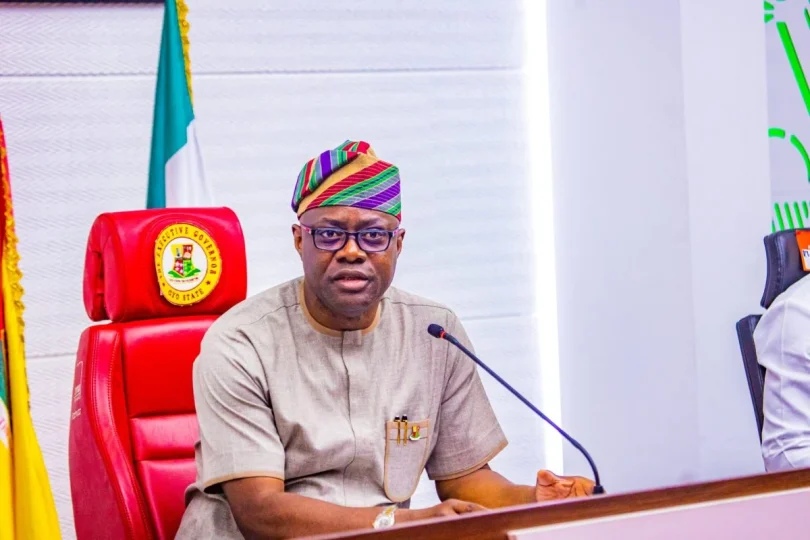
Oyo State Governor, ‘Seyi Makinde, has called for a fundamental review of Nigeria’s federal system, saying the country must strengthen its institutions and return to the principles of federalism to address its developmental challenges.
Makinde made the call in his Independence Day message marking Nigeria’s 66th anniversary, in which he reflected on the country’s journey since independence and questioned how effectively the federal structure inherited from the nation’s founding fathers had been preserved.
The governor said Independence Day should not only be a period for celebration but also an opportunity for Nigerians to examine the state of the country and consider the kind of nation being built for future generations.
He said, “Sixty-six years after independence, what kind of country have we built from what our founding fathers handed over to us?”
Makinde argued that nations would continue to face new challenges as generations changed, stressing that strong and resilient institutions were necessary to enable countries respond effectively to such challenges.
According to him, Nigeria must therefore protect and strengthen the federal system, while giving sub-national governments the authority and resources required to address issues within their jurisdictions.
He asked, “How well have we protected the system that was handed to us? When practically every important decision must wait for Abuja, are we functioning as effectively as a federation should?”
The governor said the current structure sometimes created situations where state governments had identified problems and possessed the willingness and capacity to address them, but lacked the necessary constitutional authority to act.
He said such limitations had direct consequences for security, infrastructure development, job creation, exploitation of natural resources and the growth of local economies.
“These are not abstract constitutional questions. These are questions that affect our security, how quickly infrastructure can be delivered, our ability to create jobs, develop our natural resources and grow local economies,” he said.
Makinde, who spoke from his experience as governor of Oyo State, said there had been instances where his administration knew what needed to be done but could not act fully because certain powers remained outside the control of the state.
“There have been times when we knew what needed to be done. We had the will to act. We had the capacity to act. Yet the structure of our federation meant that the authority to take certain decisions rested somewhere else,” he said.
He maintained that such an arrangement was not the most efficient way to govern a country with a population of over 200 million people.
The governor linked his argument to his proposed “Reset Nigeria” agenda, explaining that the idea was about identifying institutional weaknesses and making the changes necessary to improve governance.
“And this is why, when I speak about Reset Nigeria, I mean returning to the fundamentals, identifying what is no longer working and making the changes required to get the system working again,” he said.
Makinde also cautioned against measuring national progress solely through economic statistics, saying improved GDP growth, inflation figures, foreign reserves, government revenue and foreign investment must translate into better living conditions for Nigerians.
“I believe strongly in making decisions based on data, science and logic. But numbers must translate into something people can feel in their everyday lives,” he said.
He asked what economic growth would mean to Nigerians struggling to afford basic necessities, and what increased government revenue would mean to business owners unable to meet their operating costs.
“When governments speak about progress, Nigerians must be able to look at their own lives and say: Yes, I can see it. I can feel it. My life is better,” he said.
Looking ahead to the 2027 general elections, Makinde said the Reset Agenda would focus on measurable targets, with Nigerians expected to know what the proposed administration intended to achieve, how progress would be measured and what outcomes should be expected annually.
He said, “This is why the Reset Agenda will not simply tell Nigerians what we intend to do. We will tell you what we expect to achieve within three years, how we intend to measure progress and what you should expect to see each year.”
According to him, one term in office would be sufficient to undertake an institutional reset across key sectors.
The governor expressed confidence in Nigeria’s potential, saying the country could work if the right institutions were built and strengthened.
“I remain convinced that Nigeria can work. I believe that deeply,” he said.
“Nigeria will work when we build the institutions that make progress possible.”
Makinde concluded by saying his vision of resetting Nigeria was ultimately about creating a country in which government worked for all citizens.
“That is the Nigeria I believe in.
“That is the Nigeria worth fighting for.
“And that, for me, is what resetting Nigeria is ultimately about. Making Nigeria work for every Nigerian,” he said.