
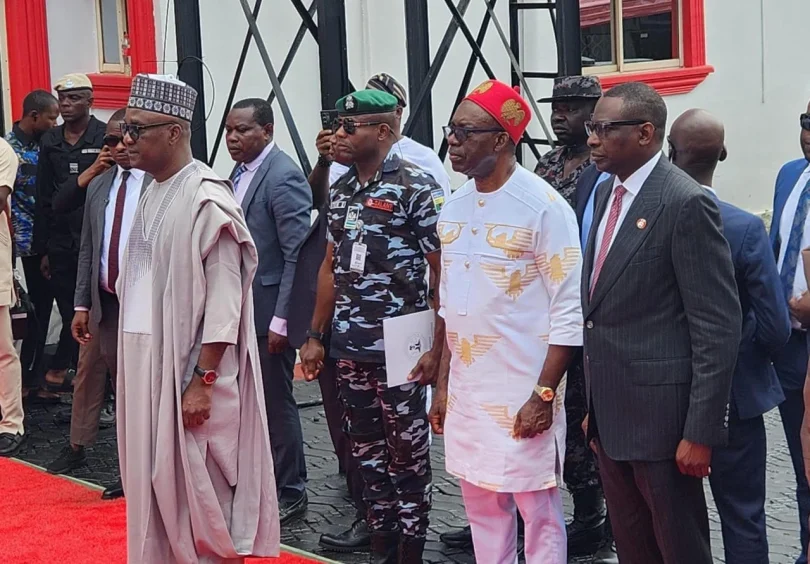
The anti-corruption agency, the Economic and Financial Crimes Commission (EFCC), has opened new zonal operational offices in Anambra and Imo states, a development the commission said would bring its fight against economic and financial crimes closer to businesses, government institutions and residents in the two states.
The EFCC Chairman, Olanipekun Olukoyede, who spoke at the opening ceremony on Friday, said the new facility would significantly strengthen the commission’s capacity to investigate and prosecute financial crimes while providing greater access to justice and accountability across Anambra and Imo.
He said the Awka office was not merely an expansion of the commission’s geographical presence, but a deliberate effort to protect legitimate economic activities and foster closer collaboration with governments, businesses and citizens in the two states.
Olukoyede noted that the creation of the Awka Directorate, alongside recent expansions in Ekiti and Katsina states, aimed to broaden the commission’s institutional presence, expand access to justice and protect legitimate economic activities.
He stated that the EFCC was expanding its focus towards prevention by, among other things, monitoring Federation Account Allocation Committee (FAAC) releases to safeguard public funds before theft occurred. He also called on communities to make whistleblowing a norm and maintain a conscious watch over financial transactions.
Reassuring citizens that EFCC officers were deployed strictly to enforce the law within its legal limits and not to oppress the public, the EFCC boss revealed that the new Awka Zonal Directorate was expected to significantly boost intelligence gathering, accelerate financial crime prosecutions, safeguard public revenues and strengthen investor confidence across Anambra and Imo states and the wider South-East region.
The event attracted the Speaker of the House of Representatives, Tajudeen Abbas, who represented President Bola Tinubu; Anambra State Governor, Prof. Chukwuma Soludo; Imo State Governor, Hope Uzodimma; prominent members of the National Assembly; traditional rulers from Anambra and Imo; captains of industry; and other stakeholders.
The state governor, Prof. Chukwuma Charles Soludo, declared that the fight against corruption and financial crimes must be seen as a collective responsibility, stressing that no society could progress under the weight of economic perversion.
Soludo expressed excitement at hosting the anti-graft agency’s new operational hub and commended the EFCC for decentralising its functions to the grassroots, recalling a personal experience from his time after leaving office as Central Bank Governor.
He said: “We are excited to host this EFCC office in Awka. You are beginning to drill down the function of fighting crime to the grassroots. Fighting crime is everybody’s business, and the work of the EFCC is pivotal for our national development.
“In a society with pervasive economic and financial crimes, there can be no forwardness—it is the foundation.
“Nobody who earns legitimate money throws it around; unfortunately, the young ones want to behave like that without earning any income. All Nigerians, including Anambra, strongly support the EFCC. On one occasion, I was given one month’s notice of invitation by the EFCC during its investigation of the Minting Company. I honoured the invitation and followed through with the investigation until it was eventually concluded. People deserve to know the end of every investigation, and we will help you produce results for our people.”
The commissioning was performed on behalf of President Bola Ahmed Tinubu by the Speaker of the House of Representatives, Rt. Hon. Tajudeen Abbas, who reaffirmed the Federal Government’s commitment under the Renewed Hope Agenda to providing the necessary environment for anti-corruption agencies to thrive.
The Imo State Governor, Senator Hope Uzodimma, expressed gratitude to President Tinubu for expanding the financial room for sub-nationals. He praised the decentralisation of EFCC operations and noted that the agency’s modern operational approach now reflected a commendable human face.
Senator Emmanuel Udende, Chairman of the Senate Committee on Financial Crimes, and Hon. Ginger Obinna Onwusibe, Chairman of the House Committee on Financial Crimes, reiterated full legislative backing for the commission’s operations.
Igwe Chidubem Iweka, Chairman of the Anambra State Traditional Rulers’ Council, advocated long-term preventive measures, including integrating anti-corruption courses into primary school curricula and administering traditional oaths of office for public officials.