
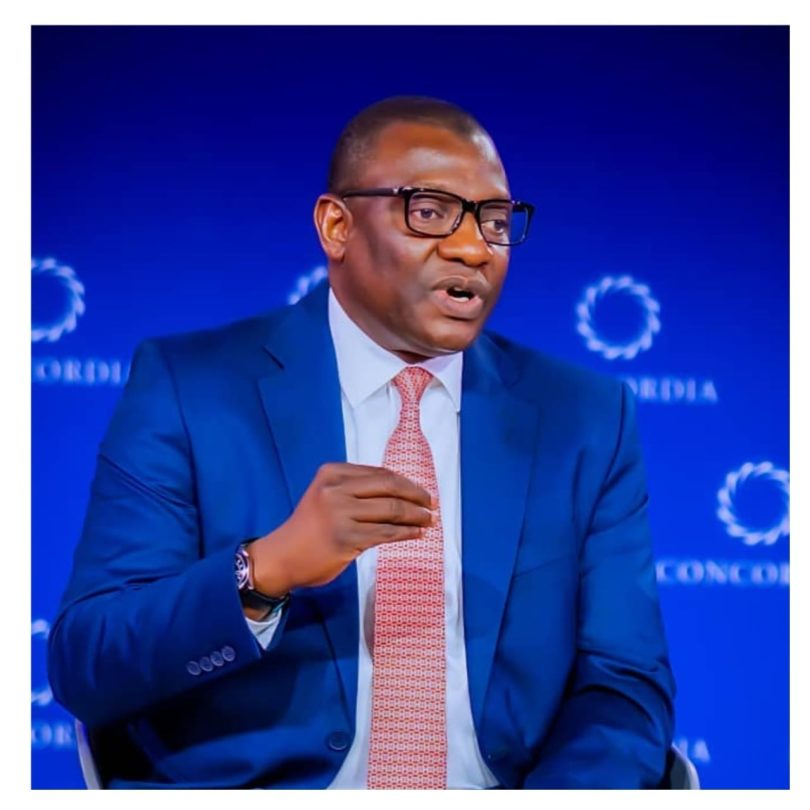
Chief Executive Officer of the World Energy Council Nigeria, Bala Wunti, has warned African countries against repeating the economic model that saw the continent export crude oil while importing refined petroleum products.
Wunti said the same mistake must not be repeated with lithium, cobalt, graphite and rare earth elements as demand for critical minerals grows globally.
He spoke at the 2026 Concordia Annual Summit in New York during a panel discussion titled “Rare Currency: Critical Minerals in a Shifting Global Economy.”
According to Wunti, Africa should move beyond exporting raw minerals and focus on processing, manufacturing and other forms of local value addition.
“Exporting crude oil and importing refined petroleum products created poverty, not prosperity. That model must not be repeated with lithium, cobalt and rare earth elements,” he said.
He argued that Africa’s opportunity lies in developing processing capacity, attracting investment and creating jobs through industrialisation rather than exporting the economic benefits of its mineral resources.
“Africa must not remain merely a source of raw materials. It must become a processing partner,” Wunti said.
‘The World Invests in Projects, Not Potential’
Addressing why Nigeria has yet to fully develop its identified critical minerals, Wunti said the country must bridge the gap between having mineral resources and developing commercially viable projects.
“Having minerals in the ground is only the beginning,” he said, noting that investors require reliable geological data, clearly defined projects and commercially credible opportunities.
He identified six key requirements for attracting investment into the sector: reliable geological data, clearly defined projects, enabling infrastructure, predictable regulation, credible developers and viable routes to market.
Wunti also described the Nigerian Solid Minerals Company as a flagship platform for transforming Nigeria’s mineral resources into commercially structured investment opportunities.
He said the focus should shift from simply announcing the existence of mineral deposits to presenting investors with bankable projects and clear commercial propositions.
Africa Needs Value Addition
Wunti said temporary exports of mineral concentrates could be commercially necessary in some circumstances but cautioned against making the permanent export of raw minerals the foundation of Africa’s critical-minerals strategy.
He maintained that processing facilities, factories and related industries should increasingly be developed on the continent to generate employment and retain more value locally.
He also urged governments to address challenges that investors cannot resolve on their own, including inadequate geological information, weak infrastructure, unpredictable regulation and inefficient permitting systems.
According to him, governments can improve the bankability of projects but cannot permanently make commercially unviable ventures profitable.
Wunti said investors ultimately require competitive economics, credible buyers, stable fiscal policies and reliable geological data.
‘Resilience, Not Isolation, Is the Goal’
The energy expert further called for stronger international partnerships in the critical-minerals sector, arguing that countries should pursue supply-chain resilience without seeking complete economic isolation.
“Pursue self sufficiency, but do not pursue isolation. Complete independence is an illusion. Resilience is the goal,” he said.
Wunti said a sustainable model would combine international technology and capital with Africa’s mineral resources, processing capacity and human talent.
He argued that such an approach could help the continent move from simply extracting resources to participating more substantially in the global critical-minerals value chain.