
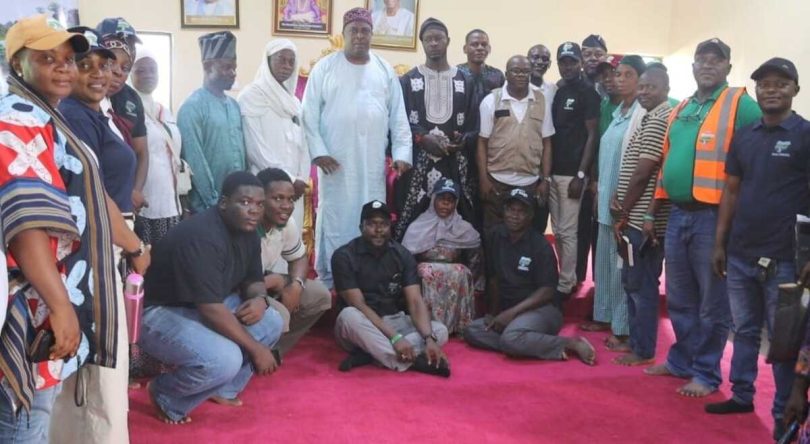
The Kwara State Agro-Climatic Resilience in Semi-Arid Landscapes (KWACReSAL) Project has partnered with the International Institute of Tropical Agriculture (IITA) on climate-smart agriculture through a stakeholders’ engagement in Ijagbo, Oyun Local Government Area of the state.
The intervention has commenced with the formation of Community Interest Groups (CIGs) for the implementation of Climate-Smart Agriculture (CSA) and Farmer-Led Irrigation Development (FLID) interventions.
Leading the KWACReSAL delegation to the community, the State Project Coordinator, Alhaji Shamsideen Olatunbosun Aregbe, described Ijagbo as one of the pilot communities selected for the intervention under the ACReSAL-IITA collaboration, aimed at strengthening farmers’ resilience to climate change through sustainable agricultural practices.
The State Project Coordinator said the engagement marked another milestone in the partnership between ACReSAL and IITA to promote sustainable agriculture through demonstration plots, farmer capacity-building and the introduction of innovative climate-smart technologies that would improve productivity while conserving natural resources.
According to him, the intervention was designed to build agro-climatic resilience by equipping farmers, women, youths and other vulnerable groups with practical knowledge of climate-smart farming, as well as efficient water management and farmer-led irrigation systems that would improve food security and livelihoods.
He also said that CIGs would serve as the foundation for implementing the interventions, ensuring active participation in demonstrations, capacity-building programmes and the adoption of improved technologies.
He added that about 300 farmers in the pilot community would benefit from specialised training, demonstration-based learning and free climate-smart seeds for priority crops such as maize, sorghum, cowpea and soybean.
Aregbe noted that the training would be facilitated by experts from Ahmadu Bello University (ABU), Zaria, and other research institutions under the coordination of IITA.
The State Project Coordinator commended the continued support of the World Bank, the Federal Project Management Unit (FPMU) and the Kwara State Government, under the leadership of Governor AbdulRahman AbdulRazaq, for creating an enabling environment for the successful implementation of the programme.
He urged community members to embrace the initiative and ensure that the knowledge and technologies acquired were replicated across neighbouring communities.
In his remarks, the Onijagbo of Ijagbo, His Royal Majesty Oba Sharafudeen Adeniyi Buhari Babalola I, pledged the full support of the traditional institution and the people of Ijagbo towards the successful implementation of the intervention.
The monarch expressed profound appreciation to the World Bank, the Federal Project Management Unit (FPMU), the Kwara State Government and the KWACReSAL Project for selecting Ijagbo as one of the pilot communities, describing the initiative as timely and capable of transforming agricultural production, increasing crop yields and improving the livelihoods of farmers.
Oba Babalola commended the efforts of the State Project Coordinator and the entire KWACReSAL team for bringing the programme to the grassroots and urged farmers, community leaders and residents to actively support the initiative to enable the Federal Government and its development partners to achieve the objectives of strengthening agricultural resilience and improving rural livelihoods.
Also speaking, the Agricultural Officer of KWACReSAL, Mrs Khadijat Oke, sensitised community members on the formation of Community Interest Groups (CIGs), explaining that beneficiaries would be organised into groups based on the project’s focus areas to ensure effective coordination, specialised training and practical demonstrations.
She noted that each group would have clearly defined leadership and responsibilities to promote inclusiveness, accountability and active participation throughout the implementation process. She encouraged farmers, women and youths to fully participate in the training and demonstration exercises, assuring them that the climate-smart technologies would enhance productivity and strengthen resilience to climate change.
The stakeholders’ engagement was attended by members of the FoNGO team, directors and officials from the Kwara State Ministries of Environment and Water Resources, representatives of other relevant government agencies, local government officials, traditional and community leaders, as well as members of the KWACReSAL Project team, all of whom reaffirmed their commitment to the successful implementation of the ACReSAL-IITA Climate-Smart Agriculture and Farmer-Led Irrigation Development initiative in Ijagbo.