
The Kogi State Government has restated its prohibition of cash collection and roadside roadblocks for revenue generation, as it unveiled a new framework for the collection of daily ticketing across the state.
The government also announced Solution Network Consults as the new consultant saddled with the management of Daily Ticketing, formerly known as the Infrastructure Maintenance Levy (IML).
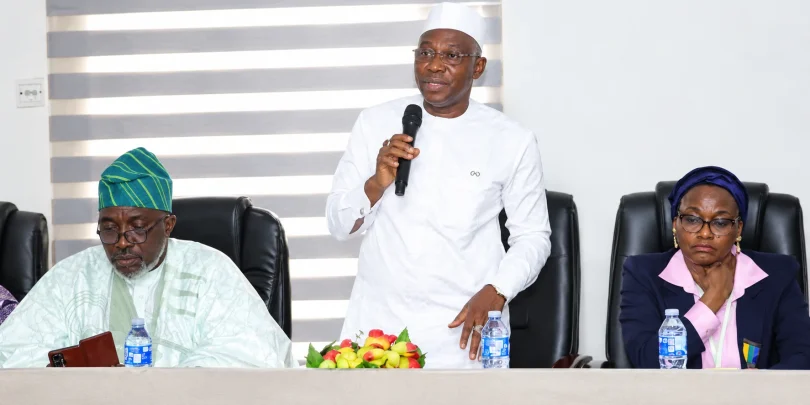
The development was announced at a stakeholders’ engagement organised by the Kogi State Internal Revenue Service (KGIRS) at its corporate headquarters in Lokoja.
The meeting brought together the Executive Chairman of KGIRS, Dr. Sule Salihu Enehe; Special Adviser to the Governor on Internally Generated Revenue (IGR), Dr. Rahman Nasir Ichanyi; directors of KGIRS; representatives of Solution Network Consults led by its Chief Executive Officer, Chief Yomi Charles, and Chief Richard Asaje, as well as leaders of transport unions, including the NURTW, Okada Riders Association and Tricycle Owners Association.
Speaking at the event, Dr. Enehe said the engagement was designed to introduce the new consultant to stakeholders and establish a common understanding on the collection process, rates and responsibilities of all parties.
He recalled that the state had, about two years ago, stopped transport unions from collecting revenue on roads, stressing that Governor Ahmed Usman Ododo had consistently advocated a peaceful, inclusive and transparent approach to revenue administration.
According to him, rather than completely shutting unions out of the revenue system, the state government opted for an arrangement under which a percentage of legitimate revenue accruing to the state would be shared with the unions to support their operations.
Dr. Enehe disclosed that the contract of the former consultant had expired, following which a competitive bidding process was conducted, with Solution Network Consults emerging as the successful bidder
He warned that cash collection and the erection of roadblocks for revenue purposes were now offences under the law, adding that plans were being concluded by the Federal Government for a national task force to clamp down on offenders.
The KGIRS boss further disclosed that the relevant tax legislation was domesticated in Kogi State on December 31, 2025, making it the fourth state in Nigeria to do so.
He said KGIRS had also introduced an automated tracking system capable of monitoring revenue collection in real time.
“With the automated system, you can buy your ticket for the whole month. Even if you give cash to an agent on the road, that cash cannot be diverted again because I will see it on my dashboard,” he explained.
Dr. Enehe appealed to stakeholders to approach the review of rates with an open mind, noting that inflation and the rising cost of goods and services had affected the cost of running government and businesses.
He urged the unions and other stakeholders to embrace dialogue, saying the ultimate objective was to create a system that would benefit both the government and the people.
Also speaking, Dr. Ichanyi commended KGIRS for organising the stakeholders’ engagement and stressed the importance of fairness, transparency and convenience in revenue collection.
He identified transparency, elimination of multiple taxation, technology, stakeholder cooperation and accountability as key principles that must guide the new Daily Ticketing regime.
The Special Adviser called for wider sensitisation of taxpayers and transport operators on approved rates, grassroots enlightenment to discourage unauthorised collections, and a functional feedback mechanism for reporting abuses.
Earlier, the Director of Income Tax, Mr Emmanuel Yusufu, clarified that the Infrastructure Maintenance Levy remained essentially unchanged under the tax reform, except for its reclassification and change of name to Daily Ticketing.
He explained that KGIRS had spent about four months reviewing the transition process before selecting Solution Network Consults through an evaluation and competitive bidding exercise.
Responding on behalf of the new consultant, Chief Yomi Charles, supported by Chief Richard Asaje, expressed appreciation to KGIRS and the transport unions for their cooperation.
He pledged that the company would deploy its expertise to improve revenue collection while ensuring that taxpayers and transport operators were not subjected to unnecessary harassment.
The engagement later proceeded into an interactive session, during which leaders of the various transport unions raised concerns over rates, welfare and implementation.
Responding to the issues, Dr. Enehe assured the stakeholders that existing agreements would be respected and improved where necessary, stressing that the objective was to build a transparent, technology-driven and taxpayer-friendly revenue system capable of supporting infrastructure development and public services in Kogi State.