
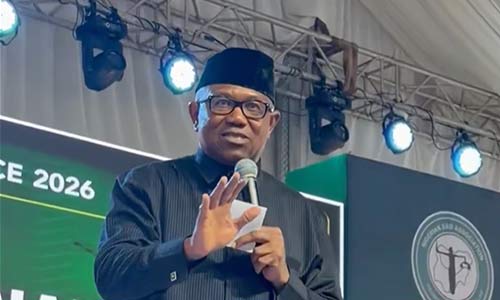
The presidential candidate of the Nigeria Democratic Congress, Peter Obi, has said he continues to support the removal of fuel subsidy, and that the mismanagement of the proceeds is not a reason to reverse the policy.
Obi spoke on Monday at the 66th Annual General Conference of the Nigerian Bar Association in Port Harcourt, in remarks that place him at odds with the presidential candidate of the African Democratic Congress, Atiku Abubakar, who recently pledged to restore the subsidy if elected in 2027.
The former Anambra State governor set out his position plainly.
“I subscribe and I maintain that you need to remove subsidy. Mismanagement of the proceeds should not be the reason for not removing it,” he said.
He said the fault lay in what followed the removal rather than in the decision itself. “What we should have done is that when we removed the subsidy, we would have given the people alternative usage for the subsidy. What we have today is that that removal and the attendant resources being recovered is also being mismanaged and stolen. For example, we have received, according to them, N16 trillion.”
He said his own leadership blueprint provided for removal in an organised manner, with the recovered proceeds properly invested.
Obi then worked through what he said the savings could have purchased, beginning with health.
“The number one thing a nation needs to develop is health. But today our health is very poor, our primary care is very poor. Where we are now, we have more maternal and child issues than countries like India,” he said.
He put a figure to it. “Assuming, let me use five per cent. You said they saved N15.8 trillion, so call it about N16 trillion. So five per cent of that is just about N800 billion.”
He applied it to primary care. “If you decide today our biggest problem is the issue of primary healthcare, and you decide to put primary care in each ward, just each ward, today it will cost you, from my own studies, an average of N100 million for one. We have 8,809 wards. Call it 10,000. I use N100 million for each. It will cost you N800 billion.”
He turned next to renal care.
“If you decide today, we have an issue now with kidney dialysis. We have over 25 million Nigerians with kidney issues,” he said.
He set out the arithmetic. “To build a kidney centre, you need N200 million. And we need about 1,000 centres when we have less than 200. We need about 5,000 machines when we have less than 800. It costs you N200 million to do a centre, and it costs you exactly N10 million to buy one machine.”
Obi said the alternative to spending was saving, and that the country had forgone both.
Obi said the alternative to spending was saving, and that the country had forgone both.
“If they had saved the money and decided to do like any other country, we would have had $10 billion added to our sovereign wealth fund,” he said, adding that such a fund would generate returns available for public purposes.
He rejected the argument that misuse of the savings justifies restoring the subsidy, and turned it instead into a charge against those in office.
“So don’t say because people used the money they were supposed to utilise very well for party, and you say, no, we should bring back,” he said.
He added: “What I have said is that people in government have asked Nigerians to fast. They cannot be feasting when Nigerians are fasting.”
Put to him that the government has rolled out several health programmes, including health guards and free cancer treatment, Obi disputed the claim.