
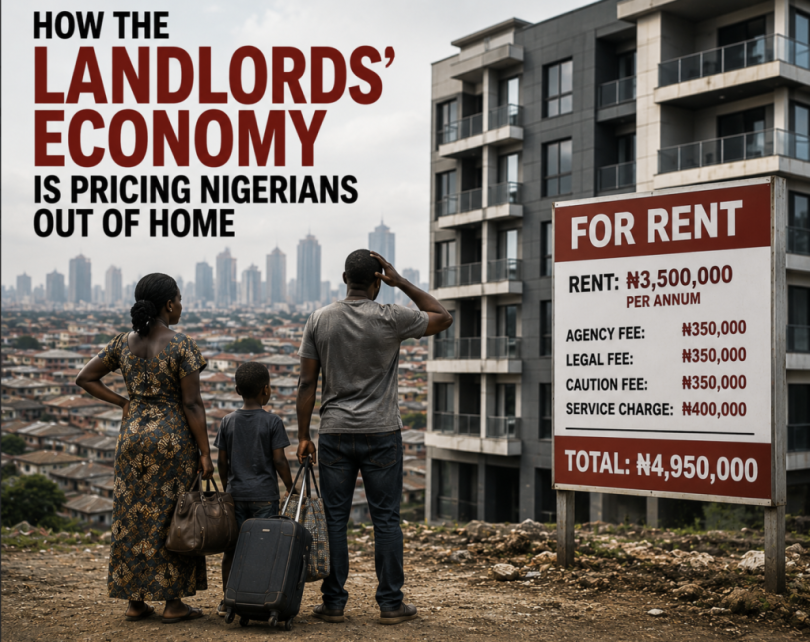
How The Landlords’ Economy Is Pricing Nigerians Out Of Home
It is considered that in every organized society, the home is supposed to be a place of security. It should be where families find peace after a hard day’s work, where children grow, where dreams are nurtured, and where the pressures of life temporarily fade away. This narrative comes with keen interest, having witnessed that for millions of Nigerians, home has become the country’s newest economic battlefield. This is fast becoming the experience for the vast majority of Nigerians.
Across the length and breadth of Nigeria, citizens are deeply lamenting the skyrocketing rent. Regrettably, this has become one of the fastest-rising costs of living. An unexpected trend which has become a huge concern is that currently apartments that were rented for N700,000 or N1 million just a few years ago are now advertised for N3 million, N5 million or even higher. Amidst this bizarre development, do you know that they are often without significant improvements to the property itself? One key troubling development is that recent estimates suggest that house rents in many Nigerian cities have surged by between 100 and 300 percent over the last two years, a pace that far exceeds the country’s official inflation rate and has placed unprecedented pressure on households already struggling with rising food, transportation and energy costs.
Landlords, through estate agents, increasingly demand one or two years’ rent upfront. Tenants are expected to pay 10 percent of the principal rent toward agency fees, legal fees, agreement charges, caution deposits, and, in most cases, the service charge (which appears to be higher), security levies, and utility-related costs before receiving the keys. In many cases, these additional charges add hundreds of thousands or even millions of naira to the advertised rent, making the total cost of securing accommodation far beyond the reach of average-income earners. Equally disturbing is the unchecked exploitation by agent marauders, who prey on desperate house seekers by imposing outrageous and often illegal fees that further deepen Nigeria’s housing crisis. What should ordinarily be a routine life event has become a financial ordeal.
Nigeria’s housing crisis is no longer simply a property story. It has evolved into an economic emergency with profound implications for families, businesses, public health and national development.
The Federal Government’s National Housing Data Technical Committee estimates that Nigeria faces a housing deficit of approximately 15 to 20million homes. At the same time, millions of existing houses are considered structurally inadequate and lack access to essential infrastructure. If this figure is something to consider, anyone would know that these figures reveal two overlapping crises. First, this shows that millions of Nigerians cannot find decent accommodation, whilst millions more live in overcrowded, unsafe or poorly serviced housing.
At the same time, Nigeria’s population continues to expand rapidly, with cities absorbing hundreds of thousands of new residents every year.
One of the challenges is that urbanisation has consistently outpaced housing development, widening the gap between supply and demand while predictably, rents continue to rise and affordability continues to decline.
Remarkably, housing experts generally recommend that households should spend no more than 30 percent of their income on accommodation. For many Nigerian families, that recommendation has become almost impossible to achieve.
Teachers, nurses, journalists, police officers, civil servants, young bankers, entrepreneurs, artisans and other middle-income earners increasingly devote more than half of their annual income to rent alone. For many, housing has become the single largest financial obligation, leaving very little for every other necessity of life.
After paying landlords, food budgets shrink. Healthcare is postponed. Children are transferred to less expensive schools. Retirement savings disappear. Business investments are suspended. Vacations become unimaginable luxuries. The rent bill has become the first expense families think about and the last financial burden they can escape.
The effects extend far beyond individual households. This is totally outrageous, as financial analysts have long observed that when accommodation consumes a disproportionate share of disposable income, consumer spending across the economy inevitably weakens.
Families postpone replacing household appliances. Vehicle purchases are delayed. Furniture sales decline. Restaurants receive fewer customers. Clothing retailers experience lower patronage. Small businesses lose purchasing power from consumers whose earnings are now tied up in rent. The result is a vicious economic cycle in which rising housing costs suppress consumption, reduce business activity and ultimately slow economic growth.
Behind every rent increase lies a deeply personal story. Consider a fictional but representative family whose experience mirrors that of countless Nigerians. The aspect of receiving notice that the annual rent for their modest two-bedroom apartment would rise from N1.2 million to N3 million comes with uneasiness. At this point, the Blessings’ family had spent months desperately searching for an alternative.
Unable to afford the increase and harassment from the landlord, they eventually relocated nearly 30 kilometres away from their former neighbourhood. The consequences were immediate. Their children had to change schools. The family’s daily commuting time doubled. Transportation costs rose sharply. Family time disappeared.
The father now leaves home before sunrise and returns late at night. The mother spends more each month commuting than she once spent on groceries. Their financial burden has not disappeared. It has merely shifted from rent to transportation and also deals with other issues like epileptic power supply and flooding, especially during this rainy season.
Unfortunately, such stories are no longer exceptional. They have become increasingly common across Nigeria’s major cities. Perhaps no demographic feels this pressure more acutely than young professionals.
Come to think of graduates entering the workforce quickly discover that entry-level salaries cannot support decent accommodation close to their workplaces. You would also see many remaining with their parents far longer than anticipated. Other effects include seeing them share apartments with several unrelated adults to reduce costs whilst some endure daily commutes lasting three or four hours because affordable housing exists only in distant suburbs.
The fact is that the consequences extend beyond inconvenience because long commuting hours reduce productivity, increase fatigue, heighten stress levels and significantly diminish quality of life. Another aspect of this and which is discouraging is that for many talented young Nigerians, financial independence, home ownership and family formation are becoming increasingly distant aspirations. Several interconnected forces explain why rents continue to climb so aggressively.
Inflation has significantly increased the cost of cement, steel, roofing sheets and virtually every construction material required to build houses. The depreciation of the naira has made imported building materials substantially more expensive. No doubt, from recent findings, there are clear indications that there is a significant increase in the prices of building materials. Let us see the period between 2024 to 2026, Cement: N6,500 – N13,000; blocks: N600 – N1100; 30T of sand: N165,000 – N250,000; 30T of granite: N530,000 – N780,000; rebars (iron) ton: N850,000 – N1,150,000 amongst others. To be fair, it is a known fact that high interest rates have increased borrowing costs for developers, while land acquisition remains prohibitively expensive in many urban centres. The very question at heart is, how has this recent development significantly impacted the apartments built five years ago and beyond?
The government has made it difficult to the point that obtaining development approvals can be slow and costly. Developers also contend with multiple taxes, infrastructure levies and rising labour costs before construction even begins. No doubt, these expenses inevitably find their way into rental prices. But one question keeps running through the minds of many, which is, how do these directly impact apartments built many years back? The truth is that market realities alone do not explain every increase.