
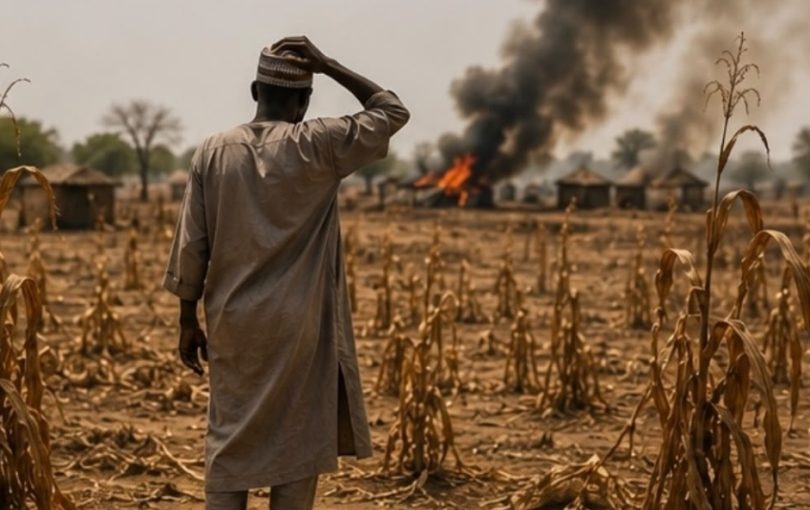
Across Nigeria’s North, the rainy season once signalled hope. Today, many farmers are abandoning their fields as insecurity turns fertile farmland into places of fear — with consequences reaching every dinner table in the country
By Fatima Mohammed
For generations, the first rains of the year have signalled a new beginning for farming families — the season of clearing fields, planting seeds and looking forward to harvests that feed households, supply markets and sustain the nation.
This year, hope is competing with fear. Across communities in Nigeria’s North-East and North-West, the biggest concern is no longer whether the rains have arrived on time or the soil is fertile enough. Instead, many farmers wake each morning asking a different question: will I return home safely if I go to my farm today?
“We are no longer worried about whether our crops will grow. We are worried about whether we will return home alive after going to the farm.” — Fatima Ali, farmer, Konduga LGA
For Fatima Ali, a 45-year-old farmer from Konduga Local Government Area of Borno State, farming is no longer simply about planting crops. It has become a daily struggle between survival and hunger. Her voice was calm, but her words revealed the fear that has settled over farming communities across the North. Every planting season now comes with uncertainty; leaving home for the farm is no longer routine but a decision weighed against the possibility of attack or kidnapping.
Her story is not unique. Across northern Nigeria, countless farmers now face the same difficult choice: risk their lives by going to the farm, or stay home and lose the harvest that feeds their families.
FIELDS FALLING SILENT
The All Farmers Association of Nigeria (AFAN) has repeatedly warned that insecurity is discouraging farmers from cultivating their lands during the planting season. AFAN Vice-President Daniel Okafor said rising insecurity, coupled with the soaring cost of farm inputs, is threatening food production nationwide.
According to him, many smallholder farmers — the people responsible for producing most of Nigeria’s staple foods — are increasingly unable to access their farmlands because of persistent attacks, kidnappings and fear of violence.
Many farmers now cultivate only small portions of land close to their homes, abandoning larger, more productive farmlands deep in isolated areas where attacks are more likely. Communities that once echoed with the sound of hoes striking the earth now live under the weight of uncertainty.
MILLIONS FACING HUNGER
The impact extends far beyond individual farmers. The World Food Programme (WFP) reports that violence by insurgents and armed groups has displaced communities, disrupted farming activities and restricted humanitarian access across conflict-affected states in the North. More than 17 million people across nine northern states are currently experiencing acute food insecurity, while over three million people in Borno State alone are affected.
Every abandoned farm represents more than an empty piece of land — it is food that will never reach the market, income that will never reach a household, and children whose next meal has become uncertain.
The Food and Agriculture Organization (FAO) warns that conflict, displacement, economic hardship and climate-related shocks are driving a deepening food crisis, projecting that 34.7 million Nigerians could face acute food insecurity during the 2026 lean season.
According to Reuters, citing the United Nations, nearly 35 million Nigerians are projected to face acute hunger in the same period, attributing the worsening situation to persistent insecurity, mass displacement, economic hardship and reduced humanitarian funding.
FROM FARM TO MARKET TO KITCHEN
When insecurity forces farmers away from their land, the consequences travel far beyond the villages. A farmer who abandons ten hectares of farmland does not only lose income — markets lose food, traders lose supplies, transporters lose business, and consumers pay more for what remains available.
Across many Nigerian cities, traders say supplies of grains, vegetables and other farm produce have become less predictable than in previous years, forcing families to reduce both the quantity and quality of their meals. Agricultural economists note that food security depends on more than fertile land and favourable weather — it also depends on whether farmers can safely cultivate, harvest and transport their produce.
A SEASON OF RETREAT
The rainy season should be the busiest period on Nigerian farms. Instead, many farmers now spend their mornings weighing the risks of going to the farm rather than planning their harvests. Some leave before sunrise but return after only a few hours, fearing to stay too long in isolated fields. Others have stopped farming altogether until security improves, and many young people who once saw agriculture as a family occupation are becoming discouraged.
Agricultural experts warn that the effects of insecurity do not end when attacks stop — a missed planting season cannot easily be recovered, and every abandoned farm today could mean lower food production months later.
Through its 2026–2028 Emergency and Resilience Plan, the FAO says millions of vulnerable Nigerians require urgent support, while long-term efforts must focus on rebuilding resilient farming communities capable of producing food despite recurring challenges.
GOVERNMENT RESPONSE
Speaking at the launch of the Presidential Emergency Food and Nutrition Distribution Programme in Maiduguri, Borno State Acting Governor Dr Umar Usman Kadafur described the intervention as “timely and critical” for families affected by conflict and economic hardship, pledging that assistance would reach vulnerable households in a transparent and accountable manner.
But stakeholders insist such interventions cannot replace lasting security. Farmer associations argue that improved seeds, fertiliser and financial assistance will have limited impact if farmers remain too afraid to cultivate their land. In their view, protecting farming communities is no longer only a security responsibility — it is an economic necessity.
Nigeria’s food security begins in its villages, on its farmlands and in the hands of farmers whose labour sustains millions of lives. Until those farmers can return to their fields without fear, every rainy season will remain a painful reminder that insecurity does not only destroy lives — it also threatens the food on every Nigerian table.
Fatima Mohammed writes this from Maiduguri