
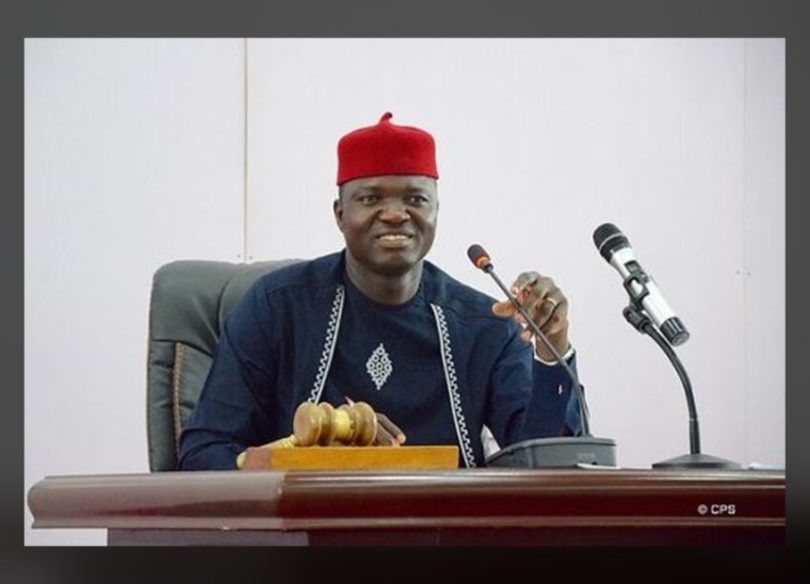
An investigation into the 2026 fiscal appropriations for the Ebonyi State Government has brought the administrative spending habits of Governor Francis Ogbonna Nwifuru under sharp scrutiny. Detailed analysis of the government’s approved budget reveals that the Office of the Executive Governor has been allocated a staggering N33,065,069,000, with a significant portion dedicated to recurring overhead costs rather than developmental infrastructure.
Financial documents indicate that the office’s overhead, which covers the daily operations and maintenance of the governor’s immediate circle, is set at N9,338,069,000. Within this allocation, travel expenses command a massive budget: local travel is pegged at N1.7 billion, while international travel and related training expenses account for an additional N300 million. Combined, these provisions mean the state is spending N2 billion annually just to facilitate the movement of officials associated with the governor’s office.
The budget also highlights substantial allocations for daily comfort and logistical maintenance. The state has earmarked N277,169,000 for refreshments and meals, while fuel and lubricants for vehicles, plants, and generators are budgeted at N600,400,000. Beyond operational costs, the government has authorized significant capital expenditure for luxury amenities within the Government House. This includes N700,000,000 for the rehabilitation of the Exco Chamber and N100,000,000 for the procurement of one hundred executive armchairs—averaging N1 million per seat. Furthermore, a Toyota Hilux for the Account Department is listed at N100,000,000, and an LED projector for the Government House Chapel is priced at N50,000,000.
Budget implementation reports for the first half of 2026 raise further questions regarding fiscal priorities. During the first two quarters, the Office of the Governor expended a total of N4,857,476,552.95. Alarmingly, 83.2 percent of this expenditure, amounting to N4,042,139,361.25, was channeled into overhead costs. By the end of June, the office had already exhausted over 43 percent of its entire annual overhead budget.
In stark contrast, the capital project performance for the same period has been remarkably low. Out of an annual capital vote of N22,015,000,000, only N136,678,075—a mere 0.6 percent—had been released or utilized by the end of the second quarter.
While the state government provides granular detail regarding its projected spending for comfort and travel, the actual quarterly implementation reports fail to offer line-by-line transparency. Instead of detailing specific expenditures, the government presents its spending as lump sums under broad economic classifications. Consequently, while the public is aware of the approved costs for amenities and logistics, the actual amounts spent on individual items—such as the chairs or the vehicle—remain obscured within a single, opaque expenditure total.
Source: NaijaProbe