
The Defence Intelligence Agency (DIA) has again barred lawyers and family members from visiting military officers detained over an alleged coup plot against President Bola Tinubu, a move that came shortly after explosive allegations of torture were made in court.
Multiple sources familiar with the matter told SaharaReporters that the restriction on access followed testimony presented during a trial-within-a-trial, a legal procedure used to determine whether confessional statements were obtained voluntarily and are therefore admissible as evidence.
During the proceedings, several of the detained military officers and witnesses reportedly testified that they were subjected to torture and other forms of coercion during interrogation on the orders of Brigadier General Nicholas Ashinze, a senior military intelligence officer.
According to the testimony, the detainees stated that they were forced under duress to memorise and recite statements prepared by their interrogators instead of giving voluntary confessions.
“They were tortured and compelled to repeat statements written for them by their interrogators,” a source familiar with the proceedings told SaharaReporters. “That testimony became part of the trial-within-a-trial.”
The allegations have intensified scrutiny of the investigation into the alleged coup plot, prompting fresh questions about the conduct of interrogations and the reliability of the confessional statements on which the prosecution seeks to rely.
Ashinze’s own history has also come under renewed public attention following the allegations.
In 2017, the Economic and Financial Crimes Commission (EFCC) publicly disclosed details of its case involving Ashinze, who was among officials linked to funds allegedly disbursed from the Office of the former National Security Adviser, Col. Sambo Dasuki (retd.).
On April 11, 2017, the EFCC explained how Ashinze and others allegedly received N5.6 billion from the Office of the National Security Adviser.
During proceedings before Justice Gabriel Kolawole of the Federal High Court in Abuja on March 7, 2017, EFCC witness Hassan Seidu testified that Ashinze and other defendants received N5.6 billion from the Office of the National Security Adviser as part of the commission’s prosecution.
Ashinze was subsequently tried in connection with the Dasuki arms procurement scandal, one of Nigeria’s biggest corruption cases involving the alleged diversion of billions of naira meant for the procurement of weapons to combat the Boko Haram insurgency.
Although those proceedings remain a matter of public record, sources have questioned why an officer whose name featured prominently in such a high-profile corruption investigation is now leading investigations into an alleged treason case involving fellow military officers.
“His involvement has raised serious concerns about the credibility and impartiality of the investigation,” one source said.
“Many believe the process is being driven by political considerations rather than objective evidence.”
Following the courtroom testimony alleging torture, the Defence Intelligence Agency reportedly moved to cut off virtually all external access to the detainees.
Sources told SaharaReporters that lawyers representing the detained officers, as well as their family members, have since been prevented from seeing them.
“Immediately after the torture allegations became public in court, access to the detainees was stopped,” another source said. “Lawyers and relatives are no longer being allowed to visit.”
According to one insider, the restriction is an attempt by Ashinze and members of the investigative team to prevent further disclosures regarding the detainees’ alleged treatment while in custody.
“The belief among those close to the matter is that Ashinze and his team are trying to cover their tracks after the torture allegations surfaced in court,” the source alleged.
Sources within the Defence Intelligence Agency, however, have reportedly defended the decision, claiming that some of the detainees were found in possession of mobile phones and batteries inside the detention facility, describing the discovery as a security breach that necessitated tighter restrictions.
However, sources familiar with the case dismissed that explanation as unconvincing.
“They are saying phones and batteries were found with some detainees, but the timing speaks for itself,” one source said. “The restrictions came immediately after the torture allegations were made before the court.”
Lawyers involved in the matter have condemned the latest development, arguing that denying detainees access to legal representation violates constitutional guarantees, due process and internationally recognised human rights standards.
Family members have also expressed growing concern over the welfare of their loved ones, saying the prolonged denial of access has heightened fears for their safety.
Relatives told SaharaReporters they fear the detainees are being deliberately isolated to prevent further disclosures about their alleged treatment while in military custody.
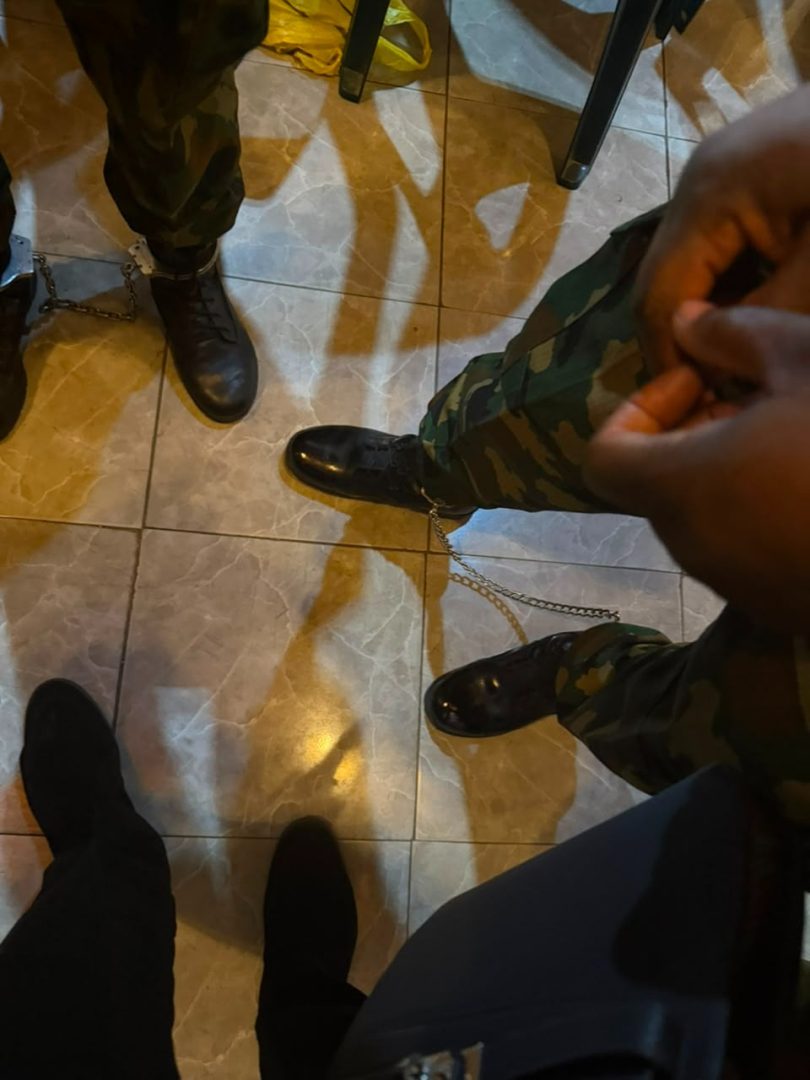
SaharaReporters previously reported that at least 35 Nigerian military personnel standing trial over allegations that they plotted to overthrow the government of President Tinubu had continued to appear in court while wearing handcuffs and leg chains, despite repeated appeals by their legal representatives.
In videos obtained by SaharaReporters, some of the accused personnel was seen in handcuffs and leg chains.
Meanwhile, sources said that whenever the accused personnel needed to use the restroom, they were required to remain shackled with both handcuffs and leg chains.