
A Professor of Comparative Political Economy and Dean of Social Sciences at the University of Lagos (UNILAG), Akoka, Adelaja Odukoya, has declared that wealth generation alone does not equal development.
He warned that Africa must build genuine political and productive capacity rather than relying on endless lamentation or waiting for a fairer international system.
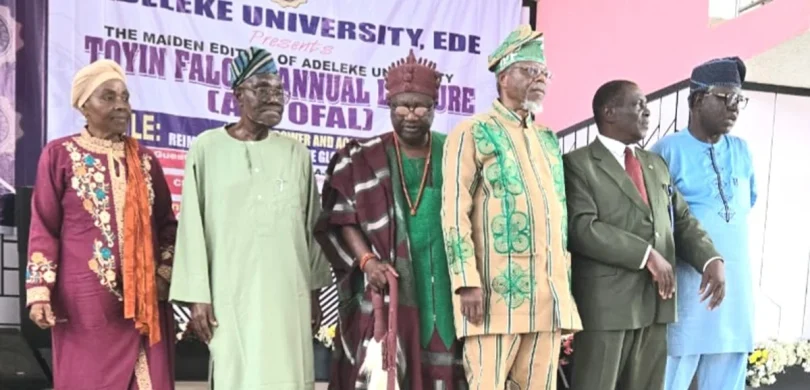
Professor Odukoya delivered this charge on Thursday in Ede, Osun State, while presenting a paper at the maiden edition of the Adeleke University Toyin Falola Annual Lecture.
The lecture was themed, “History, Power and Accumulation: Reimagining Africa in the Globally Disordered Order.”
Addressing the audience comprising academics, students, and policymakers, Odukoya challenged the conventional celebration of economic growth metrics on the continent.
“My central proposition is that accumulation is not development,” Odukoya argued. “The political economy concern is what kind of accumulation Africa needs, under whose control, for what purpose, and with what consequences.”
He emphasized that true development must be judged by whether economic accumulation expands local productive capabilities, deepens technological capacity, and secures greater developmental autonomy for African nations.
Odukoya noted that Africa’s current position within global capitalism is highly contradictory.
ALSO READ: Reimagining Africa in the globally disorderly order
While the continent is becoming increasingly vital to a changing international economy, it faces an old, dangerous pattern: becoming more valuable to the world without becoming more capable of determining what that value produces for its own people.
However, he pointed out that the current disruptions in global power structures present a rare window of opportunity.
“The same reconfiguration of global power that threatens to make Africa an arena for renewed external competition over resources has unsettled established hierarchies,” Odukoya explained. “That disruption may create the space for developmental reconstruction.”
Reflecting on the widespread citizen agitations and protests sweeping across African countries, the UNILAG don acknowledged that mass displeasure proves citizens are not powerless. However, he maintained that anger alone is insufficient to break historical structures of inequality.
“Episodic protest alone cannot reorganise the structures that produce disempowerment. Mobilisation requires organisation, institutional capacity, and political knowledge,” he stated.
He highlighted the university, democratic institutions, and continental integration as critical pillars needed to transform how Africa organizes its power and resources.
Concluding his address, Professor Odukoya urged African states and societies to view history not as a prison or a source of romantic consolation, but as a resource for active political understanding. He stressed that developmental agency will never be handed to Africa as a “gift” in foreign investment agreements; it must be intentionally constructed.
“Unending lamentation will change nothing,” Odukoya concluded. “Waiting for a better international order that may never come cannot resolve the problem.
The global order has always been shaped by power, and Africa is no exception to its dynamics.”
Sharing the sentiment, a renowned Nigerian historian and scholar, Prof Toyin Falola warned that Africa’s vast natural resources will continue to reinforce dependency unless governments build the industrial, technological, and institutional capacity to convert them into productive power.
According to him, achieving true global influence requires a coordinated framework where universities generate knowledge, governments translate it into policy, and industries add value to the continent’s resources