
The Abia State Government has denied reports that women who sell akara on the streets of the state are being made to pay N50,000 in tax.
The government said akara sellers are not subjected to such a tax or levy, describing the claim as false.
The clarification was made by the Commissioner for Information, Okey Kanu, on Monday in Umuahia.
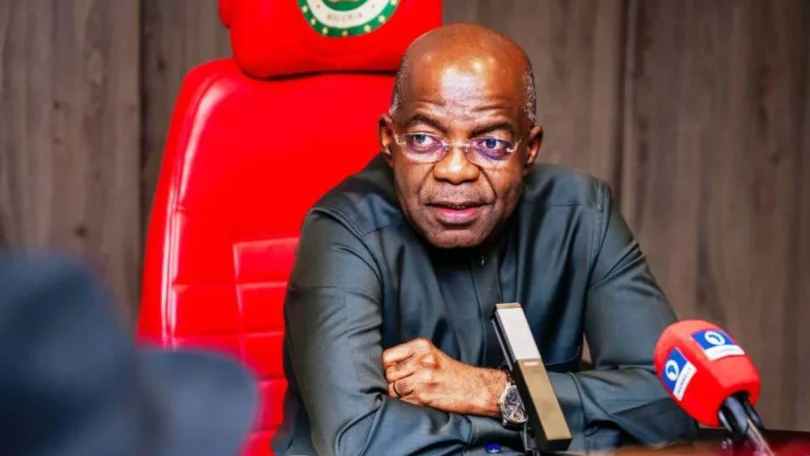
Kanu spoke while briefing journalists on the outcome of the Abia State Executive Council meeting presided over by Governor Alex Otti.
He said the administration had not introduced any new tax on small traders in the state.
According to him, the government had already abolished multiple taxation as part of efforts to make it easier for residents and businesses to operate.
Kanu said the N50,000 figure being circulated in relation to akara sellers was not a tax imposed by the state government.
“There is another one trending. It is the story of an akara seller who is paying N50,000 as tax.
“This is pure fallacy and nothing can be farther from the truth as akara sellers don’t pay tax or levies but they pay daily tolls,” Kanu said.
The commissioner explained that the daily toll paid by some roadside traders should not be confused with a tax.
He said the payment is part of the system used for small-scale trading activities and does not amount to the N50,000 tax being alleged.
Kanu, however, maintained that the administration had not authorised any fresh tax burden on traders.
He also stated that the Abia State Board of Internal Revenue could not arbitrarily increase taxes.
According to him, any increase in taxes would require the necessary legislative approval from the Abia State House of Assembly.
The commissioner therefore urged residents to disregard reports suggesting that the government had imposed N50,000 tax on women selling akara.
Kanu also addressed reports concerning school proprietors and other business owners.
He denied claims that the Otti administration was subjecting them to unbearable taxation.
The commissioner insisted that the state government’s tax policy was not designed to drive businesses out of Abia.
He said the administration was interested in creating an environment where businesses could operate and contribute to the state’s economy.
Kanu further dismissed the suggestion that the government only began paying gratuities to pensioners because of pressure from opposition parties.
He said the administration’s decision on pensioners was part of its own policy and commitment.
In a related news, the controversy over akara sellers in Abia comes months after First Lady Oluremi Tinubu drew attention with comments about akara and other small-scale businesses.
On June 26, the First Lady urged Nigerians facing economic difficulties to consider petty businesses such as akara, roasted corn and kuli-kuli.
She made the remarks after the second-quarter meeting of the Renewed Hope Initiative with the wives of state governors at the State House in Abuja.
Tinubu said such businesses could be started with relatively little capital.
She also explained that government interventions under the initiative were designed to provide grants rather than loans to beneficiaries.
“We’re trying to give hope, and to start Akara business doesn’t take a lot of money. To start roasting corn, or somebody even said kuli kuli doesn’t take much. We didn’t give them a loan; we gave it to them as a grant,” she said.
The comments caused reactions across the country.
Some Nigerians questioned whether petty trading could adequately address the wider economic difficulties facing households.
On June, she spoke in Jigawa State during the inauguration of the Abubakar Maje Haruna Hall at the palace of the Emir of Hadejia.
She disclosed that N100 million had been provided to support 2,000 petty traders in the state.
She said the beneficiaries would receive N50,000 each to recapitalise their businesses.
“And I know they’ve been talking that I said akara. It’s not only akara, we also have tomato sellers. We have bole, and those also selling pepper, selling vegetables for us in the market.
“We will continue to empower them and add to their resources so that their trade can really be sustainable. So that is what we are doing,” she said.
Tinubu also rejected the suggestion that criticism would stop the empowerment programme.
“I know all those people who are affected, they do appreciate it. And we are not intimidated by those wrong reports. But we are forging ahead and making sure that our people are well cared for,” she said.
The debate also took another turn in July after President Bola Tinubu jokingly referred to his wife as “Iya Alakara” during a Presidential Press Corps dinner, following the public attention caused by her comment.