
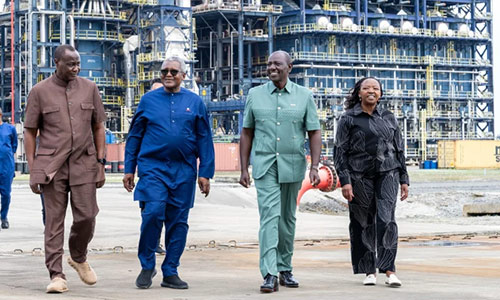
Kenyan President William Ruto has toured the Dangote Petroleum Refinery and Petrochemicals complex in Lekki, Lagos State, ahead of the scheduled groundbreaking of the Dangote-backed East African Refinery in Lamu, Kenya, on September 30, 2026.
Ruto, who visited the facility on Friday at the invitation of Dangote Group President and Chief Executive Officer Aliko Dangote, said the Nigerian refinery demonstrated what African governments, investors and financial institutions could achieve when they worked together on large-scale infrastructure and industrial projects.
The Kenyan President was accompanied by First Lady Rachel Ruto and senior government officials during the guided tour of the refinery and its adjoining petrochemical facilities.
“Toured the Dangote Refinery in Lekki, Lagos State, Nigeria, at the invitation of Dangote Group President and CEO @AlikoDangote ahead of our groundbreaking ceremony for the Dangote East African Refinery in Lamu, Kenya, next week,” Ruto said.
He described the Lekki facility as a massive industrial investment, noting that its current crude distillation capacity stands at about 700,000 barrels per day. Dangote Refinery’s official information also puts its current crude distillation unit capacity at 700,000 barrels per day.
“The refinery in Nigeria is a massive investment with a crude oil refining capacity of 700,000 barrels a day and produces more than 100 million litres of petrol, diesel and aviation fuel every day,” Ruto said.
The President also highlighted the marine infrastructure supporting the Lekki refinery, saying Dangote had constructed about 120 kilometres of subsea pipelines or marine infrastructure to move crude from vessels to the refinery.
“The company has built 120km of sea cables to move crude from ships to the refinery. This huge achievement is a testament of what African governments, investors and financial institutions can do together,” he said.
Ruto linked his visit directly to Kenya’s proposed East African Refinery in Lamu, saying the project would draw lessons from the Lagos facility while becoming a major part of East Africa’s energy and industrial infrastructure.
“The refinery whose construction we launch in Kenya next week will be bigger,” he said.
“It will transform the petroleum sector in our country and region, providing fuel reliability and security, scaling up industrialisation and creating 60,000 jobs.”
Current project descriptions put the proposed Lamu facility at about 700,000 barrels of crude oil per day, with construction expected to begin following the September 30 groundbreaking. Ruto did not specify in his remarks whether his description of the Kenyan project as “bigger” referred to refining capacity, investment size, physical footprint or the wider industrial complex.
The project, backed by the Dangote Group, is being positioned as a regional refinery that could supply petroleum products beyond Kenya to markets across East and Central Africa.
Ruto had earlier said the Lamu refinery was intended to serve Kenya as well as Ethiopia, South Sudan, Uganda, Tanzania, Rwanda, Burundi and the Democratic Republic of Congo.
Beyond petroleum products, the Kenyan President said the refinery was expected to stimulate the establishment of supporting and downstream industries.
“When the refinery is completed, spin-off industries will emerge, including the production of fertilisers, chemicals, and packaging,” Ruto said.
The project is also expected to take advantage of Lamu’s location on the Indian Ocean and its connection to the Lamu Port-South Sudan-Ethiopia Transport corridor, potentially strengthening petroleum supply routes to landlocked countries in East and Central Africa.
The planned Lamu facility has been estimated at between $15 billion and $17 billion in recent reports. Preparations are underway for the September 30 groundbreaking, with Kenyan officials saying heads of state and other dignitaries are expected at the ceremony.
However, the project still faces major execution requirements, including financing, crude supply arrangements, supporting infrastructure, regulatory approvals and environmental considerations. Reuters reported that securing reliable crude supply will be among the major challenges because Kenya currently does not have commercial crude production sufficient to feed a refinery of that scale.
Ruto’s Lagos tour comes as Dangote’s Nigerian refinery continues to expand its operations and capital-raising programme.
The refinery was originally developed with a nameplate capacity of 650,000 barrels per day before its crude distillation capacity was increased to 700,000 barrels per day following expansion works. Dangote has also announced plans to ultimately expand the Nigerian facility to 1.4 million barrels per day.
The company is currently undertaking a public offer in Nigeria. The Nigerian Exchange said 4.1 billion ordinary shares were offered at ₦525 per share, targeting about ₦2.15 trillion, with a minimum subscription of 10 shares, equivalent to ₦5,250. The offer opened on September 14 and is scheduled to close on October 13, subject to the approved prospectus.
The Securities and Exchange Commission has confirmed approval of the IPO and advised prospective investors to use only officially approved subscription channels.
... “What Africa Can Achieve When Governments, Investors Work Together” — Ruto Hails Dangote Refinery Ahead Of Kenya Project ... TheNigeriaLawyer.