
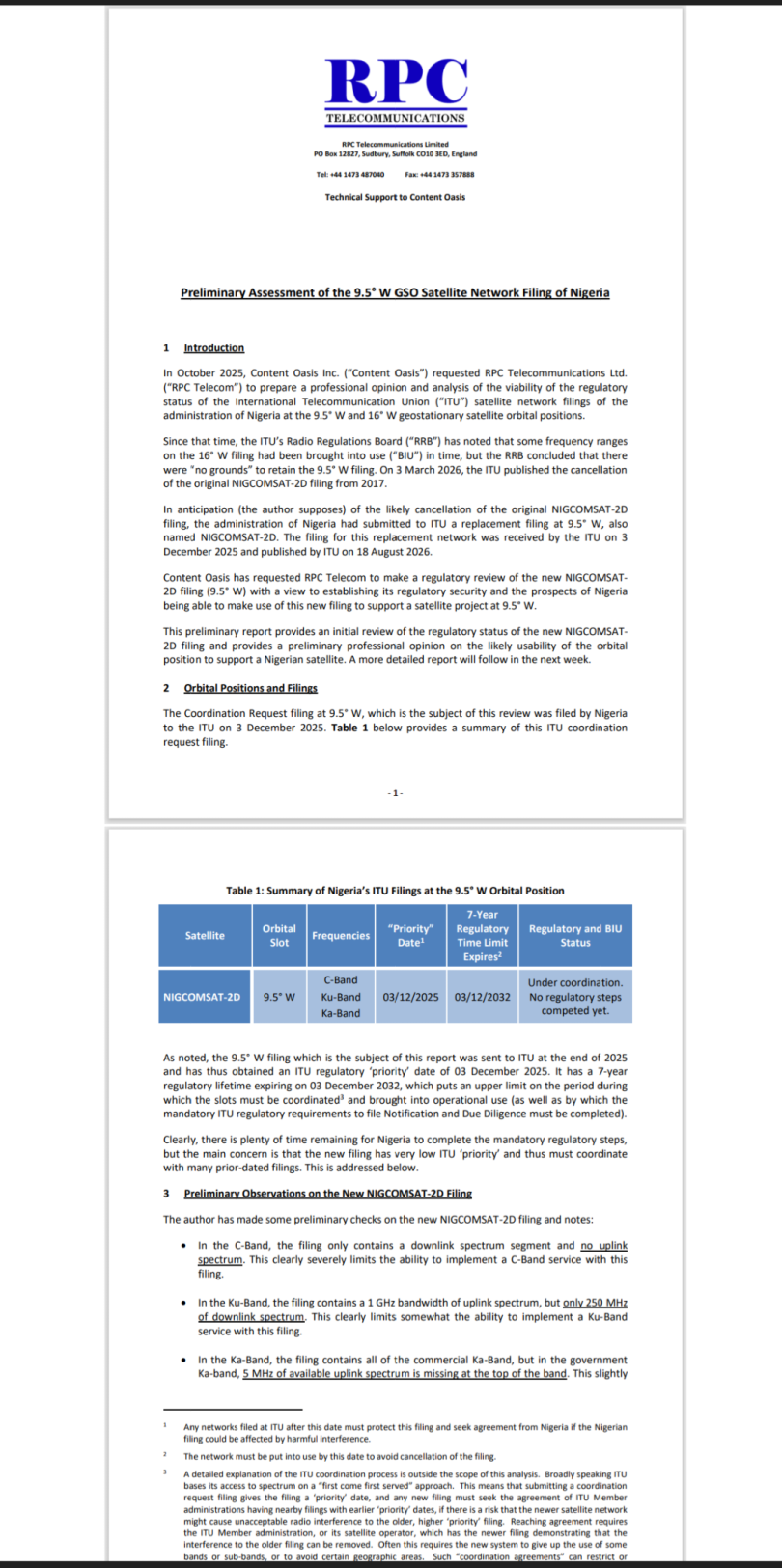
Nigeria’s ambitious plan to deploy new communications satellites is facing a major regulatory hurdle after the country lost the priority attached to its original 2017 filing for a key orbital position at 9.5° West, leaving its replacement filing to contend with at least 22 earlier satellite claims, SaharaReporters has learnt.
The setback affects the regulatory position Nigeria had pursued since 2017 for the NIGCOMSAT-2D satellite network at 9.5°W, a position subsequently earmarked for the country’s next-generation satellite programme.
The International Telecommunication Union (ITU) published the cancellation of the original 2017 NIGCOMSAT-2D filing on March 3, 2026.
However, Nigeria had already submitted a replacement filing for NIGCOMSAT-2D at the same 9.5°W position before the original filing was cancelled.
The replacement filing was received by the ITU on December 3, 2025, according to the ITU’s satellite network records.
This means Nigeria has not simply lost the ability to pursue 9.5°W. Rather, the country has lost the regulatory priority associated with its older filing and is now seeking to secure the position through a later filing that must be coordinated with other satellite networks.
A source familiar with the matter told SaharaReporters that coordination with the other networks could be extremely difficult.
The source likened Nigeria’s position to building a very expensive car without knowing where it would be parked.
“You would never risk building a $250 million (N332 billion) car when you are not sure where to park it. It is madness,” the source said.
The source was referring to the proposed new satellite investment and the uncertainty surrounding the regulatory coordination required before Nigeria can confidently deploy the satellite at the desired orbital position.
The issue is particularly significant because the Nigerian Communications Satellite Limited (NIGCOMSAT) has embarked on a major programme to replace the ageing NigComSat-1R and acquire new satellites.
According to NIGCOMSAT’s own asset-upgrade document, the agency commenced the acquisition of a replacement satellite in July 2024, began the expression-of-interest process for NIGCOMSAT-2A and 2B that month, and commenced work on ITU filings for the 9.5°W and 16°W orbital positions in August 2024. The agency said its target was to launch NIGCOMSAT-2A and 2B in 2027/2028.
The changing satellite designations have contributed to confusion around the orbital positions.
The 9.5°W position was originally associated with the NIGCOMSAT-2D filing in the ITU regulatory record. The ITU’s current database also shows NIGCOMSAT-2D filings at 9.5°W in 2024 and 2025, including the new filing received in December 2025.
At another stage of the programme, however, Nigerian submissions to the ITU referred to NIGCOMSAT-2B at 9.5°W and NIGCOMSAT-2D at 16°W. An ITU document published in 2025, for instance, expressly described Nigeria’s request as concerning NIGCOMSAT-2B at 9.5°W and NIGCOMSAT-2D at 16°W.
The distinction is important: the orbital position is the “parking space”, while the satellite or network designation can change as Nigeria’s satellite programme evolves.
What has not changed is the significance of the 9.5°W position to Nigeria’s satellite ambitions.
Loss Of 2017 Priority
The regulatory problem stems from the difference between Nigeria’s old and new filings.
Nigeria’s original 9.5°W NIGCOMSAT-2D filing dates back to December 6, 2017, according to the ITU record. The newer filing was received on December 3, 2025.
That eight-year difference is crucial because satellite filings are not simply a matter of claiming an orbital position indefinitely.
Countries and satellite operators must satisfy ITU regulatory requirements and coordinate frequency assignments with other networks to avoid harmful interference.
The loss of the earlier filing therefore means that Nigeria’s replacement application does not automatically carry the regulatory seniority of the 2017 application.
SaharaReporters’ review of the relevant filings indicates that the replacement position now faces at least 22 earlier-priority satellite networks.
That creates a potentially difficult coordination process for Nigeria.
The issue is not that 9.5°W has physically disappeared or that another country has simply taken ownership of the orbital position.
Rather, Nigeria must now negotiate its frequency assignments and operating parameters against earlier filings and demonstrate that its proposed system can coexist with the networks with which it must coordinate.
This is the key consequence of losing the 2017 priority.
$6.98m Emergency Intervention
The regulatory setback is particularly significant because NigComSat had previously sought an emergency intervention costing about $6.9875 million to preserve its position and address the regulatory challenge.
Documents reviewed by SaharaReporters showed that the satellite agency approached the Presidency for urgent intervention as the deadline and regulatory requirements surrounding the filing became pressing.
The original report had described the effort as a potential rescue of Nigeria’s 9.5°W position.
However, the subsequent cancellation of the original filing means the outcome of that intervention deserves scrutiny.
It is not yet clear from the material reviewed by SaharaReporters whether the entire $6.9875 million requested was actually released and spent, and this should not be characterised as a failed or “botched” payment unless documentary evidence establishes that.
What is clear is that the old 2017 filing was ultimately cancelled, while Nigeria had already submitted a replacement filing for the same orbital position.
The question now is whether the replacement filing can deliver the regulatory certainty that Nigeria previously enjoyed.
22 Earlier Claims
The number of earlier satellite claims is central to the emerging problem.
According to the regulatory analysis reviewed by SaharaReporters, Nigeria’s replacement filing at 9.5°W now has to contend with at least 22 earlier-priority networks.
This does not necessarily mean all 22 will prevent Nigeria from operating at 9.5°W.
Satellite coordination is a technical process involving frequency assignments, power levels, coverage areas, orbital parameters and interference calculations. Some networks may ultimately be coordinated without objection or through agreed technical modifications.
But the larger the number of earlier networks involved, the more complicated the process can become.
That raises a fundamental question about the timing of Nigeria’s satellite procurement: how far can the country proceed with an expensive satellite project before securing sufficient certainty over the regulatory environment in which the satellite will operate?
$250m Satellite Investment
The planned satellite programme represents a substantial investment. The source described the satellite as a roughly $250 million (about N332 billion) asset.
The exact naira equivalent will, of course, depend on the exchange rate used for the project valuation.
The investment is intended to replace and upgrade Nigeria’s existing satellite infrastructure.
NIGCOMSAT’s own documents say the agency began the process of acquiring replacement satellites in 2024 and targeted the launch of NIGCOMSAT-2A and 2B in 2027/2028.
Nigeria’s satellite agency has also recently defended the procurement process for NIGCOMSAT-2A and 2B against allegations of irregularities, saying the exercise was conducted competitively and in accordance with procurement requirements.
The agency has described the satellites as critical to Nigeria’s future digital infrastructure, including communications resilience, broadband coverage, national security, education, healthcare and broadcasting.
The regulatory question therefore goes beyond an administrative filing.
If the new satellite is designed and procured around a particular orbital and frequency configuration, uncertainty over the eventual operating position could have implications for the project’s technical design, coverage, frequency coordination, deployment timetable and commercial viability.
Nigeria subsequently re-applied for NIGCOMSAT-2D at the same 9.5°W position, and the ITU record confirms that the new filing was received in December 2025.
The challenge is that the new filing has a later date and therefore must go through the relevant coordination process with other satellite networks.
Earlier Regulatory Warning
Nigeria’s difficulties with the 9.5°W and related filings did not begin in 2026.
An ITU Radio Regulations Board document from 2025 recorded Nigeria’s request for an extension of the regulatory time limits for bringing into use frequency assignments associated at that stage with NIGCOMSAT-2B at 9.5°W and NIGCOMSAT-2D at 16°W.
The Board said it was not in a position at that point to grant the requested extension and directed that the frequency assignments be retained pending additional information.
The sequence illustrates the prolonged regulatory difficulties surrounding Nigeria’s next-generation satellite programme.
The country was already seeking additional time to bring the relevant frequency assignments into use, while subsequently pursuing replacement filings and a broader satellite procurement programme.
Why The Timing Matters
The issue is occurring as Nigeria prepares to replace NigComSat-1R.
NIGCOMSAT’s own programme documents describe the new satellites as an asset upgrade and target their launch for 2027/2028.
That means Nigeria has a relatively narrow window in which the regulatory, procurement, manufacturing and launch components must come together.
A satellite can be manufactured and launched, but the regulatory ability to operate its frequency assignments at a particular orbital position is a separate issue.
This is why the replacement filing at 9.5°W is potentially critical.
If coordination is achieved, Nigeria could proceed with its plans for the position.
If significant coordination difficulties remain unresolved, however, Nigeria could face the need for technical modifications, changes in operating parameters, delays or potentially a different regulatory solution.
The exact consequences would depend on the outcome of the ITU coordination process.
NIGCOMSAT has since rejected suggestions that reported Chapter 11 proceedings involving a related entity demonstrate that Hughes Network Systems lacks the capacity to deliver the required infrastructure.
The agency said such developments do not automatically establish that the procurement decision was defective and maintained that technical assessment, contractual due diligence and project-continuity safeguards were considered.
That response means the Hughes issue should be presented as a counterparty-risk question raised by the available information, rather than as evidence that the satellite programme cannot be delivered.