
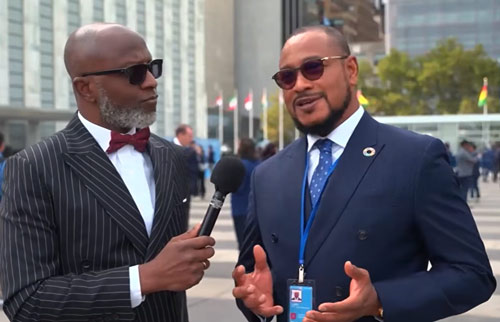
The Governor of Zamfara State, Dr. Dauda Lawal, has challenged the Minister of the Federal Capital Territory, Barrister Nyesom Wike, either to join the All Progressives Congress (APC) or to withdraw from the rainbow coalition if he intends to support President Bola Ahmed Tinubu’s re-election in 2027.
He spoke in an interview on Channels Television’s Inside Sources at the headquarters of the United Nations in New York, on the sidelines of the General Debate of the 81st Session of the General Assembly, which he is attending as one of the governors accompanying the Vice President.
Asked about the position taken by the APC Governors Forum against the coalition, the governor confirmed his participation in the decision and said the position is unchanged.
“I was part of that mission, and our message is very, very clear. Be on one side. You can’t be on two sides. If you’re in APC, please come out and support APC. Not you’re supporting APC here and you’re supporting other political parties somewhere else. It doesn’t make sense. It’s not done anywhere,” he said.
“And that is why we maintain our stand, and it is very clear. The message is very clear. He can speak, he can say whatever he wants to say, but our position has been very, very clear. APC all the way from head to toe.”
Asked directly whether the governors were in effect asking the minister to join the ruling party, he replied: “Exactly. What’s the essence?”
Asked whether the matter had been discussed with the President, the governor said it would be raised on his return from his working leave.
“Well, it’s something that I will take up with the President when he comes back. So let there be a very, very clear line where this guy belongs to,” he said.
“It’s either he’s in APC or he’s out. It’s simple. And I go with my brothers, the governors.”
Responding to the minister’s description of some APC governors as politically lazy, he said the remark was not directed at him.
“Well, I mean, he knows the people he’s referring to, honestly. As for me, I mean, you can’t say that in Zamfara State. The difference is very, very clear,” he said.
“I invite anybody to come and see what we’re doing in Zamfara State in every sector: education, healthcare, infrastructure, agriculture, and mining, where we have comparative advantage as a state.”
Asked about the demand by the African Democratic Congress and its presidential candidate that the President should have transmitted power after exceeding 21 days abroad, the governor dismissed the controversy.
“You know, I think these are just political statements,” he said. “Number one, when the President travelled, he made it very clear that he is going on a working leave. Working leave, underline the statement. Which means wherever the President is, he is working for Nigeria.”
“And moreover, Nigeria is evolving, and the President can work anywhere. That is why we’re investing so much in technology, to be able to work wherever you are. This is modernity and we are making progress in that area. So I don’t see that to be any controversial, because he is not just resting. He’s working for Nigeria.”
On the President’s absence from the General Assembly for a third year, he said the delegation to the Vice President changes nothing.
“I had this interview with some media houses I think two days ago. Same question. Why is the President not here? And the answer is very simple. The President has another engagement somewhere and he delegated his Vice President to attend on his behalf,” he said.
“And like I said, the message that the Vice President is going to deliver at the UN is the same message that President Tinubu will deliver even if he comes to the UN. So the fact that he’s not here does not change anything.”
“There are so many countries that had representation today as we speak. And so the fact that Tinubu is not here does not change anything, does not change the content, does not change the message.”
He added: “The Vice President is capable. He has done it over and over, and I’m sure he’s also going to do it. He represents Mr. President effectively as if the President is here. That is why he’s called the Vice President.”
When the presenter said he personally wished the President had attended, the governor replied: “I’m sure next time the President will be here. So let’s keep our fingers crossed, but it shouldn’t be an issue.”
Asked about his own objectives in New York, the governor said his first attendance three years ago convinced him of the value of the engagement.
“As we speak now, we have had a series of bilateral discussions. We had meetings with some of the UN agencies, for example the UNDP. And if you look at what UNDP is doing in Nigeria and in all our states, they are doing an amazing job. They are in the area of education, they’re in the area of agriculture, they’re in the area of infrastructure and so many other things, and that is exactly what we’re keen on.”
He said the security dimension made the engagement more valuable still. “Remember, I came from a region that is facing so much security challenges, and this is where we also exchange ideas, compared to what others did in different parts of the world to be able to solve their security challenges. So we are learning and we are getting technical support. We’re getting financial support from these UN agencies.”
He cited the support received under the AGILE programme, saying he knows how much has been committed in dollar terms by the development agency and others.
On mining, the governor said a meeting held the previous day was devoted to critical minerals.
“When you speak about critical minerals, Zamfara is key. And that is why it’s important for me to be here, because part of the meeting we had yesterday was basically about mining and critical minerals,” he said.
“I’m happy to say that we are making inroads into the mining sector in Zamfara State. As we speak, we have an investor that brought about 250 million dollars. Already they are working. And it’s a very big processing plant for lithium.”
“So these are the kind of advantages, because you need all this foreign direct investment. If we’re able to get it right, the issue of revenue will be something else, and that is exactly what we’re looking for, to develop the area in education, in the health sector, infrastructure and so many other things, which I believe is the way forward.”
Asked for an update on insecurity, the governor said the problem was inherited and that his administration began by diagnosing it.
“Insecurity is something that I inherited within the last one decade or more, and part of what we did as a responsible government was to look at what the issues are,” he said.
“And having realised the issues or the challenges, that was what led us to form what we call the Community Protection Guard. The Community Protection Guard is more like an internal security outfit in Zamfara that works with the conventional security, the reason being that these are people who understand the community, they live with the community.”
“And the first line of response in any distress call is those CPG, because they understand the terrain very well. They live with the people. So it’s always easier for them to identify those bandits, as we call them. And it’s working effectively.”
He said the results were measurable. “I can tell you confidently that insecurity has gone down drastically within the last three years, because we have done so much in terms of facing the problems head on. We have provided all the kind of support to the conventional security.”
“I’m sure you saw what we did in terms of the kind of new technology that we brought into fighting banditry, and that is working effectively, because right now you need technology, and that is exactly why we’re investing so much in that area. And it’s helping us to combat criminality in Zamfara State.”
Inviting scrutiny of the state’s record, the governor said access had been restored.
“Seeing is believing. In fact, I will invite you to Zamfara for you to come and see exactly what we’ve done. The airport is fully functional. As a matter of fact, we are starting commercial flights on the 1st of October next month,” he said.
“So Zamfara is open. We’re ready for business.”
Reminded of his earlier public claim that he could resolve the state’s security crisis within weeks, the governor stood by it and stated the condition attached to it.
“I made it very clear. Yes,” he said. “I don’t mince my words, and everything I said is based on reality and facts. If I have the command and control of the security forces in Zamfara State, within two months I’ll end insecurity in Zamfara State, and I mean it.”
Asked why that had not happened, he pointed to improved cooperation rather than a change of view. “I think it’s much easier now, because there’s a kind of collaboration and understanding between the state government and the federal government, and honestly they are doing so much now in terms of coming together to see how we can work things out and be able to fight these guys head on. And it’s yielding results.”
Asked whether the state would be among those to move quickly on state police, he said his position had never changed.
“My position has been very clear from inception. I always say that I support state police, because that is when I will have the command and control,” he said.
“And I should be able to have my own people that understand the terrain very well, give them all the kind of training, give them all the kind of equipment, for them to be able to face these guys head on.”
Asked for his view of the country’s future, the governor was optimistic and grounded the optimism in demography.
“I think the future of Nigeria is very, very bright. Why am I saying that? Because we have what it takes to showcase Nigeria anywhere in the world. One is, we have the population. Number is key to everything that we do. And that is why, if you look at today, China is a dominant player because of the population. Now if you’re looking at Black races, Nigeria is number one.”
“Two, we’re investing so much in the area of technology. We are doing so much in the area of infrastructure, and of course we are going into renewable energy, and that is also an area where Nigeria is doing very, very well. So that is the future. We have a dominant role, and Nigeria cannot just be washed away.”
Put to him that a large part of that population is poor, with more than 50 million in poverty, he said the answer lies in institutions.
“Well, you see, transformation doesn’t come easy. You go through a process, and what we’re doing right now is building institutions. Once we’re able to build institutions, I think 60 per cent of the problem is solved. And it’s a gradual process, and I believe that with what we’re doing right now, we’ll get there within no time.”
He said the country’s leadership is the reason for his confidence. “The kind of leadership that I see in Nigeria, they are transformational leaders, and I can give you examples. Zamfara is a case study. Go to Abia, it is a case study. Go to Enugu, it is a case study. There are so many. So things are changing for the better, and that is the way. Leadership is key. As long as you have the right set of leaders, believe me, you can go to sleep.”
He closed by predicting further change at home: “I’m sure within the next maybe one or two years, Zamfara will be a different ball game.”
The disagreement centres on the rainbow coalition promoted by the FCT Minister as a cross-party platform to mobilise support for the President’s re-election.
The minister, a member of the Peoples Democratic Party, has maintained that the coalition is separate from the ruling party, and that supporting the President at the presidential level does not require politicians to abandon their parties or to stop supporting candidates contesting governorship and legislative elections. He has said the PDP remains free to field candidates for the governorship, the National Assembly and the State Houses of Assembly, while his own priority is to mobilise support for the President.
He has cited the 2023 election, when members of the G5 group of PDP governors backed the President’s bid while remaining in their party and supporting its candidates in other contests, and has rejected the suggestion that the coalition was established to weaken or destabilise existing parties, describing it instead as a platform bringing together politicians from different parties who support the President.
The APC governors have said they will support the President and the party’s candidates, and will not endorse arrangements capable of weakening the party or affecting its candidates.
... “It’s Either He’s In APC Or He’s Out. It’s Simple” — Lawal Replies Wike Over Politically Lazy Governors On The Rainbow Coalition ... TheNigeriaLawyer.