
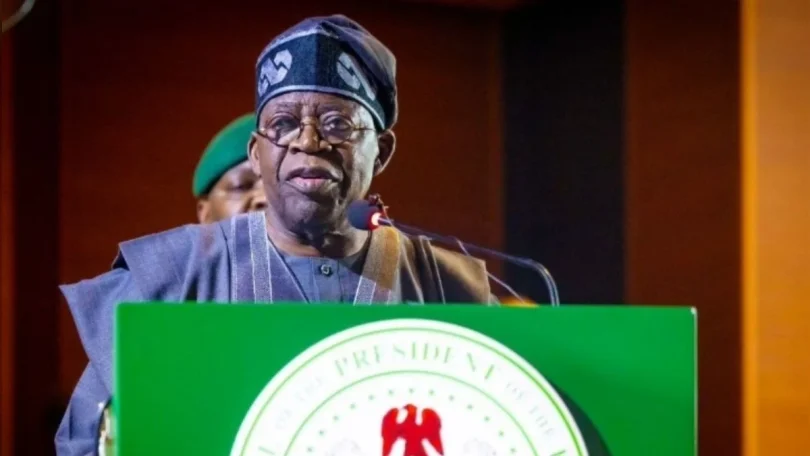
President Bola Ahmed Tinubu has said his administration cannot solve in four years all the economic and social problems that have built up in Nigeria over several generations.
Tinubu made the declaration on Thursday, October 1, in his Independence Day address to Nigerians as the country marked its 66th anniversary.
He said his administration could, however, put the country on a different path and lay the foundation for long-term prosperity.
The President used the national broadcast to defend the economic reforms introduced since he assumed office in 2023.
He acknowledged that the measures had brought hardship to many Nigerians but maintained that they were necessary to address what he described as longstanding weaknesses in the economy.
According to Tinubu, Nigeria entered his administration with serious economic distortions after years of unresolved challenges.
He said successive governments had often delayed difficult decisions, allowing structural problems to continue.
He compared the situation to a patient suffering from a serious illness whose symptoms had repeatedly been treated without addressing the underlying condition.
“By 2023, poverty was rising, and hope was nearly gone. The country’s situation was darker than ever. We had no choice but to act,” Tinubu said.
The President insisted that the reforms were not responsible for the weaknesses confronting the country.
“Our reforms did not create the weaknesses in our economy. They confronted them.”
Tinubu said the government was now moving away from the period of what he called emergency economic correction and entering what he described as an “age of prosperity”.
He said the next phase of his administration would focus more directly on reducing the cost of living, creating jobs, supporting businesses and ensuring that Nigerians begin to feel the benefits of economic growth.
“The emergency treatment is over. The foundation has been repaired. The central economic task before us has changed,” he said.
“For three years, our overriding purpose was to correct our nation’s course. Now, our purpose is simple: shared and widespread prosperity.”
The President said the economy had shown signs of improvement after the reforms, pointing to economic growth of more than four per cent, declining oil theft, lower inflation, stronger foreign reserves and greater stability in the foreign exchange market.
He also highlighted Nigeria’s non-oil export performance, saying the country recorded more than $6 billion in non-oil export revenue in 2025.
Tinubu said the government would now place greater attention on production and reducing the cost of doing business.
He listed agriculture, infrastructure, manufacturing, energy, transportation and digital connectivity among the areas that would receive attention.
According to him, the government plans to expand mechanised irrigation and dry-season farming while improving access to seeds, fertiliser and farm machinery.
He also said investments in roads, railways and ports would continue as part of efforts to connect producers with consumers and make the movement of goods cheaper.
The President said the government would also seek to use Nigeria’s gas resources to support industries and revive factories while expanding digital access and developing skills needed in the labour market.
“I want to see more Nigerians making things. I want to see more Nigerian farms feeding our cities and supplying our factories. I want to see Nigerian businesses selling Nigerian goods to the whole world,” he said.
Tinubu also addressed the issue of poverty, admitting that millions of Nigerians were still struggling with the cost of food, education, healthcare and transportation.
He said those difficulties were linked to years of low productivity, inadequate infrastructure and limited economic opportunities.
The President maintained that the scale of the problems meant they could not disappear within a single four-year administration.
“We cannot erase in four years what accumulated over generations. But we can change its course,” he said.
He said the Federal Government was strengthening its social intervention programmes to support vulnerable households.
Tinubu mentioned efforts to improve the National Social Register so that government assistance could reach Nigerians who require it.
He also highlighted the Nigerian Education Loan Fund, which he said would help students from low-income families access higher education without being prevented by financial difficulties.
Another programme mentioned was the Consumer Credit Corporation, known as CREDICORP.
Tinubu said the initiative was helping working Nigerians access credit for important purchases, including vehicles, solar systems and digital devices.
The President further said the Federal Government would continue working with state and local governments to improve basic healthcare, education and other essential services.
He also pointed to the payment of salaries and pensions as part of the government’s record since 2023.
He said pension reforms were being implemented to provide greater protection for retirees and vulnerable citizens.
“These programmes are not substitutes for prosperity. They are a bridge to aid our nation’s citizens on their path towards it,” he said.
“Our objective is not to manage poverty more efficiently. We will defeat it.”
Tinubu acknowledged that achieving the objective would require sustained economic growth and the creation of millions of productive opportunities.
He urged Nigerians to remain patient and united as the country moves into what he described as the next stage of his administration’s economic programme.
“The age of reform has done its work. Now begins the age of prosperity,” he declared.
The President also urged Nigerians not to return to the policies that, according to him, created some of the economic difficulties his administration inherited.
He said the country had already made significant sacrifices during the reform period and should now concentrate on building on the foundation created.
“Nigeria has corrected its course. We have passed through our own Red Sea. This is not the time to look back. Let us go forward together, with faith in ourselves, faith in our country, and faith that the sacrifices we have made will yield their reward,” he said.
Tinubu said his vision of a “Promised Land” was a Nigeria where prosperity would be broadly shared and where children would not be restricted by the circumstances of their birth.
“Our destination is in sight. Our foundations are strong. Our direction is clear. So let us go forward. No looking back,” Tinubu said.
He then congratulated Nigerians on the 66th Independence anniversary and prayed for the continued progress of the country.
The address came a day after the Federal Government declared Thursday a public holiday to allow Nigerians to commemorate the anniversary.
The government had urged citizens to use the occasion to reflect on the country’s journey since independence and renew their commitment to national development.
Tinubu returned to Nigeria shortly before the anniversary after a working visit abroad and was scheduled to attend events in Lagos before returning to Abuja.
In a related development, the Rivers State Government had cancelled the state’s Independence Day parade.
Rather, it opted for a more modest commemoration focused on reflection, peace and the shared responsibility of building a stronger Nigeria.