
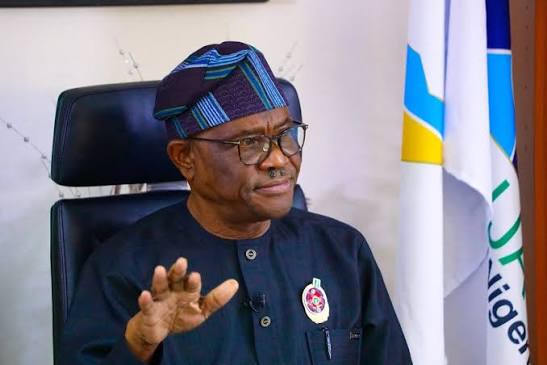
Minister of the Federal Capital Territory, Nyesom Wike, has ordered the immediate demolition of houses and other structures erected on designated water channels in Abuja, declaring that pressure from senators and other influential Nigerians will not halt the exercise.
Wike issued the directive on Monday, August 17, 2026, while inspecting areas affected by flooding following heavy rainfall in the nation’s capital.
The minister said investigations by the FCT Administration revealed that several buildings had been constructed on waterways designated under the Abuja Master Plan, obstructing the free flow of water and worsening flooding across the territory.
According to him, some of the affected properties belong to serving senators and other prominent Nigerians, but their status would not prevent the government from enforcing planning regulations.
“I’m going to bring those houses down. Any house that is found on the water channel will go down,” Wike said.
“Some of them are senators. Some of them are big men. The next thing you will see is campaign now: ‘Oh, why is he doing this during the period of election? Stop him! Let us finish the election.’
“Whether there is an election or there is no election, all those houses will go down. Heaven will not fall. Rather, heaven will be at peace that the right thing has been done.”
Wike consequently directed the FCT Department of Development Control to identify and demolish every structure obstructing designated waterways.
He gave officials until Saturday to begin carrying out the directive, warning that the administration would not accept excuses or delays.
“From today to Saturday, if Development Control delays, let them find any excuse to run away. They cannot. We will demolish all those houses found on the water channel,” he said.
The minister attributed the flooding to natural and human factors, including climate change, unusually heavy rainfall, inadequate desilting of drains, indiscriminate refuse disposal and the construction of buildings on waterways and land not designated for development.
Wike acknowledged that flooding had become a global challenge affecting even developed countries but maintained that the government must address preventable human activities contributing to the problem in Abuja.
“We are in a climate-change period. The kind of rains we have experienced, or are experiencing now, we have not experienced before. But that is not to say there are no man-made factors. There are, and it is those man-made factors we have been trying to tackle, and we will continue to tackle.”
“We are in a climate-change period. The kind of rains we have experienced, or are experiencing now, we have not experienced before. But that is not to say there are no man-made factors. There are, and it is those man-made factors we have been trying to tackle, and we will continue to tackle.”
The minister said inspections conducted after the flooding exposed several locations where buildings had been erected on channels reserved for the passage of water.
He suggested that previous administrations might have lacked the political will to remove the structures, insisting that his administration would not allow political considerations or the social standing of property owners to override public safety.
Wike also rejected suggestions that the demolition would disproportionately affect poor residents, maintaining that most of the buildings identified belonged to wealthy Nigerians who disregarded planning regulations.
“Of all the areas we have gone to, mention anything there that was caused by a poor person. All those built-up areas that were not supposed to be built up—not a single poor person lives there. Those houses were built by well-to-do Nigerians,” he said.
He further directed the immediate desilting of drainage systems in affected areas and urged residents and traders to stop dumping refuse in drains.