
By NaijaonpointOnline
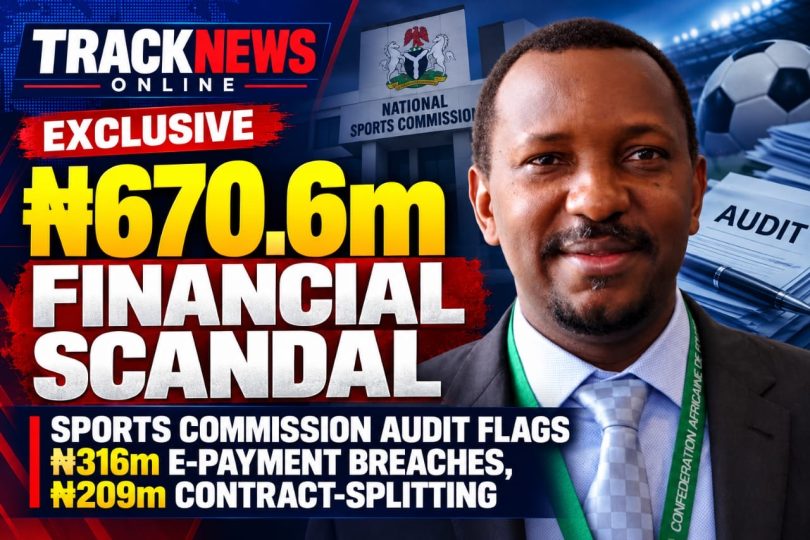
An investigation into the National Sports Commission (NSC) has raised questions over financial transactions totalling ₦670.69 million during the 2023 financial year, including alleged breaches of the Federal Government’s e-payment policy, contract splitting and expenditure lacking adequate supporting documentation.
The findings, which cover five separate financial and procurement issues, have drawn attention to the Commission’s financial management procedures, procurement compliance and accountability for public funds allocated to sports administration and development.
According to the audit findings, the transactions under review amount to ₦670,689,398.63, with the largest portion linked to payments reportedly made in violation of the government’s approved e-payment policy.
The findings also include contracts allegedly split to circumvent applicable procurement thresholds, payments made without relevant supporting documents, expenditure without evidence of utilisation and procured items missing the required entries in store records.
₦316.21m E-Payments Under Question
The largest item identified in the investigation is ₦316,214,089 reportedly paid in violation of the Federal Government’s e-payment policy.
The policy is designed to ensure that government transactions pass through approved payment channels, strengthening transparency, traceability and accountability in the management of public funds.
The audit finding raises questions about compliance with the prescribed payment procedures and the adequacy of controls governing the Commission’s financial transactions.
However, the finding alone does not establish that the money was stolen or misappropriated. Further clarification would be required to determine the circumstances surrounding the payments and whether corrective measures were subsequently taken.
₦209.65m Contracts Allegedly Split
Another major issue concerns contracts valued at ₦209,652,537.74, which the audit reportedly identified as having been split in a manner that circumvented applicable procurement and approval thresholds.
Nigeria’s public procurement framework establishes procedures and approval requirements for government contracts, including safeguards against the artificial division of procurement transactions to avoid applicable rules.
The allegation raises questions about whether the contracts were processed in accordance with the relevant procurement requirements and whether the necessary approvals were obtained.
Contract splitting can undermine procurement oversight by potentially allowing transactions to bypass approval levels and competitive procedures designed to promote transparency and value for money.
The specific contracts involved, the officials responsible for their approval and any responses from the Commission would be necessary to establish the full circumstances of the finding.
₦56.25m Paid Without Supporting Documents
The audit also questioned ₦56,255,212.69 reportedly paid without the relevant supporting documents.
Supporting documents are essential for verifying government expenditure, establishing the purpose of payments and confirming that transactions were properly authorised.
Where such records are unavailable, auditors may be unable to establish from the documents examined whether the expenditure was justified and processed in accordance with applicable financial regulations.
The finding therefore raises questions about the adequacy of the Commission’s documentation and record-keeping procedures during the period under review.
₦48.69m Expenditure Without Evidence of Utilisation
A further ₦48,695,400 was reportedly disbursed without evidence showing how the funds were utilised.
The absence of utilisation records presents an accountability concern because public institutions are expected to maintain sufficient documentation to demonstrate how allocated funds were spent and whether the intended purposes were achieved.
The audit finding does not, on its own, prove that the money was diverted. However, it highlights the need for the Commission to provide records explaining the expenditure and demonstrating how the funds were applied.
₦39.87m in Store Items Not Properly Recorded
The investigation also identified a discrepancy involving ₦39,872,159.20 worth of items reportedly not taken on ledger charge.
Store ledger records are used by public institutions to document the receipt, movement and control of procured goods.
Failure to enter purchased items into the appropriate records can weaken inventory controls and make it more difficult to verify whether the goods were received, properly accounted for and deployed for their intended purposes.
The finding raises questions about the Commission’s inventory management procedures and compliance with the financial regulations governing government stores.
Five Findings Total ₦670.69m
The five issues identified in the audit are summarised below:
Audit finding Amount
Payments reportedly made in violation of the e-payment policy ₦316,214,089.00
Contracts allegedly split to circumvent procurement thresholds ₦209,652,537.74
Payments without relevant supporting documents ₦56,255,212.69
Expenditure without evidence of utilisation ₦48,695,400.00
Items not taken on store ledger charge ₦39,872,159.20
Total ₦670,689,398.63
The findings cut across payment procedures, procurement compliance, expenditure documentation and inventory management.
Taken together, they highlight questions about the internal controls and financial accountability mechanisms operating within the Commission during the period examined.
The procurement-related finding is particularly significant because compliance with approval thresholds and established contracting procedures is a key safeguard against the circumvention of public procurement rules.
Similarly, proper documentation of payments and expenditure enables auditors and other oversight bodies to verify transactions and determine whether public funds were used for authorised purposes.
Findings Relate to 2023 Financial Year
The transactions under scrutiny relate to the Commission’s 2023 financial year, before the leadership changes announced in 2024.
In 2024, Shehu Dikko became Chairman of the National Sports Commission, while Bukola Olopade was appointed Director General.
The timing is important in establishing the period covered by the audit and distinguishing the transactions under review from the subsequent leadership’s tenure.
The findings should therefore be considered within the context of the financial year examined, rather than automatically attributed to officials who assumed leadership after the transactions occurred.
Questions Remain Over Accountability
The audit findings raise several questions about the Commission’s financial management during the period under review.
These include what measures were taken to address the alleged e-payment breaches, whether the contracts identified were subsequently examined by procurement authorities, and whether the missing supporting documents and store records were later provided or reconciled.
Clarification is also needed on whether the Commission responded to the audit observations, whether any recoveries or disciplinary measures followed, and whether the relevant oversight authorities recommended further investigation.
NaijaonpointOnline notes that audit queries are not, by themselves, proof of fraud or criminal wrongdoing. The findings require appropriate responses from the institution concerned and, where necessary, further examination by the relevant authorities.
The National Sports Commission’s response to the specific findings, including any explanations, documentary evidence or corrective actions, would be important in establishing the full facts surrounding the ₦670.69 million in transactions.
NaijaonpointOnline will continue to follow developments surrounding public expenditure, procurement compliance and accountability in Nigeria’s sports sector.