
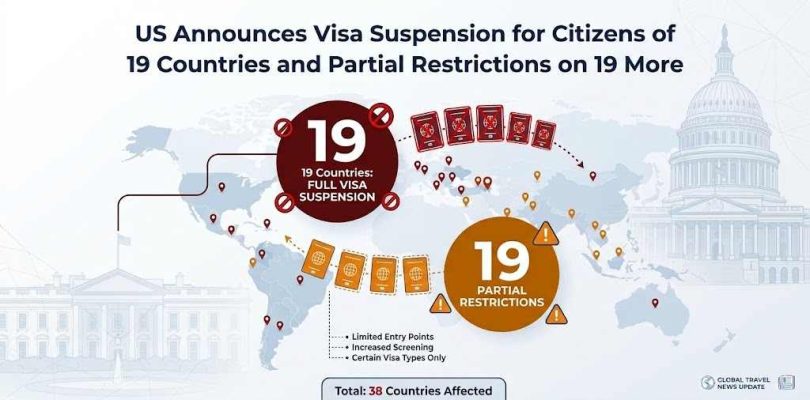
The US government has announced a major shift in its visa policy, suspending visa issuance to nationals of 19 countries and imposing partial restrictions on 19 more, bringing the total number of countries affected to 39.
The policy, established by Presidential Proclamation 10998, went into effect on January 1, 2026, at 12:01 a.m. Eastern Standard Time.
The US Department of State cited national security as the primary justification for the broad restrictions.
Countries facing full visa suspension
Nationals from the following 19 countries, as well as holders of Palestinian Authority travel documents, are not eligible for visas:
- Afghanistan
- Bhutan
- Cuba
- Eritrea
- Haiti
- Iran
- Libya
- North Korea
- Somalia
- South Sudan
- Sudan
- Syria
- Tokelau
- Venezuela
- Yemen
- Belarus
- Myanmar (Burma)
- Central African Republic
- Democratic Republic of the Congo
Countries with partial visa restrictions
An additional 19 countries face partial suspensions of specific visa categories, including B-1/B-2 tourist and business visas, F, M, and J visas for students and exchange visitors, and immigrant visas.
Those countries are:
- Angola
- Antigua and Barbuda
- Benin
- Burkina Faso
- Cambodia
- Cameroon
- Chad
- Republic of the Congo
- Equatorial Guinea
- Gambia
- Laos
- Mauritania
- Nigeria
- Pakistan
- Saint Kitts and Nevis
- Saint Lucia
- Sierra Leone
- Turkmenistan
- Vanuatu
Nigeria’s inclusion in the partial restriction category is particularly significant given the large number of Nigerians who apply for US visas each year under the tourist, student, and immigrant categories.
Who’s still eligible?
The proclamation includes only a few exceptions. Holders of diplomatic visas, lawful permanent residents (LPRs), Special Immigrant Visa (SIV) holders, dual nationals traveling on a passport from an unaffected country, and participants in certain sporting events may be eligible for entry or visa issuance despite the restrictions.