
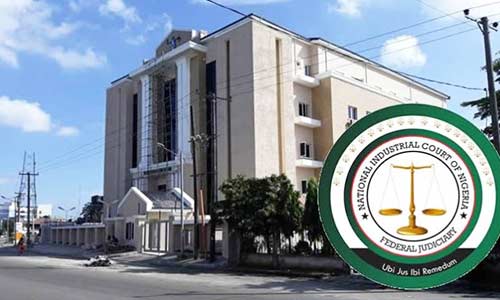
The National Industrial Court of Nigeria, sitting in Uyo, Akwa Ibom State, has declared unlawful, null and void the Akwa Ibom State Government’s dissolution of task forces and enforcement committees established by the National Union of Road Transport Workers (NURTW), holding that the state government lacks the authority to interfere with the internal affairs and statutory functions of a registered trade union.
The court also restrained the state government and other defendants from further interference with the union’s statutory responsibilities and awarded ₦2 million in damages in favour of the NURTW and five other claimants for the infringement of their rights and undue interference with their operations.
Delivering judgment, the presiding judge, Justice Salisu Danjidda, held that the state government’s decision to dissolve enforcement committees established by unions in the transport sector under the guise of maintaining law and order amounted to an infringement of the rights of the NURTW and an unlawful encroachment on powers reserved for the Federal Government.
Justice Danjidda maintained that the NURTW, being a registered trade union under the Trade Unions Act, was not an agency or body under the control of the Akwa Ibom State Government that could be subjected to arbitrary interference or dissolution at the government’s pleasure.
The dispute arose after the NURTW and five other claimants challenged the state government’s decision to dissolve enforcement committees constituted by unions operating within the transport sector.
According to the claimants, the NURTW had established an enforcement committee to ensure orderliness, compliance with union regulations and the effective coordination of activities among its members.
The union stated that it formally notified the Akwa Ibom State Government on January 16, 2026, of its intention to inaugurate the committee.
However, despite the notification, the state government issued a public notice dated February 12, 2026, purporting to dissolve all task forces and enforcement committees established by unions in the transport subsector, including the committee constituted by the NURTW.
The claimants maintained that the action amounted to an unlawful interference with the internal administration and statutory responsibilities of the union.
They also challenged the state government’s proposed compulsory biometric registration and updating of information relating to commercial tricycle and minibus operators in Akwa Ibom State.
The union further opposed the proposed electronic payment of check-off dues, arguing that the measures encroached on responsibilities legally assigned to the NURTW under the Trade Unions Act.
Consequently, the claimants approached the National Industrial Court seeking declarations affirming their statutory rights and orders restraining the state government and other defendants from further interference with the union’s activities.
In their defence, the Akwa Ibom State Government and the other defendants maintained that the introduction of Unified Government Approved Tickets was part of the government’s responsibility to administer and regulate commercial transportation within the state.
They argued that the tickets were administrative transport fees introduced for the development of the state and should not be confused with union check-off dues.
The defendants also explained that the proposed compulsory biometric registration was intended to establish an accurate database of commercial transport operators operating within Akwa Ibom State.
They further contended that the public notice issued by the state government was directed specifically at enforcement committees within the transport sector.
On these grounds, the defendants urged the court to dismiss the claims brought by the NURTW and the five other claimants.
Responding on points of law, counsel to the claimants, Chief Martins Ekung, argued that neither the Akwa Ibom State Government nor the Commissioner for Transport possessed the legal capacity to issue daily tickets in the nature of trade union check-off dues.
He maintained that because the state government and its Commissioner for Transport were neither members nor officials of a registered trade union, they could not lawfully impose such tickets on workers engaged in transporting passengers and goods by road within Akwa Ibom State.
In its judgment, the court rejected the justification advanced by the defendants for interfering with the union’s internal activities.
Justice Danjidda held that the governor’s position as the Chief Security Officer of the state did not confer authority on the government to interfere with the internal administration of a trade union registered and recognised under federal law.
The judge explained that where members of a trade union were involved in acts capable of causing public disorder or breaching the peace, the state government was entitled to take lawful measures against the individuals responsible.
However, the court held that such circumstances did not justify the wholesale dissolution of task forces and enforcement committees lawfully established by a registered trade union.
According to the court, where there was a reported case of mayhem or breach of public peace involving union members, the appropriate response was to arrest and prosecute those responsible rather than interfere with the union’s statutory structures.
Justice Danjidda consequently declared that the state government’s interference with the NURTW’s enforcement committees was unlawful, null and void.
The court further held that the action infringed the claimants’ rights and amounted to an unlawful usurpation of powers belonging to the Federal Government.
The judge also ruled that the defendants, not being registered trade unions under the Trade Unions Act, could not lawfully undertake activities reserved for trade unions or perform acts in furtherance of trade union purposes within the state.
Justice Danjidda affirmed the authority of the NURTW to constitute enforcement committees for the purpose of organising and controlling its members, maintaining orderliness and addressing their welfare.
The court further held that the Akwa Ibom State Government lacked the legal authority to introduce tickets belonging to the sphere of trade union activities or incorporate a body of persons for purposes covered by the Trade Unions Act without the necessary legal backing.
It maintained that any forceful issuance of such tickets or interference with the statutory jurisdiction of the NURTW amounted to an unlawful encroachment on the union’s functions.
Having found that the state government’s actions constituted unlawful interference with the union’s operations and statutory rights, the court granted relief in favour of the claimants.
Justice Danjidda restrained the Akwa Ibom State Government and the other defendants from further interference with the NURTW’s statutory functions.
The court also ordered the defendants to pay ₦2 million in damages to the NURTW and five other claimants for the undue interference with the union’s operations and infringement of its legally guaranteed rights.
Post Title: “Unlawful, Null And Void” — Court Sets Aside Akwa Ibom Govt’s Dissolution Of NURTW Enforcement Committees, Awards ₦2m Damages By Naijaonpoint.