
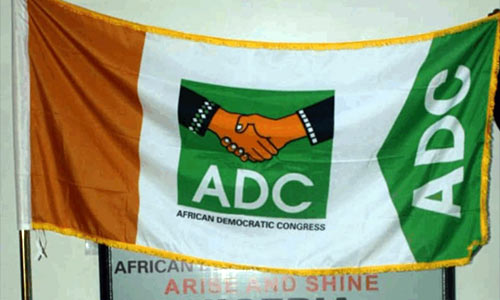
The Federal High Court in Abuja has nullified the emergence of Tukur Ribadu as the African Democratic Congress (ADC) governorship candidate for Adamawa State and ordered the Independent National Electoral Commission (INEC) to recognise Omar Suleiman, who won the party’s governorship primary election, as its candidate.
Justice Obiora Egwuatu, who delivered the judgment on Friday, held that the ADC had no valid basis for substituting Suleiman with Ribadu after the former emerged victorious in the party’s governorship primary.
The court consequently directed the ADC to forward Suleiman’s particulars to INEC for publication as its governorship candidate in Adamawa State.
Justice Egwuatu specifically ordered the party to “forward Mr Suleiman’s details to INEC for publication as its governorship candidate.”
The judge also directed INEC not to “recognise or publish” Ribadu’s name as the ADC governorship candidate and restrained Ribadu “from parading himself as the ADC governorship candidate for Adamawa State.”
The judgment followed a suit instituted by Suleiman challenging the decision of the ADC leadership to replace him with Ribadu despite his victory at the party’s primary election.
Suleiman maintained that he had lawfully emerged as the party’s candidate and that the subsequent substitution was not supported by any valid appeal process or lawful decision capable of overturning the primary election result.
Before determining the substantive issues, Justice Egwuatu considered preliminary objections filed by the ADC and Ribadu challenging the competence of Suleiman’s suit.
The ADC urged the court to strike out the action, arguing that it was incompetent, statute-barred and an abuse of court process.
Ribadu also challenged the court’s jurisdiction to entertain the matter and sought its dismissal.
One of the objections concerned the length of the written address filed by Suleiman in support of his case.
The defendants argued that the address contained 17 pages, exceeding the 15-page limit prescribed by the Federal High Court’s Election Proceedings Practice Directions.
They consequently urged the court to strike out the suit for failure to comply with the applicable procedural requirements.
However, Suleiman opposed the objection, maintaining that exceeding the prescribed page limit by two pages was insufficient justification for terminating the proceedings.
In his ruling, Justice Egwuatu acknowledged that the plaintiff’s written address exceeded the stipulated limit by two pages.
The judge nevertheless declined to strike out the case, holding that such a decision would not serve the interests of justice.
The court also considered the ADC’s argument that the suit relied on a constitutional provision that was inapplicable to the party.
Justice Egwuatu rejected the objection, holding that the argument did not establish that the action was incompetent at the preliminary stage.
The defendants further contended that the suit was statute-barred under the constitutional provisions governing pre-election matters.
They argued that Suleiman failed to institute the proceedings within the mandatory 14-day period prescribed by the Constitution.
According to the defendants, the plaintiff ought to have approached the court earlier instead of waiting until August 6, when the action was filed.
However, Justice Egwuatu rejected the contention and held that Suleiman commenced the suit within the constitutional time limit.
The court consequently refused to terminate the action on the ground that it was filed outside the prescribed period.
Another objection raised by the defendants concerned Suleiman’s failure to exhaust the ADC’s internal dispute-resolution mechanism before approaching the Federal High Court.
The party and Ribadu argued that the plaintiff should have pursued the available internal remedies before seeking judicial intervention.
Justice Egwuatu, however, rejected the argument, reasoning that requiring Suleiman to exhaust the party’s internal dispute-resolution process could have resulted in the expiration of the 14-day constitutional period for instituting a pre-election action.
The judge held that Suleiman was entitled to approach the court to protect his rights rather than allow the constitutional timeframe to expire while pursuing internal party procedures.
Having dismissed the preliminary objections, the court proceeded to examine the circumstances surrounding the ADC governorship primary and the subsequent substitution of Suleiman with Ribadu.
The central issue was whether Ribadu had validly challenged the primary election result before a properly constituted party appeal committee and whether the ADC had a lawful basis for replacing the declared winner.
Suleiman maintained that no properly constituted appeal committee had reviewed the governorship primary election.
He also argued that there was no evidence establishing that Ribadu appeared before such a committee or successfully challenged the election result.
The ADC and Ribadu, however, maintained that an appeal had been lodged against the primary election result.
According to the defendants, the party’s appeal committee reviewed the dispute and submitted a report to the National Working Committee (NWC).
They argued that the NWC subsequently considered the report and adopted a resolution on May 29, leading to Ribadu’s recognition as the party’s governorship candidate.
Ribadu also maintained that his name was submitted to INEC following the party’s decision to review the disputed result.
In determining the controversy, Justice Egwuatu examined documentary evidence from an earlier suit involving another governorship aspirant.
The documents, which Suleiman relied upon, included court processes filed by the ADC and statements made by party officials responsible for conducting the primary election.
The judge observed that the ADC’s processes in the earlier proceedings did not disclose that Ribadu had submitted a petition to the appeal committee or that any such committee had determined a petition in his favour.
The court also considered affidavits made by the chairman and secretary of the ADC’s Adamawa State Governorship Primary Election Committee.
According to the judgment, the officials denied that an appeal committee had been constituted to review the governorship primary election.
Justice Egwuatu further examined the report of the primary election committee, which indicated that no petition had been received at the time the committee submitted its report.
The report also recorded that there was no violence at the venue of the primary election.
The court found no evidence establishing that Ribadu had successfully challenged Suleiman’s victory through the ADC’s appeal process.
Consequently, Justice Egwuatu upheld Suleiman’s position that he emerged as the lawful winner of the party’s governorship primary election.
The judge held that the ADC had no valid basis for replacing him with Ribadu.
The dispute arose after Suleiman, a former Managing Director of the Nigerian Ports Authority and former Nigerian Ambassador to the Democratic Republic of the Congo, defeated Ribadu and another aspirant, Umar Uba, in the ADC governorship primary held in May.
According to the declared results, Suleiman secured 143,216 votes across Adamawa State’s 21 local government areas.
Ribadu came second with 56,801 votes, while Uba polled 20,343 votes.
The results were announced in late May by the Chairman of the ADC Adamawa State Governorship Primary Committee, Nicholas Msheliza, who declared Suleiman the winner.
However, the national leadership of the party subsequently endorsed Ribadu as its governorship candidate, notwithstanding Suleiman’s victory at the primary.
The decision prompted Suleiman to approach the Federal High Court, seeking judicial intervention to protect his nomination.
After examining the parties’ arguments and the documentary evidence, Justice Egwuatu ruled in Suleiman’s favour and nullified Ribadu’s emergence as the ADC governorship candidate.
The court directed the party to submit Suleiman’s details to INEC, barred the electoral commission from recognising or publishing Ribadu as the party’s candidate and restrained Ribadu from presenting himself as the ADC governorship candidate in Adamawa State.
The judgment resolves the dispute before the Federal High Court in Suleiman’s favour, subject to any further proceedings that may arise from the decision.
Post Title: “No Valid Basis To Replace Him” — Court Nullifies Tukur Ribadu’s Candidacy, Orders INEC To Recognise Omar Suleiman As ADC Governorship Candidate By Naijaonpoint.