
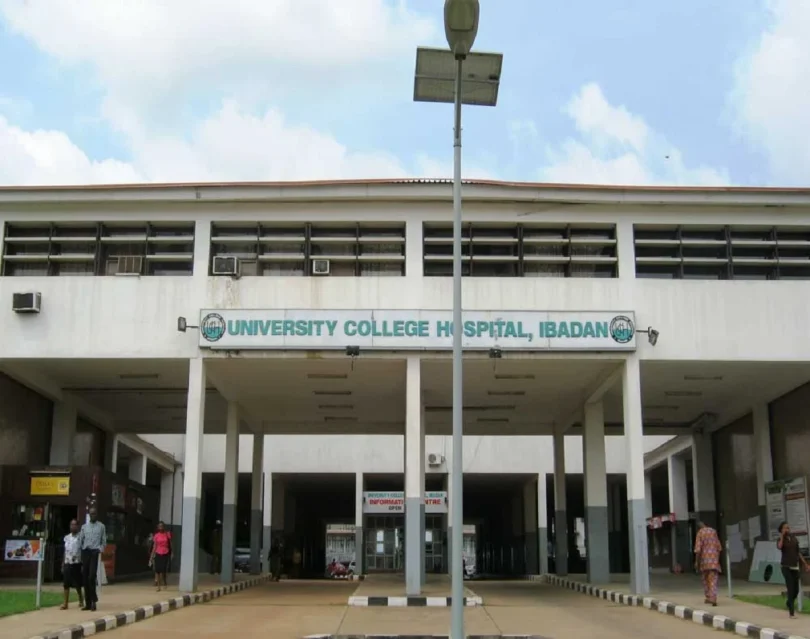
University College Hospital, Ibadan, has emerged as Nigeria’s leading health institution in the 2026 SCImago Institutions Rankings, placing 7,051st globally and among the top 25 per cent of institutions in the international health-sector ranking.
UCH’s performance puts it 1,300 places ahead of its closest Nigerian rival, the Nigerian Institute of Medical Research, Lagos, which ranked 8,383rd globally.
The ranking places Nigeria’s premier teaching hospital ahead of four other institutions that featured on the country’s health-sector list: Lagos University Teaching Hospital, which ranked 9,053rd; Lagos State University Teaching Hospital, 9,860th; University of Ilorin Teaching Hospital, 9,883rd; and Obafemi Awolowo University Teaching Hospitals Complex, 10,668th.
ALSO READ: 2027: Crisis deepens in Plateau NDC over planned guber substitution primary
The SCImago Institutions Rankings, produced in Spain, assessed institutions using 20 indicators across three major areas — research performance, innovation output and societal impact.
Research performance carries the highest weighting at 50 per cent, followed by innovation at 30 per cent and societal impact at 20 per cent.
The research component measures publication output, citation impact, presence in top-quartile journals, international research collaboration and open-access publications.
Innovation is assessed through indicators including patents and technological impact, while societal impact considers web visibility, media mentions, contributions to the United Nations Sustainable Development Goals and influence on public policy.
Reacting to the ranking, the Chief Medical Director of UCH, Prof. Jesse Abiodun Otegbayo, attributed the achievement to the commitment of the hospital’s workforce.
He described the recognition as “a collective achievement due to the contributions of all our committed and dedicated staff who toil day and night to keep services going on despite the challenges and the difficult work terrain.”
Otegbayo said the ranking would motivate staff to sustain their contributions to the institution and the nation’s healthcare system.
He also commended the Federal Government for prioritising the health sector while calling for greater investment in healthcare infrastructure and personnel.
The CMD specifically advocated improved funding, stable electricity, better infrastructure and enhanced remuneration for healthcare workers.
“I celebrate this ranking on behalf of and over the shoulders of our greatest assets, our staff, as it perfectly aligns with the mantra of the current administration of Shared Vision for Excellence,” he said.
Established on November 20, 1957, UCH was Nigeria’s first teaching hospital. It is affiliated with the University of Ibadan College of Medicine and serves as a major referral centre for southwestern Nigeria.
The hospital is also one of Nigeria’s eight federally funded Cancer Centres of Excellence.
Its research capacity has received additional support through internal funding initiatives. In October 2024, Otegbayo awarded research grants to six members of staff.
The University of Ibadan’s medical research community has also recorded international recognition, with Prof. Godwin Ogbole, a clinician-researcher, becoming the first indigenous African Senior Fellow of the world’s leading MRI society this year.
Despite UCH’s strong performance, the ranking highlights the relatively limited global research presence of Nigeria’s health institutions.
Only six Nigerian institutions featured in the health-sector ranking, five of them teaching hospitals.
Nigeria’s representation was considerably smaller than that of countries such as Egypt, South Africa and Kenya, which recorded stronger performances in the ranking.
The Kenya Medical Research Institute emerged as Africa’s highest-ranked institution in the health-sector category.
State hospitals, federal medical centres and private healthcare providers were not represented among the Nigerian institutions listed.
The development underscores the need for increased investment in medical research, innovation and healthcare infrastructure if Nigerian institutions are to improve their global competitiveness.
SCImago, which also publishes the Scopus-powered Journal & Country Rank, says its indicators are designed to enable institutions to benchmark their performance in research, innovation and societal impact.