
John Maynard Keynes once remarked that “in the long run we are all dead.” It was not an argument against reform. It was a warning that governments cannot ask people to endure present hardship indefinitely while promising future prosperity. That warning has become increasingly relevant in Nigeria.
Over the past three years, the government has undertaken one of the country’s most ambitious economic reform programmes in decades. Fuel subsidies were removed. The naira was floated. Electricity tariffs rose. Interest rates climbed to their highest level in years. Four new tax laws were signed.
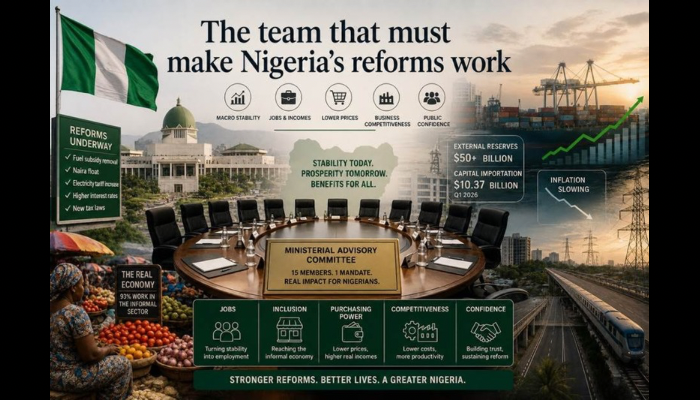
Most economists agree many of those decisions were necessary. The bigger question today is no longer whether the reforms were right. It is whether Nigerians will ever feel their benefits. That is why the Federal Government’s newly inaugurated 15-member Ministerial Advisory Committee may become one of the most important institutions of the reform era.
Its assignment is not to design another reform programme. Those decisions have largely been taken. Its task is considerably harder: ensuring the reforms already introduced begin producing visible improvements in jobs, incomes and living standards before public confidence in the reform agenda begins to fade.
The hardest phase of reform has just begun
Correcting macroeconomic distortions was always the easier part. Turning macroeconomic stability into broad-based prosperity is where reform programmes often succeed or fail.
Three years into the reform programme, Nigeria’s macroeconomic indicators are considerably stronger. External reserves have risen above $50 billion. Capital importation reached a record $10.37 billion in the first quarter of 2026. The exchange rate has stabilised after the volatility that followed the naira float, while economic growth has strengthened.
Yet most Nigerians experience the economy differently. They judge it by the price of rice, transport fares, electricity bills and school fees rather than foreign reserves or capital inflows. Inflation has slowed sharply from its peak, but prices remain far above where they stood before the reforms began. The World Bank estimates that inflation pushed millions more Nigerians into poverty, while National Bureau of Statistics surveys consistently show food remains the biggest pressure on household budgets.
That disconnect between stronger macroeconomic indicators and weaker household welfare explains why this committee matters. Its success will determine whether Nigeria’s reforms become an economic recovery people can actually feel.
The committee faces five implementation tests
The committee is not being asked whether fuel subsidies should return or whether the exchange rate should be fixed again. Those debates are largely over. Its challenge is making existing reforms work better. Five tests will determine whether it succeeds.
The first is converting stability into jobs. Investor confidence has improved, capital inflows have surged and macroeconomic conditions are more stable than they were three years ago. Yet employment has not improved at the same pace because most of the new capital has gone into portfolio investments rather than productive sectors capable of generating large-scale employment. Unless reforms begin attracting more investment into manufacturing, agriculture and other productive industries, stronger economic growth will remain largely invisible in the labour market.
The second is making reforms reach the informal economy. According to the National Bureau of Statistics Labour Force Survey and the Nigerian Economic Summit Group’s From Hustle to Decent Work report, about 93 percent of employed Nigerians work outside the formal economy. They are traders, transport operators, artisans, mechanics, farmers and owners of micro-enterprises.
Most do not borrow from commercial banks. Most are outside formal tax systems. Most are not covered by the minimum wage. Yet they account for the overwhelming majority of employment. That means many of government’s most important policy tools reach only a small fraction of the people they are supposed to help. The committee must find ways to ensure reforms benefit the economy Nigerians actually work in rather than only the economy policymakers usually regulate.
The third is restoring purchasing power without reversing reform. Inflation has slowed, but households continue to struggle because prices remain substantially higher than before the reforms began. The challenge is no longer reducing inflation alone. It is ensuring that lower inflation eventually translates into stronger real incomes through higher productivity, better food supply, lower logistics costs and more competitive markets, without undermining the macroeconomic stability already achieved.
The fourth is reducing the cost of doing business. Businesses continue to borrow at interest rates above 30 percent while grappling with unreliable electricity, rising logistics costs and multiple taxes. These constraints discourage expansion even as investor sentiment improves. Unless businesses can invest, produce and employ more workers, macroeconomic recovery will remain disconnected from household welfare.
The fifth is rebuilding public confidence. Economic reforms survive only while citizens believe the sacrifices are temporary and worthwhile. That confidence is becoming increasingly difficult to sustain. If Nigerians continue to experience only the costs of reform while the benefits remain largely invisible, public support for the broader reform programme will weaken regardless of improvements in reserves, exchange rates or GDP growth.
From policy design to policy delivery
When Taiwo Oyedele inaugurated the committee, he urged members to think beyond policy design. He asked them to identify second- and third-order effects before they become crises, monitor how reforms affect businesses and households, and recommend practical adjustments that improve implementation.
That mandate reflects an important shift in government’s priorities. The first phase of reform focused on correcting macroeconomic distortions. The second phase is about execution. It is about ensuring stronger public finances improve public services, higher investor confidence creates more jobs, and lower inflation eventually restores purchasing power.
Those are implementation challenges rather than policy challenges, and they are considerably harder to solve.
Why success matters
The committee’s work extends beyond economics. It is increasingly about the credibility of the reform agenda itself.
Abubakar Suleiman, Managing Director of Sterling Bank and chairman of the advisory committee, acknowledged this reality when he said the committee would focus on understanding “what Nigerians are really saying, where they are truly feeling the pain, which policies are working,” and ensuring those realities shape government decision-making.
That may prove the committee’s greatest contribution. Not producing another report, but serving as the mechanism that reconnects government policy with economic reality.
Nigeria has largely completed the first phase of reform. Prices have been liberalised. The exchange rate has adjusted. Government revenues have improved. The more difficult phase begins now: ensuring those gains become visible in households, businesses and communities.
If the committee succeeds, Nigerians should gradually experience reforms through stronger job creation, rising real incomes, more productive businesses and greater confidence in the economy.
If it fails, Nigeria risks creating an increasingly dangerous imbalance: healthier macroeconomic indicators alongside growing public frustration. That would leave the government with stronger economic fundamentals but weaker public legitimacy. Three years after Nigeria embarked on its most ambitious economic reforms in decades, that is the risk the committee has been appointed to prevent.