
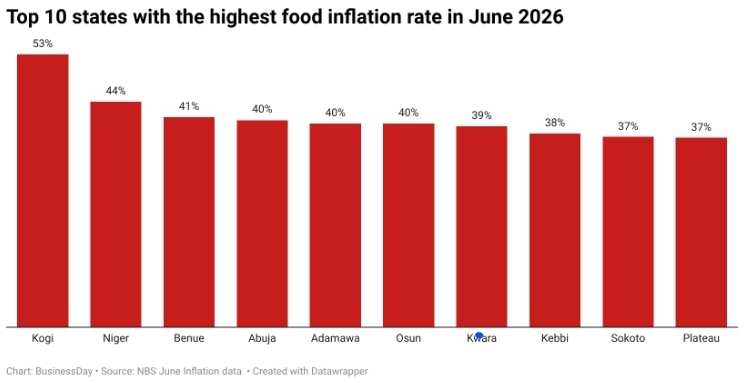
Despite Nigeria’s easing headline inflation, food prices remain high across many states, with Kogi and Niger emerging as the country’s food inflation hotspots as households continue to grapple with rising costs of basic staples.
Latest data from the National Bureau of Statistics (NBS) show that Kogi, the Confluence State, recorded the highest food inflation rate in the country at 53.02 percent year-on-year in June 2026, far above the national average of 17.52 percent.
Niger followed with 43.83 percent, while Benue posted 40.83 percent, highlighting persistent regional disparities in food prices.
In contrast, Imo recorded the lowest food inflation at 19.47 percent, followed by Ebonyi (20.79 percent) and Katsina (21.87 percent), according to the Consumer Price Index (CPI) report released by the NBS.
The latest figures underscore the uneven impact of inflation across Nigeria, with consumers in several food-producing states still facing sharp increases in the prices of essential commodities despite broader signs that inflationary pressures are easing.
According to the report, food inflation persists in June. Nigeria’s food inflation rate continued to rise, reaching 17.52 percent in June, up from 16.96 percent in the previous month, compared to 25.41 percent recorded in the same period of 2025.
On a month-on-month basis, food inflation accelerated to 3.75 percent, up from 2.98 percent in May, suggesting that the cost of food continued to rise between May and June.
The NBS attributed the monthly increase to higher prices of staples, including crayfish, fresh pepper, tomatoes, dried green peas, yam flour, water yam, beef, bananas, cassava flour, cowpeas, garri, Irish potatoes, and yam tubers.
On a monthly basis, Niger recorded the sharpest increase in food prices at 11.65 percent, followed by Katsina (8.13 percent) and Kwara (7.52 percent). In contrast, Bayelsa recorded the steepest decline at -6.48 percent, while Benue (-5.58 percent) and Cross River (-5.12 percent) also experienced lower month-on-month food inflation.
The latest state-level data come as Nigeria’s broader inflation environment shows signs of moderation.
BusinessDay earlier reported that the country’s headline inflation rate eased to 15.91 percent in June, marking its first decline in five months and strengthening expectations that the Central Bank of Nigeria (CBN) may keep its benchmark interest rate unchanged at its next Monetary Policy Committee meeting.
According to the Central Bank of Nigeria’s June 2026 Inflation Expectation Survey, the inflation perception index stood at 45.0 points during the month, although respondents expect it to moderate to 32.2 points in July.
The survey revealed that 72.2 percent of microbusinesses perceived inflation as high, the highest among business categories, while 64.3 percent of small businesses shared the same view.
“Among households, 76.4 percent of rural respondents perceived inflation as high, slightly above 75.8 percent recorded among urban households. Energy costs, insecurity, high interest rates, and exchange rate movements remained the four biggest drivers shaping inflation expectations among businesses and households,” the CBN report said.