
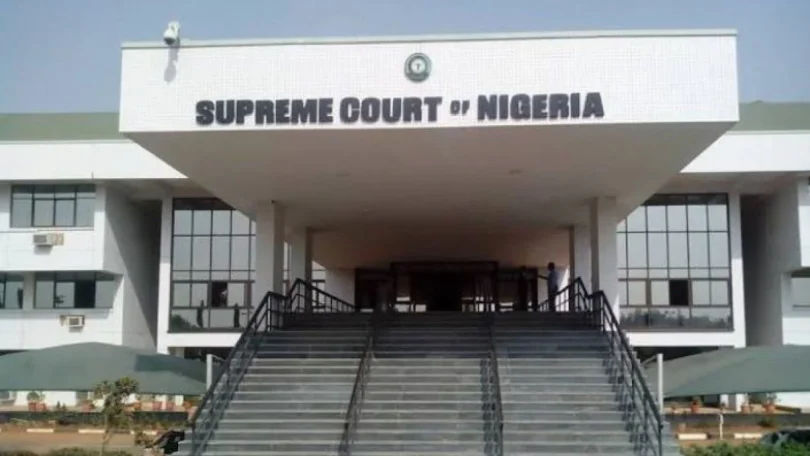
The Supreme Court of Nigeria’s decision, which validated key provisions of the Electoral Act 2026, on Sunday sparked divergent legal opinions among Senior Advocates of Nigeria (SANs) on its implications for political parties, candidates and actions already taken under the disputed provisions.
It would be recalled that the highest court in the country had on Thursday, September 24, 2026, upheld an appeal by the Independent National Electoral Commission (INEC) and restored Sections 77(5), 77(6), 77(7) and 84(2) of the Electoral Act 2026.
Principally, the provisions concerned political party membership registers and the procedures for nominating candidates for elective positions.
The Supreme Court, through a seven-member panel led by Justice Adamu Jauro, declared that the disputed provisions were not inconsistent with the 1999 Constitution, thereby setting aside the July 16, 2026, judgment of the Court of Appeal, which had voided the provisions following a challenge by the Zenith Labour Party (ZLP).
Before then, the Abuja Division of the Federal High Court had thrown out ZLP’s constitutional challenge in a judgment delivered on May 5, 2026.
However, the Court of Appeal partially allowed the party’s appeal and declared the disputed provisions invalid, prompting INEC to approach the Supreme Court.
Speaking in an exclusive interview with the Nigerian Tribune, a Senior Advocate of Nigeria, Dr Abiodun Layonu, insisted that the question of whether the decision of the Supreme Court would operate retrospectively should be approached differently from the ordinary rule concerning the retrospective application of legislation.
The SAN posited that legislation ordinarily does not operate retrospectively unless the law expressly provides otherwise, subject to constitutional limitations.
However, Dr Layonu distinguished between the operation of legislation and the effect of a judicial pronouncement by the Supreme Court.
In his words, the significance of the apex court’s judgment was that it had now authoritatively determined that the disputed provisions of the Electoral Act were valid.
The SAN explained that because the provisions were part of the Electoral Act from the time the legislation was enacted, the Supreme Court’s validation meant that their legal validity had now been affirmed at the highest judicial level.
According to Dr Layonu, “It would therefore be inaccurate to simply describe the judgment as giving the Electoral Act retrospective effect.
“Rather, the Supreme Court had determined the legal status of the provisions as contained in the legislation, meaning that conduct occurring after the enactment of the law could be subject to those provisions where applicable.”
The SAN stressed that the earlier Court of Appeal judgment could not necessarily be relied upon by a candidate or political party seeking to avoid the consequences of the Supreme Court’s subsequent pronouncement.
Dr Layonu maintained that he was not commenting on the merits or outcome of any particular individual case.
Another SAN, Mr Francis Amobi Nzelu, viewed the apex court’s judgment from the perspective of the changing relationship between political parties, candidates, INEC and the electorate.
Nzelu queried the continued relevance of the traditional position that political parties have the final say in determining their candidates, particularly in view of the statutory framework governing party primaries under the Electoral Act 2026.
The SAN said political parties in earlier periods operated under a system in which their conventions effectively selected candidates to represent them in elections.
The senior lawyer suggested that the introduction of direct primaries, under which registered party members participate in determining candidates, had changed the character of the process.
Nzelu held that where a party member had obtained nomination forms, been screened and cleared, participated in a primary election and emerged victorious, questions could arise if the party subsequently sought to remove the person’s name.
The SAN insisted that such circumstances should also be considered from the standpoint of the electorate, which ultimately votes for candidates at general elections.
On his part, human rights crusader Ige Asemudara described the Supreme Court’s decision as a development that would reinforce order and adherence to established electoral rules.
The legal luminary stated that persons who were not listed on the membership register of a political party within the statutory period should not seek to participate in the party’s primary process.
Asemudara referenced instances where aspirants dissatisfied with the outcome of primaries in one political party subsequently moved to another party and sought to contest under its platform.
The Supreme Court, according to Asemudara, had restored clarity regarding the relevance of party membership registers and the statutory requirements governing participation in party primaries.
On the question of retrospectivity, the human rights lawyer argued that a judicial decision is intended to determine the legal position arising from a dispute and provide guidance for the future.
Asemudara insisted that the Supreme Court did not create a new law through its judgment but interpreted the existing provisions of the Electoral Act 2026 and determined their constitutional validity.
Therefore, Asemudara rejected the suggestion that the judgment should simply be characterised as a retrospective application of the Electoral Act.
The senior lawyer maintained that the practical implications of the ruling would be relevant to persons participating in the electoral process where their actions fall within the provisions of Sections 77 and 84 of the Electoral Act 2026.