
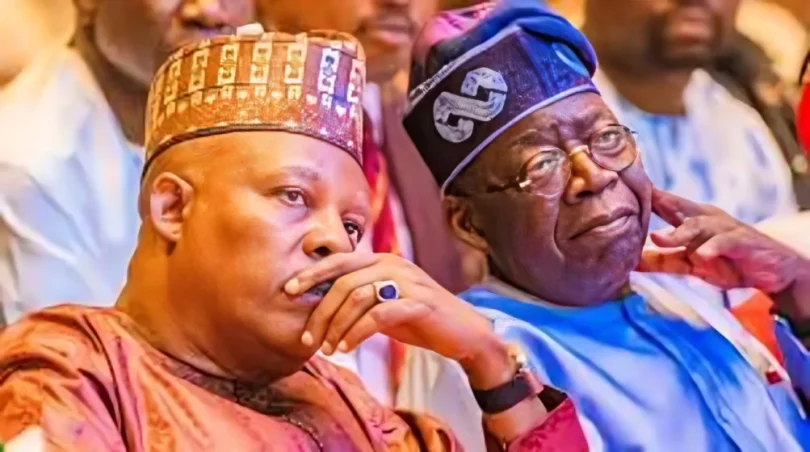
THE simultaneous absence from Nigeria of President Bola Tinubu and Vice-President Kashim Shettima has sparked concerns among constitutional lawyers over the implications for governance and the country’s constitutional order.
The two principal political officeholders are currently outside the country on separate foreign engagements, prompting questions about the continuity of executive authority in the event of an emergency.
President Tinubu embarked on a working vacation on August 30, which has since been extended by a few days. On Monday, it will be 29 days since he left the country, as against the provision of Section 145 (2) of the 1999 Constitution (as amended), which sets a 21-day threshold for the National Assembly to force the formal transmission of power if the president fails to transfer power.
Speaking on the development, constitutional lawyer, Mr Silas Onu, described the situation as unusual, arguing that the government should ensure that the president and vice-president are not simultaneously outside the country.
“Basically, the number one, two, three and four in the hierarchy of Nigeria’s power configuration are absent and out of the territory of Nigeria. This cannot happen in any serious nation,” Onu told Sunday Tribune.
He argued that the state should properly coordinate the activities of national leaders to ensure continuity of government, particularly because of the constitutional implications of an emergency requiring the exercise of presidential powers.
According to him, the simultaneous absence of the president and vice-president could also raise questions about succession and the exercise of the President’s constitutional responsibilities.
“This even affects succession in case of an emergency. As it stands now, our military has no Commander-in-Chief within his area of responsibility, and that simply implies that Nigeria is on autopilot,” he said.
Onu further criticised the foreign engagements, arguing that the country’s leadership should remain focused on its responsibilities at home.
Another lawyer, Mr Aloy Ejimakor, described the situation as exposing what he called a “dangerous constitutional loophole” and a governance deficit.
Ejimakor, a former special counsel to the convicted leader of the proscribed Indigenous People of Biafra, Mazi Nnamdi Kanu, questioned the legal basis for administering the affairs of the country remotely in circumstances where the president and other senior officials are simultaneously outside Nigeria.
While the Presidency has maintained that Tinubu continues to direct affairs remotely, Ejimakor argued that remote administration does not necessarily address the constitutional requirements surrounding the exercise of certain presidential powers.
“Under Section 145 of the 1999 Constitution, the President must transmit power to the vice-president upon proceeding on vacation,” he said.
“Section 146 mandates succession only in cases of permanent vacancy or death, leaving temporary, simultaneous absences legally unaddressed and creating an unacceptable administrative void during national challenges,” he added.
But Dr Monday Ubani, a Senior Advocate of Nigeria (SAN) and former Chairman of the Nigerian Bar Association Section on Public Interest and Development Law (NBA-SPIDEL), noted that the Vice-President is also currently in the United States (US), where he represented the President at United Nations General Assembly (UNGA) proceedings.
While acknowledging that Section 145(2) of the 1999 Constitution (as amended) gives the National Assembly the power to force the transfer of power to Shettima after 21 days of Tinubu’s absence without formal notification, Ubani said the Presidency has described the President’s trip as a “working vacation” which may open up a constitutional loophole.
“Where is the vice-president? The vice-president is in America. The man that you want to be acting, he’s not even in Nigeria, right? While it is true that he is in the US on official duties, the President has also said he is on a working vacation,” Ubani said.
However, Ibrahim Eleja, a lawyer, disagreed that Shettima’s absence from Nigeria was material to the constitutional debate, arguing that while the Vice-President is working in the US, the President is on vacation.
“The vice-president is on official assignment. He is acting in his capacity as the Vice-President. So, it is not as if he is on vacation. Since the President is on vacation, the Vice-President is supposed to be named as an Acting President,” he said.
Eleja also dismissed the positions of the Senate President Godswill Akpabio and Speaker of the House of Representatives, Tajudeen Abbas, in the succession conversation, noting that the Constitution does not provide for either of the legislative leaders to act as president if both the president and vice-president are outside the country.
“There is no provision of the Constitution that says if, in the absence of the vice-president and the president, the Senate president or the speaker can step in. What the Constitution provides is, in the absence of the president, the vice-president should act as Acting President,” he said But the lawyer blamed the National Assembly leaders for failing to act 28 days since Tinubu embarked on his vacation, noting that both chambers should have voted for a resolution that forces the transition of power to Shettima as provided in Section 145(2) of the Constitution.
“The Constitution has already given them the power, and they failed to utilise the power that the Constitution gives to them, which brings us to the present situation where we are now. The National Assembly failed to do what is expected of them. It is a dereliction of duty on their part,” Eleja added.
The lawyers’ concerns centre on the interpretation and practical application of Sections 145 and 146 of the 1999 Constitution, particularly where the president and vice-president are simultaneously outside the country.
The development has consequently renewed debate over whether Nigeria’s constitutional framework provides sufficient safeguards for continuity of government when several of the country’s highest-ranking officials are simultaneously absent from the country.