
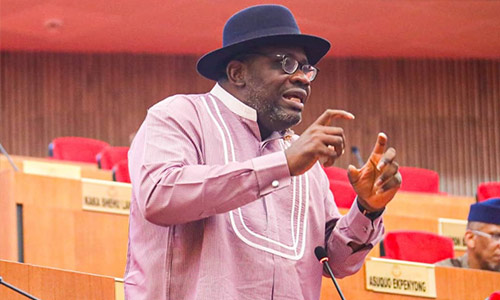
The National Leader of the Nigeria Democratic Congress (NDC), Senator Seriake Dickson, has criticised the Obi-Kwankwaso (OK) Movement for constituting a 59-member Presidential Campaign Council, insisting that support groups should mobilise for candidates rather than create structures that compete with the political party sponsoring them.
Dickson spoke in Abuja while receiving former Secretary to the Government of the Federation, Babachir Lawal, into the NDC, as disagreement between the party leadership and the OK Movement over campaign organisation ahead of the 2027 general elections continued.
The dispute began after the OK Movement, which supports the NDC presidential candidate, Peter Obi, and his running mate, Rabiu Musa Kwankwaso, unveiled a 59-member presidential campaign council on September 17.
The structure named the movement’s Director-General, John Ughulu, to head the campaign organisation, with National Secretary Saadatu Sani among its principal officials. It also provided for zonal and state coordinators and directors responsible for mobilisation, women’s affairs, strategy and planning, security and intelligence, legal affairs, information technology, administration and other campaign functions across the six geopolitical zones and the Federal Capital Territory.
The NDC subsequently dissociated itself from the council.
In a statement, National Chairman Senator Moses Cleopas said the campaign structure did not emanate from the party and should be disregarded, maintaining that no individual, candidate or support group had authority to constitute a campaign council in the NDC’s name without approval from the party’s National Working Committee.
Dickson has now reinforced that position, arguing that while political support groups have an important role in mobilising voters, they should not assume functions reserved for the political party.
“Support groups don’t compete with the political party that is sponsoring candidates. Support groups don’t compete for supremacy and space,” he said.
According to the former Bayelsa State governor, support groups exist primarily to provide grassroots mobilisation and support for candidates rather than function as parallel political organisations.
He added that such groups should neither sponsor candidates nor present themselves as alternative centres of campaign authority.
Dickson described the OK Movement’s decision to establish what it called a presidential campaign council as “unheard of” and “nonsensical”, arguing that support organisations associated with other political parties do not ordinarily constitute presidential campaign councils independent of the parties fielding the candidates.
He nevertheless said the NDC recognised the importance of grassroots groups and remained willing to work with them.
Dickson disclosed that he had held discussions with groups associated with the Obidient movement and said the party welcomed organisations prepared to mobilise support for its candidates, provided their activities complemented rather than competed with the official party structure.
Its leadership maintains that it is an independently organised political movement comprising individuals from different political backgrounds who support the Obi-Kwankwaso presidential ticket.
Its leadership maintains that it is an independently organised political movement comprising individuals from different political backgrounds who support the Obi-Kwankwaso presidential ticket.
Following the NDC’s initial rejection of its campaign council, the movement’s National Secretary, Saadatu Sani, said it did not require the personal approval of any individual within the NDC to conduct what she described as its legitimate internal organisational activities.
The movement also demanded an apology from Cleopas and insisted that it would retain its own leadership, structures and administrative processes.
The disagreement deepened after Dickson’s latest remarks.
Ughulu subsequently maintained that the OK Movement would not collapse, merge or surrender its national, state, local government and ward structures to the NDC or another organisation.
He said the movement respected the NDC’s authority over its own affairs but argued that political cooperation with the party did not extinguish the OK Movement’s separate identity.