
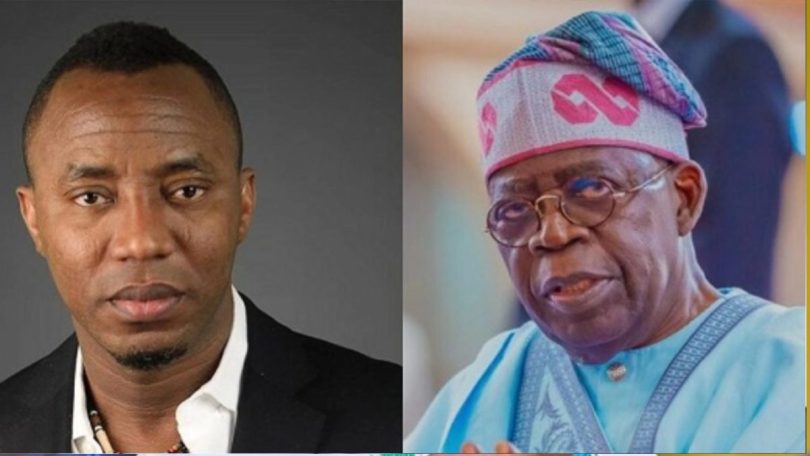
The presidential candidate of the African Action Congress (AAC), Omoyele Sowore, has claimed responsibility for what he described as the Federal Government’s renewed push to reduce transportation costs following President Bola Tinubu’s latest directive on compressed natural gas (CNG) infrastructure.
Sowore, in a statement reacting to Tinubu’s announcement, also criticised former vice-president and presidential candidate of the African Democratic Congress (ADC), Atiku Abubakar.
He accused Atiku of attempting to take credit for mounting pressure on the Tinubu administration over fuel prices and subsidy policy.
His comments came shortly after Tinubu ordered the deployment of an additional 500 CNG refuelling stations nationwide, bringing the planned network under the Federal Government’s programme to 1,000 stations.
The president had said the initiative was designed to expand access to cheaper alternative fuel and ultimately bring down transportation fares across the country.
Tinubu, after meeting with the Governors’ Forum on Thursday, said the governors had agreed to take immediate measures to reduce transport costs in their respective states by expanding the use of CNG-powered and electric vehicles.
He also announced that the Federal and state governments would establish a joint committee to implement measures aimed at lowering transportation costs.
Reacting to the development, Sowore said the government’s latest moves followed pressure mounted by the AAC, particularly his position at the Nigerian Bar Association Annual General Conference in Port Harcourt.
“Don’t let Atiku Abubakar and his clowning group deceive you about fuel subsidy or pretend that they are responsible for the panic now gripping the failed Asiwaju Bola Ahmed Tinubu regime,” Sowore said.
According to him, the AAC had consistently opposed the removal of fuel subsidy, unlike what he described as the shifting positions of established political figures.
“It was our firm and uncompromising stance at the Nigerian Bar Association Annual General Conference in Port Harcourt that sent the Asiwaju Bola Ahmed Tinubu regime scampering,” he added.
Sowore further claimed that Atiku altered his position on fuel subsidy after the conference in an attempt to align himself with the growing opposition to the government’s policies.
“Only the African Action Congress (AAC) made its position absolutely clear that we will not remove fuel subsidy. In fact, by the time we returned from Port Harcourt, Atiku had already changed his position and was scrambling to catch up,” he said.
The AAC candidate accused establishment politicians of changing their positions based on political expediency and external influence, insisting that they should not be allowed to recast themselves as the originators of opposition to the government’s policies.
Sowore’s remarks followed Atiku’s recent pledge to restore petrol subsidy if elected president in 2027.
Atiku, however, said his proposal was different from the former import-subsidy arrangement, arguing that his proposed intervention would be targeted, capped, transparently budgeted and independently audited.
He said the policy would support domestic refining and production while gradually becoming unnecessary as local refining capacity expands and market conditions improve.
“There is no arbitrary withdrawal date. As domestic refining expands, supply stabilises, competition deepens, and the market becomes capable of delivering affordable prices without government support, the intervention progressively becomes unnecessary,” Atiku said.
Meanwhile, Tinubu has said more than 120,000 vehicles have already been converted to CNG nationwide under the Presidential CNG Initiative, with more than 100,000 additional conversion kits being processed.
The president also disclosed that the Midstream and Downstream Gas Infrastructure Fund was financing more than 100 gas projects, including 15 CNG mother stations and 86 daughter stations.
Tinubu said CNG-powered vehicles could reduce fuel expenditure by between 60 and 80 per cent compared with petrol-powered vehicles, creating room for transport fares to fall.
“From October 1, our goal is that Nigerians begin to partake in those savings through lower transport fares,” the president said.