
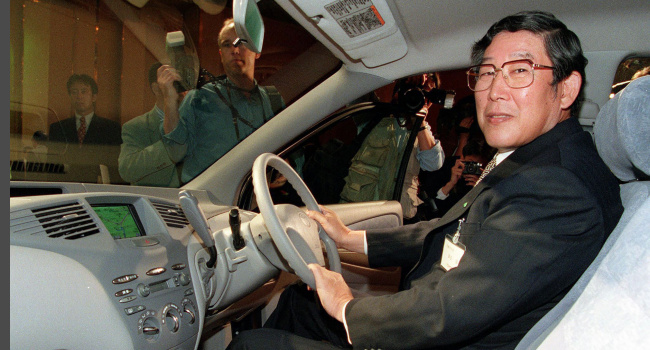
Hiroshi Okuda, the former president of Toyota who helped transform the Japanese automaker from a famously cautious company into a global automotive powerhouse, has died at the age of 93.
Toyota confirmed Okuda’s death on Wednesday, although the company did not immediately disclose further details about the circumstances surrounding his passing.
For many in the automotive industry, Okuda will be remembered not simply as a former Toyota boss, but as a leader who was willing to bet on ideas that seemed too ambitious, or even unrealistic, at the time.
One of his biggest bets was the Toyota Prius.
Today, hybrid vehicles are a familiar sight on roads around the world. But when Toyota began developing the Prius, the idea of combining a petrol engine with electric power for mass-market motorists was still viewed with considerable scepticism.
Okuda was among those who backed the technology.
Okuda took over as Toyota’s president in 1995, becoming the first person outside the company’s founding Toyoda family to lead the automaker in several decades.
He inherited a company widely regarded as disciplined and successful, but also conservative and slow to take major risks.
Okuda wanted to change that.
Rather than simply protect Toyota’s existing strengths, he pushed the company towards a more aggressive strategy built around new products, international expansion and emerging technology.
That approach helped pave the way for the launch of the RAV4 SUV and, more significantly, the Prius.
The Prius went on to become a landmark vehicle in the history of the automobile.
At a time when many industry observers doubted whether hybrid technology could become commercially viable, Toyota committed itself to producing the vehicle on a mass scale.
The decision would eventually prove remarkably prescient.
A Gamble That Changed The Automobile
The Prius became one of the world’s best-known hybrid vehicles and helped establish Toyota as a major force in the development of lower-emission automotive technology.
What once looked like an expensive experiment gradually became a mainstream category.
As fuel costs rose and consumers became increasingly interested in vehicles that could deliver better fuel economy without relying entirely on charging infrastructure, hybrids gained popularity in markets around the world.
Okuda’s decision to back the technology therefore became one of the defining moments of his tenure.
His philosophy was straightforward: Toyota could not remain successful by simply protecting what had worked in the past.
In a 1998 interview with The New York Times, Okuda reflected on the culture he inherited at Toyota.
“Everyone is different. But what I can say about Toyota is that before I became president, the company was considered to be very conservative, so I have tried to make us more aggressive.”
That aggressive mindset would become central to Toyota’s transformation.
Okuda also accelerated Toyota’s international expansion.
Under his leadership, the company increased its manufacturing footprint outside Japan, establishing and expanding factories in overseas markets and moving closer to customers around the world.
The strategy helped Toyota compete more aggressively with established Western automakers.
The company’s expansion eventually contributed to Toyota overtaking General Motors as the world’s largest carmaker by sales volume.
For Toyota, it was a remarkable evolution.
The company had moved from being primarily identified with Japan to becoming one of the most powerful automotive brands on the planet.
Also Read: US cancels 175,000 visas under Trump administration
And Okuda was one of the executives who helped drive that transition.
A Businessman With An Unconventional Streak
Okuda’s reputation extended beyond corporate strategy.
He was known as a strong-willed and outspoken figure who was comfortable challenging established thinking.
He held a black belt in karate and later became an influential voice in Japanese business and government circles.
Okuda served as chairman of Keidanren, Japan’s powerful business federation, and was also involved in advising the Japanese government on economic and industrial issues.
His willingness to venture outside conventional corporate spaces was evident earlier in his career.
While overseeing Toyota’s operations in the Philippines in the 1970s, Okuda reportedly travelled through jungle terrain to meet directly with leftist guerrilla fighters.
The episode offered an early glimpse of the personality that would later define his leadership at Toyota: direct, adventurous and prepared to take risks when circumstances demanded it.
Okuda’s most important contribution may ultimately have been his ability to convince a deeply successful company that success itself could become dangerous if it produced complacency.
He pushed Toyota to move faster, expand further and invest in technology before its commercial potential was obvious.
The Prius became the clearest symbol of that philosophy.
What initially looked like a risky bet on an uncertain future eventually helped shape the direction of the global automobile industry.
As the world continues to debate the future of petrol, hybrid and fully electric vehicles, the decision Toyota made decades ago to embrace hybrid technology remains a significant part of that story.
Hiroshi Okuda is survived by a legacy that extends well beyond the boardroom: he helped persuade one of the world’s biggest carmakers to take the future seriously before the future had fully arrived.