
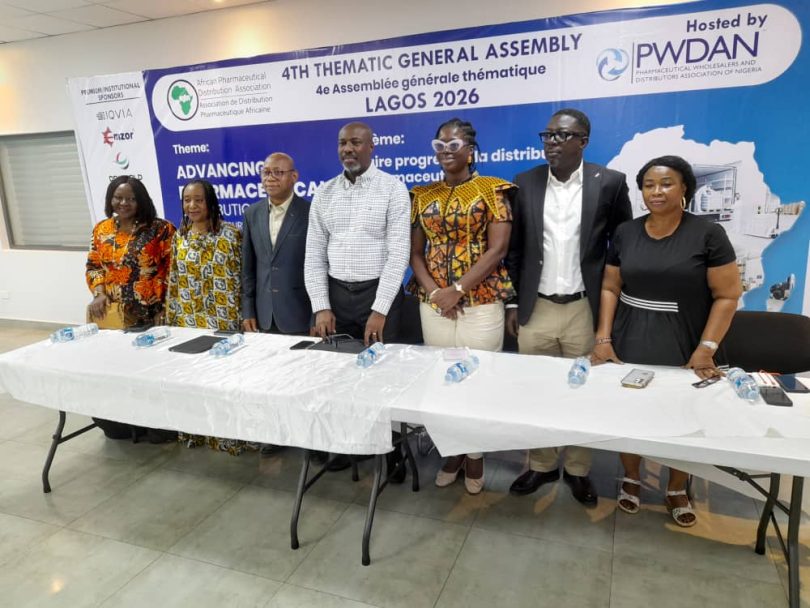
The Pharmaceutical Wholesalers and Distributors Association of Nigeria (PWDAN) has called for stronger traceability, facility inspection, technology-driven authentication and adherence to Good Distribution Practices (GDP) to tackle the circulation of falsified and substandard medicines across Africa.
PWDAN Chairman, Pharm. Ogheneochuko Omaruaye, made the call at a press conference held Tuesday, ahead of the 4th Thematic General Assembly of the African Pharmaceutical Distribution Association (APDA) and PWDAN Conference 2026, scheduled for October 6–8 in Lagos.
The conference, with the theme, “Advancing Pharmaceutical Distribution in Africa: Building Secure Supply Chains Against Falsified Medicines,” is expected to bring together regulators, policymakers, manufacturers, distributors, healthcare professionals, technology providers and development partners.
Omaruaye, who is also the Chief Executive Officer (CEO) of New Heights Pharmaceuticals, said the growing circulation of falsified medicines was no longer merely a regulatory or commercial concern but a major public health and supply-chain security challenge.
According to him, weaknesses at any point in the pharmaceutical supply chain, from manufacturing and importation to warehousing, transportation, wholesale distribution and dispensing, could allow compromised products to reach patients.
He identified poor traceability, weak documentation, fragmented distribution networks, inadequate storage conditions and limited consumer awareness as some of the vulnerabilities being exploited by criminal actors.
He said medicines commonly affected included antimalarials, antibiotics, analgesics, paediatric medicines, herbal remedies, vitamins and dietary supplements.
“When compromised products enter the supply chain, the consequences can be devastating: treatment failure, antimicrobial resistance, avoidable illness and death, loss of confidence in healthcare systems, and significant economic losses to governments and legitimate businesses,” he said.
Omaruaye stressed that “medicine security is healthcare security,” arguing that the quality of medicines manufactured or imported could be undermined if proper controls were not maintained throughout their distribution.
He said particular attention would be given at the conference to warehousing standards, transportation conditions, temperature monitoring, humidity control and other critical parameters required to preserve pharmaceutical product integrity.
The PWDAN chairman said the Lagos Assembly would focus on strengthening pharmaceutical supply-chain security through improved traceability and product authentication, technology deployment, GDP compliance, professional capacity development and stronger collaboration between regulators and industry.
Other priorities include regional regulatory harmonisation and improving access to quality-assured medicines across Africa.
He said Nigeria’s strategic position as one of Africa’s largest pharmaceutical markets meant that weaknesses in its distribution system could have consequences beyond its borders, particularly across West Africa.
“A weakness in one supply chain can become a regional challenge. Conversely, a strong and transparent distribution system in Nigeria contributes significantly to medicine security across West Africa and the continent,” he said.
The association also wants greater investment in warehousing, cold-chain infrastructure, transportation networks and digital technologies.
According to Omaruaye, the conference is expected to produce a Lagos Declaration on Pharmaceutical Supply Chain Integrity, an action framework against falsified medicines, a capacity-development roadmap and stronger commitments to GDP compliance.
It is also expected to promote public awareness, regulatory harmonisation and more integrated pharmaceutical distribution networks across the continent.
Speaking further during an interview, Omaruaye disclosed that PWDAN had tightened its membership requirements to prevent unqualified persons and unscrupulous operators from infiltrating the pharmaceutical distribution system.
He said prospective members must be appropriately licensed and registered with the Pharmacy Council of Nigeria (PCN), describing the requirement as a minimum threshold for legitimate pharmaceutical distribution.
“Our members, we are not out there to just populate the membership,” he said, noting that the association would rather maintain a smaller membership that adheres to established distribution standards than admit large numbers of operators without proper credentials.
Omaruaye disclosed that PWDAN currently has about 56 members across the country, all engaged in pharmaceutical product distribution.