
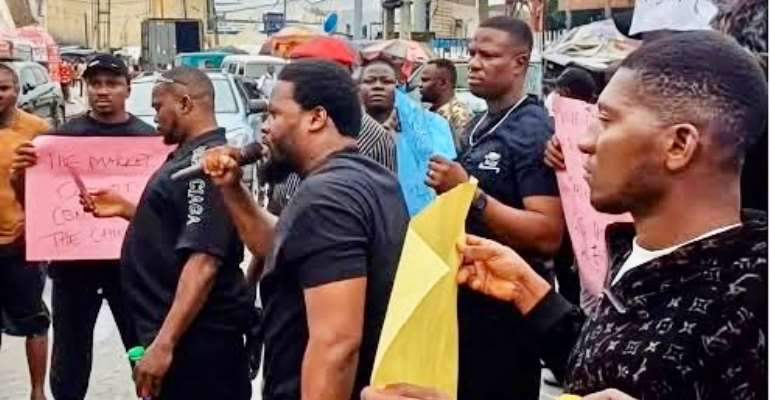
Traders at the Lagos International Trade Fair Complex along the Lagos-Badagry Expressway on Monday protested the alleged expansion of Chinese merchants into retail trading, expressing fears that the development could push Nigerian businesses out of the market.
The protest was later suspended following interventions by the leadership of the Traders Association, local government officials and the police.
The traders’ main concern centres on allegations that Chinese manufacturers and wholesalers are increasingly moving beyond supplying goods to local businesses and opening retail outlets within the market.
Speaking on the development in a recent Facebook post, a social commentator, Martin Beck Nworah, said the development is causing concern among local traders and distributors who believe the direct entry of Chinese wholesalers into retail is disrupting the traditional trading structure.
Nworah said the traders alleged that Chinese merchants were bypassing local middlemen, selling directly to consumers at prices comparable to wholesale rates and making it difficult for Nigerian retailers to compete.
“The entire trading model is based on the middleman, and once the wholesaler becomes the middleman, the retailer is edged out.
“It is not yet too late for business leaders and the government to discuss a strategy to encourage collaboration and protect all relevant interests.
“Left on their own, I do not see these local traders surviving because the Chinese wholesalers have direct access to low-interest credit from home and can afford to import more, sell for less and capture the market easily,” he said.
The concerns were also reflected in a video shared by social media activist Martins Otse, popularly known as VeryDarkMan, in which one of the protesters warned that the continued expansion of Chinese merchants could have long-term consequences for Nigerian traders.
“If this continues, I am telling you, five to six years from now, your shops will be taken away from you,” the trader said.
The trader acknowledged the importance of the relationship between Nigerian traders and their Chinese business partners but objected to what he described as Chinese merchants taking over retail activities traditionally carried out by Nigerians.
“What we are saying is that the personal relationship between us and the Chinese is important to us, but they should not do our business.
“They came and built warehouses, rented shops and are now selling as we do as retailers. If we send a waybill, they copy the customer’s number. We no longer make sales.
“If you import goods, they slash their prices lower than ours and sell to our customers. Is this how we would continue? Our forefathers, who did this business before us, was this how they did it? If this continues, five years from now, your shop will be taken away from you,” he said.
In a separate clip, the trader alleged that the growing competition could leave Nigerian traders economically dependent, saying, “They want to turn us into slaves,” as others in the crowd chorused, “Say no to China.”
Nworah, however, urged traders to look beyond protests and consider partnerships and local manufacturing as possible responses to the changing business environment.
“While waiting for proper government-backed guidance, wealthy traders who can afford to go into manufacturing should do so now. If you cannot do it alone, team up with your social clubs and do something.
“If you cannot produce the finished product here in Nigeria, find an aspect of the value chain you can support and own right here at home.
“Protests will not solve economic problems because buyers will always seek out the best prices they can get. Collaboration will work best because these traders get most of their goods from China. Stakeholders need to discuss and map out a solution as soon as possible,” he added.