
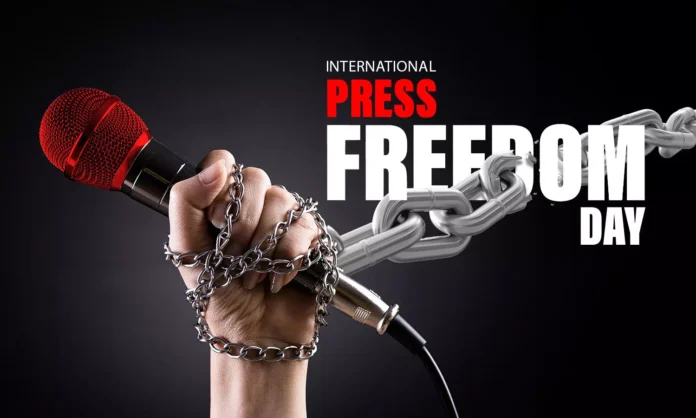
Nigeria joined the global historic World Press Freedom Day celebrations which holds May 3 annually.
Amid the plethora of events to mark the Day were damming revelations of grave scenarios media practitioners go through in the line of duty.
One ugly statistic from the United Nations depicts a sad reality. It avers that at least 85% of crimes against journalists globally go unpunished. That percentage is frightening and negates tenets of freedom of speech and related legal parameters which ought to protect media practitioners.
Some countries including Nigeria have even gone steps ahead to enact the Freedom of Information law which is expected to give unfettered access to not only journalists but any interested party on any information in the public domain.
In the country, as a major stakeholder, the Wole Soyinka Centre for Investigative Journalism, WSCIJ, was part of the grand event as it called for the establishment of a National Framework for Media Sustainability, Independence, and Protection as an urgent priority for safeguarding the country’s democratic future.
This call is coming at a defining moment, as the global theme, ‘Shaping a Future at Peace: Journalism in the Face of the
Indeed, for the Nigerian journalists the moment also provided an auspicious ambience for demanding enhanced safety, advocating for media sustainability, as it underscores the need for protection against escalating security threats. These demands are not new but require serious attention among stakeholders.
We appreciate the groundswell of activities marking the event as well as the various engagements from civil society organisations, media groups and regulatory bodies who took out time to participate in the event.
Faced with a myriad of economic and security challenges, we can not but salute the courage of the Nigerian journalists who wade through stormy weathers, brace the odds and ensure that they preserve the tempo expected of their duty.
We salute the Nigeria Union of Journalists, NUJ, Nigerian Guild of Editors, NGE, and advocacy groups like SERAP who have consistently demanded improved safety for practitioners, even as they keep citing incidents of harassment and the need for legal protection for journalists.
In tandem with age-long advocacies on the need for government to move beyond promises and create a framework for media safety and independence, we urge for a renewed vigour to ensure that the need is addressed soon through appropriate legislation.
Notably, it is reasonable amidst economic pressures, that the 2026 theme (Shaping a Future at Peace) was adapted to emphasize the necessity of financial independence for media outlets to maintain integrity.
We condemn recent media attacks which could undermine efficiency and no doubt integrity as data reveal a high number of historic and recent violations, with stakeholders expressing concern over the safety of journalists reporting on corruption and insecurity, particularly ahead of upcoming election cycles.
As the fourth estate of the realm, the media deserves more than a passing commendation for their long history and contribution to nation-building. On that note, we urge all stakeholders in the Nigerian project to overwhelmingly contribute to the common cause of protecting and enhancing the welfare of journalists for a greater future even beyond the upcoming 2027 elections.
We reiterate calls to safeguard journalists in order to uphold truth amid escalating insecurity and ingrained political intolerance across the country.
With the gap still existing between journalists and security agencies, we view this as inimical to a the country’s common cause as forging a strict cooperation is critical in addressing Nigeria’s security challenges, as the rippling down effects would affect citizens across the country.
The concerns expressed towards enhancing productivity and invariably national cohesion and development should not be merely yearly rituals of fanfare and eloquent speeches but should translate into concrete outcomes.
Related