By Chimezie Godfrey
Former Minister of Education and founder of the School of Politics, Policy and Governance, Dr. Obiageli Ezekwesili, alongside the Africa Director of the MacArthur Foundation, Dr. Kole Ahmed Shettima, have called for a deliberate overhaul of Nigeria’s leadership recruitment process, stressing that only value-driven and prepared leaders can rescue the country from poor governance and institutional decline.
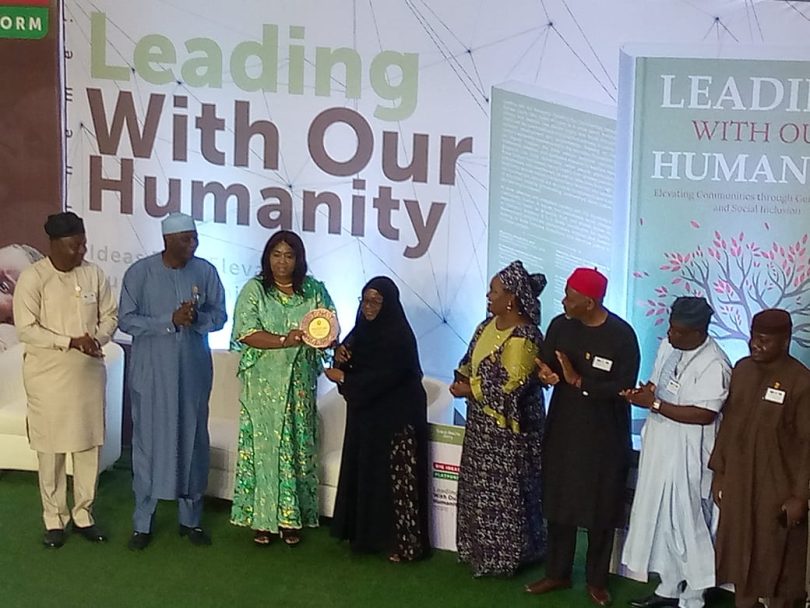
The stakeholders made the call during the Big Ideas Platform of the School of Politics, Policy and Governance (SPPG), held in Abuja, where Dr. Amina Salihu, mni, officially presented her new book titled Living With Our Humanity.
Speaking at the event, Dr. Shettima lamented what he described as the monetisation of Nigeria’s political process, where individuals allegedly deploy wealth acquired without accountability to gain access to public office.
According to him, leadership should emerge through a deliberate process of learning, mentorship, and service rather than financial influence.
“You cannot jump into public office just because you have stolen billions of naira and suddenly claim to be working with the President of the Federal Republic of Nigeria. That should not happen,” he stated.
Drawing parallels with traditional institutions, Dr. Shettima referenced the Emirate system, noting that leadership in traditional settings evolves through gradual learning and responsibility.
“There must be a learning process. You must learn how to crawl, stumble, and then walk,” he added.
He commended SPPG for attempting to reform the nation’s political recruitment process by grooming ethical and competent leaders committed to public service.
The MacArthur Foundation’s Africa Director, Dr Kole Shettima also emphasised that the future of governance would be shaped by individuals who intentionally prepare themselves for leadership responsibilities.
During the event, Ms. Toyin Akinniyi, encouraged young Nigerians to embrace opportunities for leadership development and governance participation.
“If you have ever wanted to be part of shaping decisions rather than reacting to them, then don’t ignore it. Growth doesn’t happen before you step up. It happens because you step up,” she said while encouraging participants to apply for the 2027 leadership award.
Presenting her book, Dr. Salihu explained that Living With Our Humanity interrogates issues of development, inclusion, philanthropy, and governance through a human-centred lens.
She argued that development opportunities remain unevenly distributed because power often sits at the centre of unequal social structures shaped by poverty, gender, disability, and language barriers.
According to her, adopting gender, equity, and social inclusion frameworks compels institutions to rethink how resources are distributed and how accountability is defined.
Dr. Salihu stressed that sustainable development must begin from grassroots communities, insisting that local realities remain central to national transformation.
“Everything is local and everything is political,” she stated.
She further urged leaders to embrace empathy, kindness, and community-driven engagement in governance and development initiatives.
In her keynote remarks, Dr. Ezekwesili described character and ethics as the foundation of quality leadership, noting that SPPG was established to create a pipeline of leaders committed to public interest above personal gain.
“At SPPG, we train for character, competence, and capacity,” she declared.
The former minister noted that gender equity and social inclusion frameworks have consistently produced better governance outcomes in societies where they are intentionally implemented.
She urged Nigerians to build communities around shared values capable of demanding accountability and resisting poor governance.
“Any society where the majority are suffering is a society that is broken and brittle. It will collapse,” Ezekwesili warned.
She described community action as the antidote to helplessness and called on citizens to organise around values capable of transforming governance and strengthening democratic accountability.
Oby Ezekwesili, MacArthur Foundation’s Shettima Advocate Value-Based Leadership, Community Action at SPPG Big Ideas Platform