
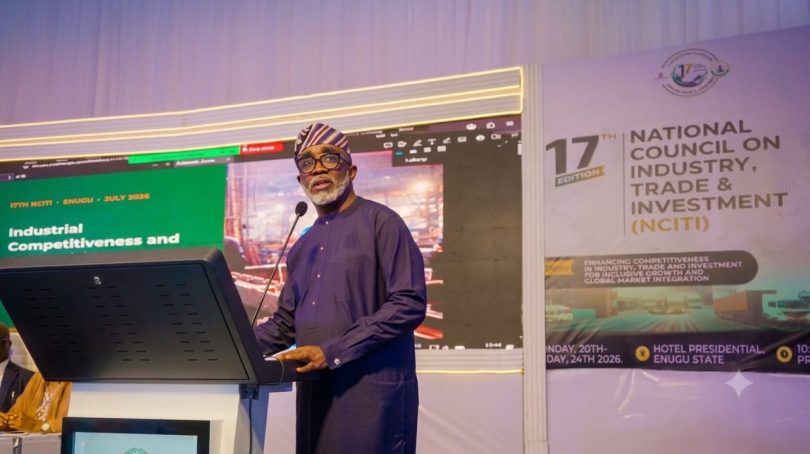
The National Sugar Development Council (NSDC) has intensified efforts to reduce the cost of sugar production in Nigeria.
The Council said Nigerian factories pay between two and 10 times more than their competitors for power, credit and logistics.
According to a statement by the Council, discussions at the National Council on Industry, Trade and Investment (NCITI) meeting held in Enugu showed that disciplined pricing of production inputs, as seen in Nigeria’s urea industry, can transform an importing nation into a top-10 global exporter.
The Executive Secretary of the NSDC, Mr Kamar Bakrin, said Nigeria must now choose between competing for the African market or conceding it to others.
He asked the Council to consider two factory managers — one in Aba and the other in Ho Chi Minh City — running the same machines, employing equally skilled workers and serving the same customers.
“By the time their products reach the factory gate,” he said, “the Nigerian manufacturer has paid between two and 10 times more for the three things every manufacturer in the world must buy: power, money and movement.
“Industrial power costs a Vietnamese factory about 8 US cents per kilowatt-hour and a Chinese factory about 10 cents. The Nigerian factory pays about 15 cents on the grid, rising to nearly 30 cents once diesel generators take over.
ALSO READ: Tinubu’s govt will meet January deadline on FCT projects completion — Wike
“Nigerian manufacturers spent an estimated ₦1.34 trillion last year generating their own electricity. In Mr Bakrin’s words, ‘Every factory in Nigeria is running a second, unwanted business as a private power station.’”
Bakrin noted that working capital costs between 27 and 35 per cent in Nigeria, compared to about 9 per cent in Vietnam and 3 per cent in China. He also said Nigeria ranks 88th out of 139 countries on the World Bank’s Logistics Performance Index, compared to Vietnam’s 43rd and China’s 19th.
“The result is that, in a country of 230 million consumers, with duty-free access to 1.4 billion more under the African Continental Free Trade Area (AfCFTA), manufacturing contributes barely 8 per cent of GDP, while capacity utilisation has dropped to 57.7 per cent.
“None of this is a demand problem. Nobody on this continent needs persuading to buy what Nigeria makes,” he said. “It is a cost-of-production problem, and that distinction matters because costs, unlike demand, are within our power to fix.”
The NSDC boss said the timing could not be more significant.
“The government’s macroeconomic reforms have delivered greater stability, with inflation roughly halved from its peak and foreign reserves standing at $51 billion, the highest since 2009. This gives factories, for the first time in years, the confidence to plan and invest.
“Global supply chains are being redrawn as companies diversify, and a factory established in another country this decade is unlikely to relocate. AfCFTA also cuts both ways: either our goods cross borders into other markets, or other countries’ goods flood ours. We are either going to compete or concede the market.”
He pointed to Nigeria’s urea industry, which expanded from a production capacity of 500,000 tonnes in 2005 to 6.5 million tonnes today, making Nigeria one of the world’s top 10 exporters of nitrogen fertiliser.
According to him, the transformation was driven by one key policy decision: pricing natural gas as an industrial input rather than treating it solely as a source of government revenue.
“The whole lesson is in one sentence: when a country prices inputs as if it wants industry to thrive, industry thrives.”
Bakrin then presented four resolutions for the Council’s consideration. These include requiring every state to designate at least one industrial cluster for a dedicated power arrangement within 12 months; establishing a federal-state compact to harmonise levies and eliminate informal checkpoints along industrial corridors; introducing an annual State Industrial Competitiveness Index to publicly rank states on power, land, levies and logistics; and enforcing the Nigeria First procurement policy at both federal and state levels through quarterly compliance dashboards.
He added that all four proposals are built on one guiding principle.
“Public support must be earned continuously and transparently. Every tax credit, every unit of subsidised power and every act of government patronage should be tied to measurable performance that is independently verified and publicly reported,” the Executive Secretary said.
The National Council on Industry, Trade and Investment (NCITI) is Nigeria’s highest policy advisory body on industry, trade and investment. It brings together federal and state governments annually. Its 17th meeting was held in Enugu under the theme, “Enhancing Competitiveness in Industry, Trade and Investment for Inclusive Growth and Global Market Integration.”